

SDLA Compliance Resource
County Superintendent Approves Qualifying School-District LCAPs
An operational guide to the approval decision step in the 2026–27 LCAP accountability cycle.
State county-review duties and local intake procedures
A county superintendent performs these statewide statutory duties for school-district LCAPs. A county-specific portal or earlier intake target is a separate local procedure.
- EC 52070(a): the district files its adopted LCAP/annual update with the county superintendent no later than five days after adoption. The county may request written clarification by August 15; the district board responds in writing within fifteen days of the request.
- The county may send written amendment recommendations within fifteen days after receiving the district response. The district board considers those recommendations in a public meeting within fifteen days of receipt. Retain actual delivery/receipt dates; these are triggered clocks, not identical fixed dates for every district.
- The county superintendent approves by October 8 if the statutory template, budget, expenditure and applicable carryover/service conditions are met. Keep local board adoption distinct from reviewer approval and retain the approval/revision record.
- Where the county superintendent has jurisdiction over a single district, the State Superintendent performs the EC 52070 duties. COE-own LCAP review and charter submission follow their own authorities; this district approval chain must not be generalized to them.
- If a county requests an earlier upload, checklist or local format, record the county, notice, receiving system and local target separately from EC 52070. No statewide earlier intake date is established by a county worksheet.
Authority: EC 52070: district/county clocks and single-district exception. Reviewed October 21, 2026.
State authority, county reviewer, district plan
The county superintendent performs the review; the school district owns the plan and receives the decision. This is a state-assigned county duty under Education Code section 52070, not an RCOE-only requirement and not a district task to approve its own LCAP.
A COE’s own LCAP follows the state review pathway under section 52070.5; a single-district county follows its applicable exception. A charter’s submission to its authorizer/county is distinct from district LCAP approval. Identify the actor, recipient and LEA type before assigning this calendar item.
County submission portals, routing instructions and internal lead times are local procedures. Label them separately from the October 8 statutory approval deadline. The 2019 presentation formerly linked as the calendar’s primary source has been replaced with the governing statute.
In Plain Language: Complete the statutory review and approve a district LCAP when the budget is approvable and the plan satisfies expenditure, template, and increased-or-improved-services approval criteria.
Review conditional content and distinguish the reviewer
Use a documented content/funding matrix covering required EL/LTEL actions, low-performing school/group actions, technical assistance, Equity Multiplier focus goals, contributing-action explanations and metrics, proportionality/carryover and LREBG. Test the budget against the proposed actions and retain the reviewer’s disposition.
This is a state-required county-superintendent review of district LCAPs, with the single-district-county exception. A COE’s own LCAP follows SPI review; ordinary charter submission does not create a county/authorizer LCAP approval requirement. Final 2027–28 template and changed-criteria verification remains open.
Coverage addition reviewed October 21, 2026.
Why this matters
Approval is a reasoned oversight decision, not a ceremonial receipt. The record should show how the county resolved material program and fiscal questions.
Primary ownership
Primary owner: county superintendent and LCAP/fiscal review team. Partners: district superintendent, LCAP and business leads, county counsel, and records staff.
From a reviewed LCAP to a county approval decision: the SDLA ITO workflow
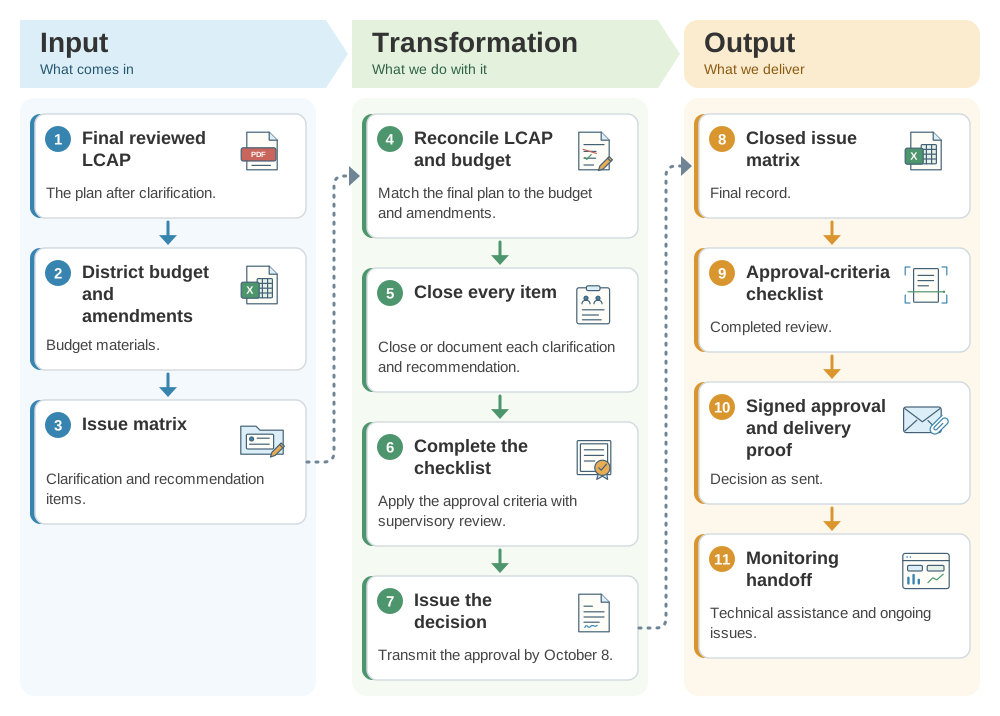
Approval follows closed clarification items and a completed approval-criteria checklist. This SDLA ITO (Input, Transformation, Output) graphic shows how the final reviewed LCAP, the district budget, and the issue matrix become the closed issue matrix, the checklist, and the signed approval with proof of delivery.
Operational workflow
- Reconcile the final reviewed LCAP with the district budget and amendments.
- Close or document every clarification and recommendation item.
- Complete the formal approval-criteria checklist and supervisory review.
- Issue and transmit the approval decision by October 8.
- Archive the review record and hand continuing issues to monitoring/technical assistance.
Implementation pathway
Evidence to retain
- Final reviewed LCAP and budget
- Closed issue matrix
- Approval-criteria checklist
- Signed approval and delivery proof
- Technical-assistance/monitoring handoff
Official guidance and help
- CDE Local Control and Accountability PlanCurrent templates, instructions, and resources
- CDE LCFF Frequently Asked QuestionsState review and approval context
- Education Code section 52062District consultation, hearing, adoption, submission, and posting
- Education Code section 52070County review, clarification, recommendations, and approval
Targeted authority/source review: October 21, 2026. Checked the district-review versus COE-own-plan distinction against EC 52070 and 52070.5; final future template review remains separate. See the source-version register. Other source history is retained in the publication record.