



SDLA Compliance Resource
Develop and Monitor Equity Multiplier Focus Goals
Build a focus goal for each Equity Multiplier school using its student-group needs, educator issues and measurable evidence-based supports.
Eligibility, closed sites and fiscal evidence
Recheck the official annual generating-site file and keep the funding conditions separate from ordinary LCAP county review.
- Use the initial published prior-year stability-rate file and the strict greater-than thresholds: nonstability over 25%, socioeconomic disadvantage over 70%. LCFF-generating districts/COEs/classroom-based charters qualify; prior-year P-2 nonclassroom-based charters are excluded. Closed current-year sites and district-office enrollment do not generate eligible site funding.
- Distribute each generating site’s calculated allocation and maintain evidence-based services that increase/improve supports compared with the no-award baseline. Retain school-specific ledgers, existing commitments and supplement-not-supplant rationale; the ordinary LCAP process is not a new grant application approval.
- EC 42238.024(b)(5) requires return of unspent funds from any fiscal year associated with a closed schoolsite and reporting the total under CDE instructions. Inventory closed-site balances and seek current prescribed forms/channel. A specific return-report cutoff was not verified here and remains pending; do not invent a sixty-day rule for this grant.
Authority: EC 42238.024 · CDE Equity Multiplier. Reviewed October 21, 2026.
In Plain Language: Build a focus goal for each Equity Multiplier school using its student-group needs, educator issues and measurable evidence-based supports.
Why this matters
LEA-wide consultation and general improvement goals do not by themselves document each generating school’s needs or use of its funds.
Primary ownership
LCAP and site leaders with fiscal services, school partners, HR and data owners
Required distinctions and controls
- Eligibility is determined annually from prior-year nonstability greater than 25 percent and socioeconomically disadvantaged pupil rate greater than 70 percent. Confirm the official current funding results and operating-school status; there is no application and annual eligibility is not guaranteed.
- Consult the generating school’s educational partners. Address all student groups at the lowest Dashboard performance level and applicable credentialing, subject-matter preparation and educator-retention issues. If no group is Red, CDE directs the LEA to use state/local data to identify the lowest-performing group(s).
- Use specific school/group metrics and evidence-based services. A combined focus goal is appropriate only when schools share the relevant group/performance or educator issues and each school’s needs and metrics remain identifiable.
- Supplement rather than replace LCFF, ELO-P, literacy-coach or community-school funding. Reconcile the school allocation and expenditures using Resource 7399 and applicable CDE accounting instructions.
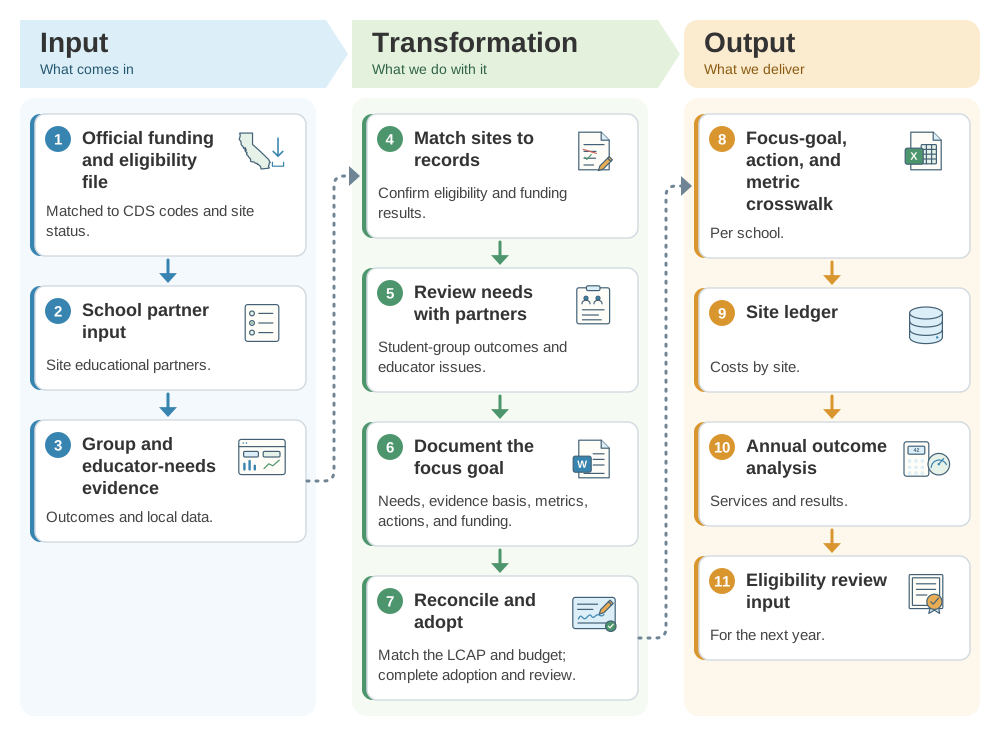
From official site data to a monitored Equity Multiplier focus goal: the SDLA ITO workflow
Each generating school needs a focus goal built from its own group needs, educator issues, and evidence-based supports. This SDLA ITO (Input, Transformation, Output) graphic shows how the official site funding and eligibility file, school partner input, and group and educator-needs data become the focus-goal crosswalk, the site ledger, and the annual outcome analysis.
Recommended LEA workflow
- Match official funding results and eligibility data to CDS codes and site status.
- Review school/group outcomes and local educator data with site educational partners.
- Document the focus goal, targeted needs, evidence basis, metrics, actions and site funding.
- Reconcile to the LCAP and budget and complete the applicable adoption and review process.
- Monitor services, costs and school/group outcomes; use the evidence in annual analysis and the next eligibility review.
Evidence to retain
- Official site funding and eligibility match
- School partner input
- Group and educator-needs evidence
- Focus-goal/action/metric crosswalk
- Site ledger and annual outcome analysis
Official guidance and help
Return to the Annual Compliance Calendar
Reviewed October 21, 2026. Confirm the current agency instructions, applicable funding year, recipient scope, local policy and final submitted or approved state before acting. Recommended preparation steps support the named requirement and do not create an additional statewide filing deadline.