



SDLA Compliance Resource
Check LCAP Content, Funding and Template Versions
Use an evidence checklist to test required LCAP content and funding alignment, and distinguish verified current requirements from pending next-cycle form changes.
In Plain Language: Use an evidence checklist to test required LCAP content and funding alignment, and distinguish verified current requirements from pending next-cycle form changes.
Why this matters
An apparently complete template can omit conditional actions, student groups or funding explanations that apply to the LEA.
Primary ownership
LCAP and fiscal leads with EL, school-improvement, site, HR and data owners
Required distinctions and controls
- Version control: record the template, instructions and action-table version. The current index covers 2024–27; do not represent the September 2026 revision draft or a future November meeting as a completed 2027–28 adoption.
- EL/LTEL: under current instructions, 30 or more English learners and/or 15 or more long-term English learners trigger language-acquisition and teacher professional-learning actions. When both thresholds apply, address both groups.
- Low performance and assistance: map required school/group actions to the governing Dashboard cohort; the current 2024–27 instructions use the 2023 Dashboard. Confirm the next-cycle cohort in the final instructions instead of simply copying that year forward. Include actions implementing applicable technical assistance.
- Contributing actions: test required explanations of increased/improved services, intended student groups, action design and effectiveness; identify the required metric(s) for LEA-wide contributing actions. Reconcile proportionality, planned improvement percentages, concentration add-on and carryover to the action tables and fiscal evidence.
- Equity Multiplier: identify every generating school and applicable focus goal, targeted-group metrics and educator issues. LREBG: link needs assessment, funded actions, research rationale, amounts and metrics; perform the statutory 2027–28 strategy-effectiveness review.
- Review routing: district LCAP review belongs to the county superintendent, with the single-district-county exception. COE LCAPs follow SPI review. Ordinary charter submission does not create an authorizer LCAP approval requirement; CSI prompts have a separate applicable review pathway.
From source versions to a traceable LCAP content and funding check: the SDLA ITO workflow
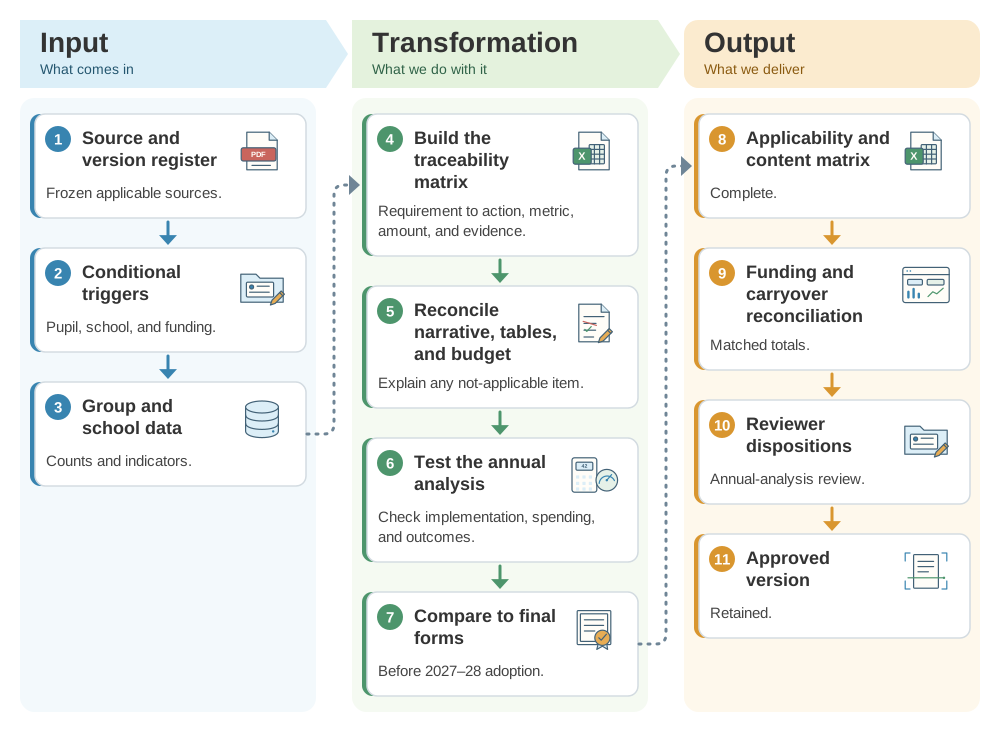
A traceability matrix shows each requirement's applicability, plan location, evidence, and reviewer disposition. This SDLA ITO (Input, Transformation, Output) graphic shows how frozen source versions, conditional pupil, school, and funding triggers, and group and school data become the source and version register, the content matrix, and the funding reconciliation.
Recommended LEA workflow
- Freeze the applicable source versions and list conditional pupil, school and funding triggers.
- Create a traceability matrix: requirement, applicability, plan section/action, metric, amount, evidence, reviewer and disposition.
- Reconcile narrative, tables and budget; document why any item is not applicable.
- Check annual analysis against implementation, expenditure and outcome evidence and route unresolved content/funding gaps to the responsible owner.
- Before 2027–28 adoption, compare the package to the final SBE-adopted forms and current statutory review criteria, update the matrix and retain the approved version.
Evidence to retain
- Source/version register
- Applicability and content matrix
- Group/school data
- Funding and carryover reconciliation
- Annual-analysis and reviewer disposition
Official guidance and help
- CDE current LCAP instructions
- CDE adopted-template index
- CDE LREBG planning and 2027–28 review requirements
- CDE Equity Multiplier requirements
- SBE September 2026 draft-revision agenda
Return to the Annual Compliance Calendar
Reviewed October 21, 2026. Confirm the current agency instructions, applicable funding year, recipient scope, local policy and final submitted or approved state before acting. Recommended preparation steps support the named requirement and do not create an additional statewide filing deadline.