



SDLA Compliance Resource
Conduct or Review the FBA and Implement or Revise the BIP After an Applicable Placement Change
A function-based workflow for turning a disciplinary determination into positive, individualized, measurable behavioral supports that staff can implement and the IEP Team can evaluate.
In Plain Language: A functional behavioral assessment asks what purpose a specific interfering behavior serves for this student and what conditions make it more or less likely. A behavioral intervention plan uses that understanding to prevent the behavior, teach a safer and more effective replacement behavior, reinforce progress, and guide consistent adult responses. After a disciplinary change of placement, the required action depends on the manifestation determination, the quality and timing of any existing FBA, and whether a BIP already exists. Do not substitute a generic behavior contract, punishment schedule, incident summary, or copied plan for individualized functional analysis.
Why this matters
Discipline may stop behavior temporarily without identifying why it occurred or what the student needs to succeed. A defensible FBA/BIP process connects assessment, instruction, environment, communication, reinforcement, staff practice, services, and progress data so that the same conditions do not produce the same result.
Joint ownership
IEP Team: makes individualized assessment and program decisions. Qualified assessor or behavior specialist: designs and conducts the FBA and helps translate its findings into a plan. Implementers: teachers, aides, administrators, transportation, related-service staff, and others named in the BIP. Essential partners: the parent and, when appropriate, the student.
Select the correct post-discipline branch
| Determination and current record | Required treatment | Control question |
|---|---|---|
| Conduct was a manifestation; no FBA was conducted before the behavior | Conduct an FBA and implement a BIP. | Has the LEA initiated a legally sufficient, child-specific FBA process rather than treating the MDR record as the assessment? |
| Conduct was a manifestation; an FBA existed before the behavior, but no BIP exists | Use the current, relevant FBA to implement a BIP; obtain additional assessment data when the existing analysis does not adequately explain the conduct. | Does the pre-incident FBA address this operationally defined behavior, setting, and current function? |
| Conduct was a manifestation; a BIP already exists | Review the BIP and modify it as necessary to address the behavior. | Was the plan implemented with fidelity, did its functional hypothesis fit the incident, and what must change? |
| Conduct was not a manifestation | Provide, as appropriate, an FBA and behavioral intervention services and modifications designed to address the behavior violation so it does not recur. | What assessment and supports are needed while the child continues to receive required educational services? |
| No disciplinary placement change, but behavior impedes learning | The IEP Team must consider positive behavioral interventions and supports and other strategies; an FBA/BIP may be appropriate proactively. | Why wait for exclusion or crisis when current data show unmet behavioral needs? |
What a defensible FBA must do
| FBA element | Evidence-led treatment | Weak substitute to avoid |
|---|---|---|
| Operational behavior definition | Describe observable, measurable actions with clear examples, nonexamples, start and stop rules, intensity, frequency or duration, and relevant safety dimensions. | Labels such as “defiant,” “aggressive,” “noncompliant,” “unmotivated,” or a disability category without observable definition. |
| Context and baseline | Identify when, where, with whom, during what tasks or transitions, and under what environmental, instructional, communication, sensory, health, cultural, or social conditions behavior occurs and does not occur. | A count of office referrals without exposure, setting, opportunity, or comparison information. |
| Multiple information sources | Use record review, parent and student input, teacher and provider input, direct observation, ABC or other systematic data, assessment information, and relevant implementation evidence. | One interview, one incident report, a vendor score, or one observer’s impression as the entire assessment. |
| Antecedents and consequences | Analyze what reliably precedes the behavior and what happens immediately afterward, including adult and peer responses, task changes, access, escape, delay, attention, sensory effects, and regulation. | Assuming the consequence staff intended is the consequence the student actually experienced. |
| Function and contributing factors | Develop and test a data-supported hypothesis about the purpose or outcome maintaining the behavior and conditions that influence it; identify skill, communication, academic, environmental, health, or regulation needs. | Treating the function as the student’s moral intent or using a predetermined list without testing it against data. |
| Decision utility | Translate findings into prevention, replacement-skill, reinforcement, response, safety, training, and progress-monitoring recommendations that match the identified function. | An assessment report that ends with “develop a BIP” but does not tell the team what should change. |
Build a BIP that can actually be implemented
- Behavior and function: state the operationally defined behavior and the FBA-supported hypothesis the plan is designed to address.
- Prevention: specify changes to instruction, task difficulty, schedule, environment, communication, choice, predictability, sensory conditions, relationships, and antecedents.
- Replacement behavior: teach a socially valid, efficient skill that can obtain the same or a comparable outcome as the interfering behavior.
- Instruction plan: name who teaches the skill, where and how often practice occurs, prompts and materials, generalization settings, and mastery criteria.
- Reinforcement: define what meaningful reinforcement follows the replacement behavior, who delivers it, when, at what schedule, and how it will be faded or naturalized.
- Adult response: specify calm, safe, instructionally useful responses to precursors and occurrence; avoid responses that unintentionally strengthen the behavior.
- Safety and crisis: when needed, separate a prevention-centered BIP from a narrowly scoped emergency response protocol consistent with California law and prohibited-intervention rules.
- Implementation ownership: list every responsible role, setting, start date, materials, training, coaching, substitute coverage, and supervisory check.
- Measurement: define student outcome measures, replacement-skill measures, fidelity measures, data collectors, frequency, decision rules, and review dates.
- Family and student access: make the plan understandable, culturally and linguistically responsive, accessible, respectful, and feasible across relevant environments.
From a disciplinary determination to an implemented FBA and BIP: the SDLA ITO workflow
The correct branch depends on the manifestation result and on what FBA or BIP already exists. This SDLA ITO (Input, Transformation, Output) graphic shows how the determination and placement-change record, the existing FBA and BIP history, and parent consent become the FBA and hypothesis, the adopted or revised BIP, and the fidelity and review data.
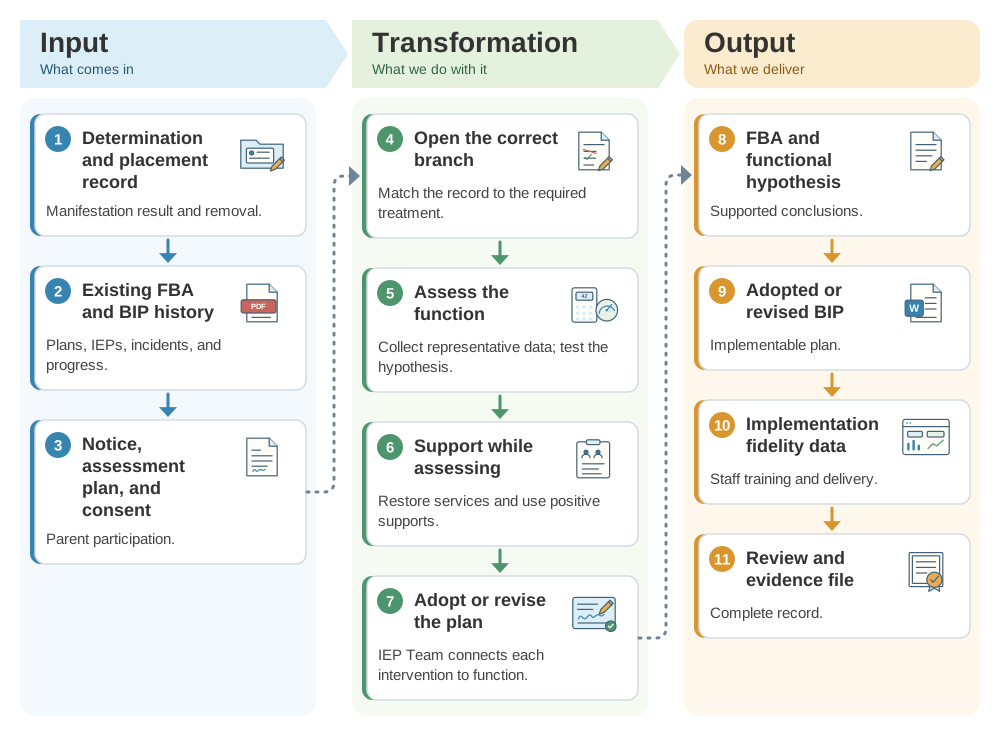
The assessment-to-implementation workflow
- Immediately after the determinationOpen the correct action branch. Record the manifestation result, existing FBA/BIP status, responsible case manager, placement and service context, immediate correction or safety needs, and the legal basis for the next action.
- Before new assessment activityProvide notice, assessment plan, and obtain consent. Treat the post-discipline FBA as requiring parental consent under current federal guidance; follow California assessment-plan requirements and calendar the applicable California and IDEA timeline.
- While assessment proceedsImplement what is already known. Restore missing IEP supports, provide required services, use positive interim strategies supported by existing data, train relevant staff, and avoid repeating conditions already known to contribute to the behavior.
- During the FBACollect representative data. Define the behavior; listen to the student and parent; review records; observe across relevant settings, people, tasks, and times; examine successful conditions; and assess implementation of existing supports.
- At functional analysisTest the hypothesis. Compare competing explanations against the data, identify the most supportable function and contributing conditions, state limitations, and avoid claims the evidence cannot sustain.
- At the IEP Team meetingAdopt or revise the plan. Review the assessment and parent/student input, connect each intervention to the function, amend the IEP as appropriate, determine services and supports, assign implementers, provide required notice, and give staff access to their responsibilities.
- Before implementationMake the BIP executable. Train and coach every implementer, rehearse prevention and response procedures, distribute controlled materials, verify schedules and staffing, establish data collection, and identify whom to contact when the plan cannot be followed.
- From the first implementation dayMonitor outcome and fidelity together. Review whether the student is improving and whether adults are implementing the plan as designed. Do not call the plan ineffective when fidelity is unknown.
- At each decision rule or material changeAdjust through the IEP process. Respond to worsening behavior, new settings, ineffective strategies, previously unseen serious behavior, implementation barriers, or achieved goals with data-informed review—not undocumented local edits.
Minimum data and fidelity dashboard
| Measure | Question answered | Decision use |
|---|---|---|
| Target-behavior frequency, rate, duration, latency, intensity, or opportunity-based percentage | Is the interfering behavior changing relative to baseline and opportunity? | Continue, intensify, revise, or reassess. |
| Replacement-skill use and independence | Is the student learning and using the functionally equivalent skill? | Adjust teaching, prompting, reinforcement, or generalization. |
| Antecedent and setting data | Where and under what conditions is improvement occurring or failing to occur? | Change prevention, environment, instruction, or supports. |
| Implementation fidelity by plan component and setting | Was the plan delivered as written by each responsible role? | Coach, simplify, resource, supervise, or revise feasibility before judging effect. |
| Access and educational impact | Are attendance, removals, instruction, participation, relationships, progress, and IEP goal access improving? | Review placement, services, goals, supports, and compensatory needs. |
| Safety and restrictive intervention events | Are crises, injuries, emergency interventions, or exclusion decreasing? | Immediate IEP/safety review and required California reporting actions. |
Decision routes
An FBA exists, but it does not address the current behavior
Action: Treat relevance as unresolved. Review when, where, and for what behavior the FBA was conducted; determine whether new assessment or reevaluation is needed; and use current data to update the functional hypothesis before relying on it.
Control: The existence of a document titled “FBA” does not satisfy the requirement when its target behavior, context, function, or data are materially different.
A BIP existed before the incident
Action: Review both plan design and fidelity. Determine whether the plan matched the function, staff had access and training, each component was implemented, data were collected, known barriers were corrected, and the incident revealed a new behavior or condition. Modify the plan as necessary through the IEP process.
Control: Do not assume the BIP “failed” merely because behavior occurred, and do not assume implementation merely because staff signed an acknowledgment.
The parent does not consent to the post-discipline FBA
Action: Provide clear notice, answer questions, offer accessible participation, document the response, and follow current IDEA and California procedures concerning reevaluation consent and available dispute options. Continue required services and implement lawful supports based on existing information.
Control: Do not collect prohibited new evaluative data under a different label or stop all positive behavioral support while consent is unresolved.
The student moved to an interim alternative educational setting
Action: Collect data in both the prior and interim contexts when relevant, coordinate staff across settings, ensure the BIP travels with the student, and distinguish behavior change caused by environmental differences from actual skill acquisition.
Control: A quiet record in a highly restrictive or unfamiliar setting does not by itself disprove the earlier function or establish generalization.
Behavior worsens or a new serious behavior appears
Action: Address immediate safety, notify the case manager and parent, verify implementation, review health and environmental changes, collect new data, and reconvene the IEP Team promptly. Determine whether new assessment, revised function, additional services, or a changed safety plan is needed.
Control: Do not simply add harsher consequences to a function-based plan or wait for the next annual IEP.
A California behavioral emergency intervention was used
Action: Follow Education Code section 56521.1: notify the parent, guardian, and residential care provider if appropriate within one school day; immediately complete the behavioral emergency report; and forward it to the designated responsible administrator. If no BIP exists, the administrator must schedule an IEP Team meeting within two days to review the report and determine the need for an FBA and interim plan. If a BIP exists and the event involves previously unseen serious behavior or an ineffective intervention, refer it to the IEP Team for review.
Control: Emergency intervention may not substitute for a systematic positive behavioral support plan, and prohibited interventions remain prohibited.
The plan works in one setting but not another
Action: Compare antecedents, demands, reinforcement, relationships, communication access, staff fidelity, and opportunity across settings. Coach the implementers and revise setting-specific prevention or teaching while preserving the function-based logic.
Control: Do not blame the student or copy a successful setting’s surface procedure without understanding why it works.
Behavior-system data conflict with classroom or family information
Action: Reconcile definitions, observation periods, missed entries, settings, opportunities, data collectors, and context. Preserve each source, identify limitations, and collect prospective comparable data where needed.
Control: Do not select the source that supports a preferred disciplinary or placement result and discard the others without analysis.
FBA/BIP evidence file
- Manifestation determination, disciplinary placement-change record, service-continuity decision, and immediate-remedy actions.
- Existing FBA and BIP history, IEPs and amendments, evaluations, progress, removals, incident records, emergency reports, and implementation evidence.
- Prior written notice, assessment plan, informed parental consent for the post-discipline FBA, and applicable timeline.
- Operational behavior definitions, data plan, parent and student input, interviews, record review, direct observations, baseline, setting comparisons, and limitations.
- Functional hypothesis and supporting analysis connecting antecedents, behavior, consequences, contextual factors, skills, and successful conditions.
- IEP Team consideration, decisions, differing views, adopted BIP, placement and service implications, and copies provided to the parent.
- Implementer roster, access acknowledgments, training, coaching, materials, start dates, substitute and transportation coverage, and supervision.
- Student outcome data, replacement-skill data, implementation-fidelity data, review dates, decision rules, plan revisions, and family communication.
- Any emergency intervention reports, injury or restraint/seclusion records, required notifications, administrative review, corrective actions, and complaints.
Official resources
- IDEA Regulation: Determination That Behavior Was a Manifestation, 34 CFR § 300.530(f)
- IDEA Regulation: Services During Disciplinary Removal, 34 CFR § 300.530(d)
- IDEA Regulation: Consideration of Positive Behavioral Interventions and Supports, 34 CFR § 300.324(a)(2)(i)
- U.S. Department of Education: Using Functional Behavioral Assessments to Create Supportive Learning Environments
- U.S. Department of Education: Questions and Answers on IDEA’s Discipline Provisions
- California Department of Education: Behavioral Intervention FAQs for LEAs
- California Education Code § 56521.1: Positive Behavioral Supports and Emergency Reports
- California Education Code § 56521.2: Prohibited Interventions
- IDEA Regulation: Parental Consent, 34 CFR § 300.300
Local implementation questions
- Who issues and tracks the assessment plan, prior written notice, and parental consent required before the post-discipline FBA?
- What current positive supports begin while new assessment data are being collected?
- Does the behavior system capture opportunity, context, successful conditions, replacement skills, and fidelity—not only incidents?
- How does each BIP component connect to the FBA-supported function?
- Who trains, coaches, and observes every implementer across classroom, nonclassroom, transportation, and alternative settings?
- What numeric and qualitative decision rules trigger continuation, revision, reassessment, or immediate IEP review?
- Can the team distinguish an ineffective plan from an unimplemented, impractical, or inadequately resourced plan?
Source review completed August 29, 2026. Verify current IDEA regulations and federal guidance, California Education Code, CDE guidance, SELPA procedures, assessment-plan and consent requirements, IEP and placement decisions, behavioral emergency and prohibited-intervention rules, professional scope, student-record protections, and child-specific facts before acting. “Immediately” describes the operational response to the placement-change determination; it does not manufacture a universal FBA completion deadline where controlling law instead requires an individualized assessment process. This resource does not replace legal or clinical advice.