



SDLA Compliance Resource
Conduct Manifestation Determination After a Disciplinary Change of Placement
An incident-triggered guide for detecting a disciplinary change of placement, conducting the required two-question review, and carrying the determination into placement, services, and behavioral supports.
In Plain Language: Before carrying out discipline that changes the placement of a child with a disability, the LEA, the parent, and relevant members of the IEP Team must review the child’s information and answer two questions: Was the conduct caused by, or did it have a direct and substantial relationship to, the child’s disability? Was the conduct the direct result of the LEA’s failure to implement the IEP? A “yes” to either question means the conduct was a manifestation. The team must base the decision on the actual incident and actual records—not diagnosis alone, assumptions, a preset form response, or missing data filled in after the fact.
Why this matters
A manifestation determination is a disability-protection and implementation-control review, not a second guilt hearing. It tests whether disability or IEP implementation is materially connected to the conduct before the LEA imposes a disciplinary placement change. Errors can remove access to FAPE, conceal service failures, or leave serious behavioral needs unaddressed.
Joint ownership
Discipline administrator: establishes the alleged code violation and proposed removal. Special education lead: verifies the trigger, convenes the review, and protects IDEA procedures. Parent and relevant IEP members: review the evidence and make the manifestation determination. Records, service, and behavior staff: supply reliable implementation, incident, assessment, attendance, and intervention evidence.
First decide whether the discipline changes placement
| Removal pattern | Change-of-placement treatment | Required control |
|---|---|---|
| More than 10 consecutive school days | A disciplinary change of placement | Record the decision date, notify the parent and provide procedural safeguards that date, and complete the manifestation determination within 10 school days. |
| A series of removals totals more than 10 school days in the school year | A change of placement if the series is a pattern | Determine case by case whether the behavior is substantially similar to behavior in prior incidents and consider each removal’s length, cumulative time removed, and proximity of removals. |
| Ten or fewer cumulative school days, with no placement-change pattern | Generally not a disciplinary change of placement under IDEA | Continue cumulative-day tracking. Other service, IEP, Section 504, state-law, district-policy, and student-support duties may still apply. |
| Removal for weapons, drugs, or infliction of serious bodily injury under the federal definitions | Special-circumstances interim alternative educational setting may be used for up to 45 school days | Still conduct the manifestation determination. The IEP Team determines the interim setting, and required educational and behavioral services continue. |
The two-question manifestation test
| Required question | Evidence to examine | Decision discipline |
|---|---|---|
| Was the conduct caused by, or did it have a direct and substantial relationship to, the child’s disability? | Eligibility and evaluation information; disability-related needs; present levels; IEP goals, supports, and services; behavior assessments and plans; teacher and provider observations; parent information; incident facts; antecedents, setting, communication, health, sensory, social-emotional, and functional information. | Analyze the specific conduct and child. A disability label alone does not automatically answer the question, and “the child knew the rule” does not by itself disprove a direct and substantial relationship. |
| Was the conduct the direct result of the LEA’s failure to implement the IEP? | Service logs; provider schedules and absences; accommodations and modifications; supplementary aids; behavior supports; staff training and access to the IEP; transportation; placement and minutes; progress data; missed-service recovery; and incident-date implementation evidence. | Compare what the IEP required with what was actually delivered. Do not rely only on assurances or reconstruct missing service records to support a preferred outcome. |
From incident to manifestation determination: the SDLA ITO workflow
Before discipline that changes a child's placement, the LEA, the parent, and relevant IEP team members must review the child's information and answer two questions. This SDLA ITO (Input, Transformation, Output) graphic shows how the incident record, the removal history, and the child's IEP and behavior records become the trigger decision record, the determination packet, and the updated IEP and behavior records.
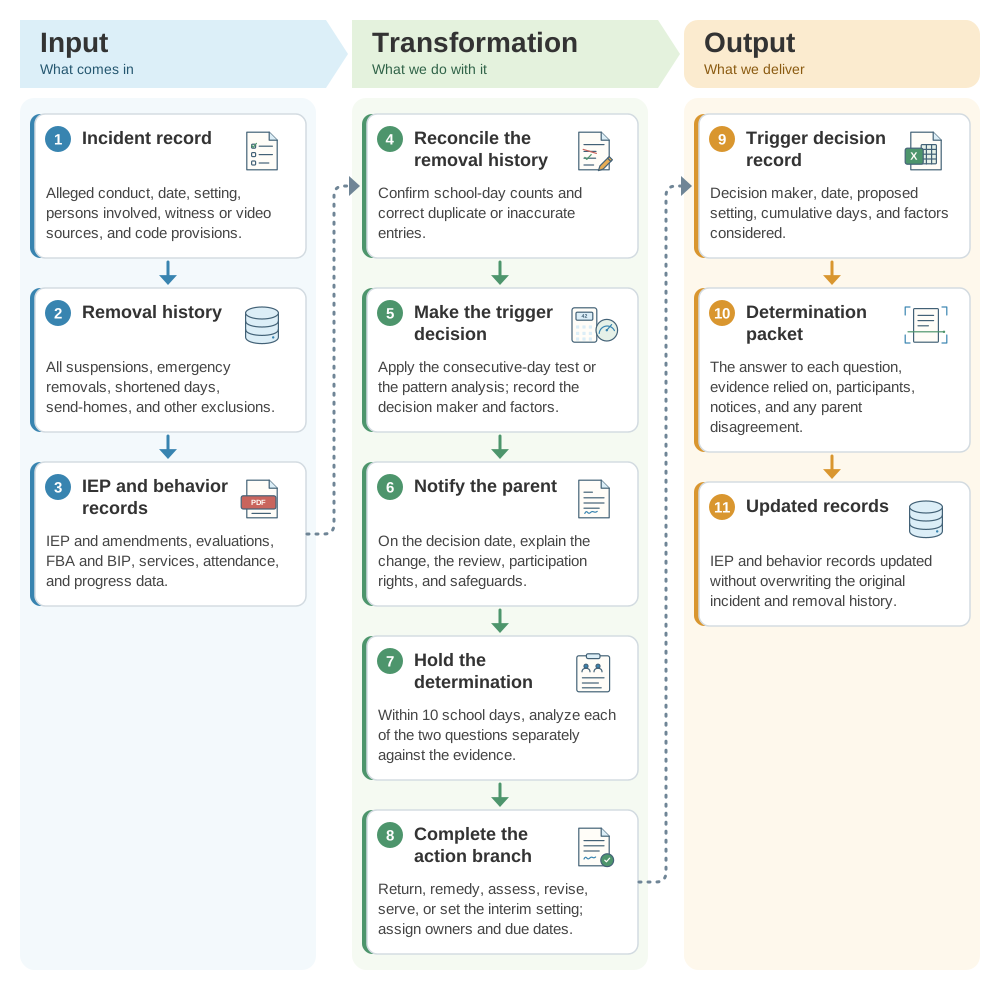
The incident-to-determination workflow
- At incident intakePreserve facts without prejudging the manifestation.Record the alleged conduct, date, time, setting, involved persons, immediate safety actions, witness or video sources, code provisions, and student response. Provide language and disability access and follow ordinary discipline fact-finding procedures.
- Before assigning removal daysReconcile the removal history.Pull all in-school and out-of-school suspensions, emergency removals, shortened-day removals, informal send-homes, and other exclusions from instruction. Confirm school-day counts and correct inaccurate or duplicate entries.
- At the proposed placement changeMake and document the trigger decision.Apply the consecutive-day test or the case-specific pattern analysis. Record the decision maker, decision date, proposed duration and setting, behavior-similarity analysis, cumulative days, and factors considered.
- On the decision dateNotify the parent and provide safeguards.Explain the proposed disciplinary placement change, the manifestation review, participation rights, meeting logistics, and procedural safeguards in an understandable and accessible form.
- Before the meetingAssemble the actual evidence.Collect the IEP and amendments, evaluations, BIP and FBA, incident record, parent information, teacher and provider observations, implementation evidence, services and attendance data, removal history, progress information, and relevant health or communication information.
- Within 10 school daysConduct the manifestation determination.Confirm participants and relevant records, establish the conduct being reviewed, analyze each required question separately, document differing views, and reach a child-specific determination.
- At the determinationIssue the result and required notices.Clearly state the answer to each question, the evidence relied upon, the resulting placement and service actions, parent disagreement if any, and prior written notice as applicable.
- Immediately afterwardComplete the correct action branch.Return, remedy, assess, revise, serve, or implement the interim setting as required; assign owners and due dates; update the IEP and behavior-management records without overwriting the original incident or removal history.
Apply the correct outcome branch
| Determination | Required next action | Placement and services |
|---|---|---|
| Conduct was a manifestation because either required question is answered “yes” | Conduct an FBA unless one was completed before the behavior, and implement a BIP; or, if a BIP already exists, review and modify it as necessary. | Return the child to the placement from which removed unless the parent and LEA agree to a placement change as part of modifying the BIP, or the special-circumstances exception applies. |
| Conduct was the direct result of failure to implement the IEP | In addition to the manifestation actions, take immediate steps to remedy the implementation deficiencies and determine any additional corrective or compensatory action needed. | Restore required supports and services, verify staff understanding and access, and monitor implementation rather than treating a paper correction as completion. |
| Conduct was not a manifestation | The same relevant disciplinary procedures and duration may be applied as for children without disabilities, subject to IDEA and other applicable protections. | Continue educational services enabling participation in the general curriculum and progress toward IEP goals, and provide an FBA and behavioral intervention services and modifications as appropriate to prevent recurrence. |
| Weapons, drugs, or serious bodily injury special circumstance | School personnel may remove the child to an appropriate interim alternative educational setting for not more than 45 school days, regardless of manifestation. | The IEP Team determines the interim setting. The child continues required educational and behavioral services; the manifestation result still controls other required actions. |
Behavior-management system controls
- Single removal ledger: reconcile every exclusion from instruction across the SIS, behavior platform, attendance system, alternative-program records, and manual site logs.
- School-day calculation: calculate consecutive and cumulative removal days against the student’s actual instructional calendar; distinguish partial days and document local legal treatment.
- Pattern alert: flag cumulative removals before they exceed 10 days and present prior conduct descriptions, lengths, totals, and proximity for human case-by-case review.
- Decision-date field: maintain a specific, auditable placement-change decision date rather than deriving the MDR deadline solely from the incident or suspension date.
- Disability-status check: check IDEA eligibility, pending evaluation, Section 504 status, and whether the LEA is deemed to have knowledge that the child may have a disability.
- Service continuity: trigger coordination of educational and behavioral services when cumulative removals exceed 10 school days, including when individual removals do not constitute a placement change.
- Immutable history: preserve original incident, attendance, service, and removal entries; correct errors through traceable amendments rather than deleting or manufacturing records to support the determination.
- Privacy and access: restrict sensitive disability, discipline, health, and behavior records to authorized personnel while ensuring relevant MDR participants receive the information needed for meaningful review.
Decision routes
A series of short removals may form a pattern
Action: Total the school days removed, compare the behavior in the current and prior incidents, and consider removal length, cumulative time, and proximity. Document the case-specific determination before finalizing discipline.
Control: Do not configure the system to treat “11 cumulative days” as automatically a placement change or automatically not a placement change. The substantially-similar-behavior and additional-factor analysis is required.
The student is not yet IDEA-eligible
Action: Determine whether the LEA had knowledge before the conduct that the child was a child with a disability under 34 CFR § 300.534. If so, apply IDEA discipline protections. If an evaluation is requested during discipline and the LEA was not deemed to know, conduct the evaluation in an expedited manner while the child remains in the placement determined by school authorities, subject to the regulation.
Control: A pending or suspected disability is not a reason to ignore child find, and staff should not backdate a concern or fabricate prior knowledge.
The parent cannot attend the proposed meeting time
Action: Make documented, reasonable efforts to secure participation through mutually workable scheduling, remote access, interpretation, accessible materials, and prompt rescheduling within the 10-school-day deadline.
Control: Do not treat a single invitation as meaningful participation or automatically postpone the statutory deadline without current legal review.
The records do not prove whether the IEP was implemented
Action: Gather contemporaneous provider, teacher, schedule, attendance, substitute, progress, and communication evidence; identify gaps and obtain direct accounts. Assess the effect of missing evidence on the required question.
Control: Do not create service logs after the incident and present them as contemporaneous evidence. Correct the record transparently and address any control failure.
The conduct involves weapons, drugs, or serious bodily injury
Action: Verify that the facts satisfy the federal definition; convene the MDR; have the IEP Team determine an appropriate interim alternative educational setting; continue services; and calendar the maximum 45-school-day period.
Control: Do not treat every dangerous, injurious, medication-related, or substance-related incident as a federal special circumstance without applying the controlling definitions.
The participants do not reach consensus
Action: Document the evidence and views. The LEA makes the determination and provides prior written notice. Explain the parent’s rights to mediation, an expedited due process hearing, and the State complaint process as applicable.
Control: Do not record “team consensus” if disagreement remains, and do not use majority vote as a substitute for the IDEA process.
The student is in foster care
Action: Identify the educational rights holder and provide required notice and participation. California CDE guidance states that when a special education student in foster care faces a proposed placement change, the educational rights holder, attorney, and social worker must be notified and invited to the manifestation-determination IEP meeting.
Control: Confirm the current court orders, educational decision maker, confidentiality permissions, and applicable California notice requirements rather than assuming the caregiver holds educational rights.
Manifestation determination packet
- Incident report, code-of-conduct provision, discipline fact findings, student response, and evidence index.
- Complete removal ledger with consecutive days, cumulative days, partial-day treatment, prior incident descriptions, and pattern analysis.
- Placement-change decision, decision date, decision maker, proposed setting and duration, parent notice, and safeguards delivery evidence.
- Current IEP and amendments, eligibility and evaluation information, FBA, BIP, behavior goals, supports, accommodations, and placement history.
- Parent-supplied information; teacher, provider, and relevant staff observations; progress, attendance, health, communication, sensory, and functional information.
- Contemporaneous service and implementation evidence covering each material IEP requirement and the period surrounding the conduct.
- Participant and relevance record, meeting access and interpretation evidence, each required question, analysis, differing views, and determination.
- Prior written notice and resulting FBA/BIP, remediation, return, alternative setting, service-continuity, progress, and follow-up actions.
- Any appeal, mediation, expedited hearing, State complaint, stay-put determination, corrective action, and legal consultation records.
Official resources
- IDEA Regulation: Authority of School Personnel, 34 CFR § 300.530
- IDEA Regulation: Change of Placement Because of Disciplinary Removals, 34 CFR § 300.536
- IDEA Regulation: Protections for Children Not Yet Determined Eligible, 34 CFR § 300.534
- IDEA Regulation: Determination of Setting, 34 CFR § 300.531
- IDEA Regulation: Appeal, 34 CFR § 300.532
- U.S. Department of Education: Questions and Answers on IDEA’s Discipline Provisions
- California Department of Education: Behavioral Intervention Plans Frequently Asked Questions
- California Department of Education: Summary of Procedural Safeguards and Parental Rights
- California Department of Education: Foster Youth Education Rights
Local implementation questions
- Which exclusions from instruction are captured outside the central behavior system, and who reconciles them?
- Who makes and documents the case-specific pattern determination before the LEA crosses a cumulative threshold?
- Can the system distinguish incident, removal, placement-change decision, notice, safeguards delivery, and MDR meeting dates?
- How are parents and the LEA jointly identifying the relevant IEP Team members?
- What contemporaneous evidence proves each service, accommodation, and behavior support was implemented?
- Who activates continuing services, FBA/BIP, return-to-placement, IEP-remedy, or interim-setting actions immediately after the determination?
- How are informal removals, shortened days, and early pickups reviewed so they do not disappear from cumulative-day monitoring?
Source review completed August 29, 2026. Verify current IDEA regulations and guidance, California discipline and special education law, SELPA policy, local codes of conduct, procedural safeguards, behavior-system configuration, removal history, IEP implementation evidence, federal special-circumstance definitions, foster-youth rights, and student-specific facts before acting. This operational resource does not replace legal advice.