



SDLA Compliance Resource
Conduct Scoliosis Screening with Parent Notice, Rescreening, Referral, Follow-Up, and Recordkeeping
A complete school-health workflow for identifying the statutory cohort, protecting student dignity, confirming suspected findings, connecting families to evaluation, and closing the annual evidence file.
In Plain Language: California school districts must provide scoliosis screening for every female pupil in grade 7 and every male pupil in grade 8, subject to the parent-refusal provisions of Education Code section 49451. Families receive notice before screening. Qualified personnel screen the student privately, document the result, and arrange an independent rescreen when a finding is suspected. A suspected finding after rescreening is not a diagnosis: notify the parent or guardian in the family’s primary language, explain why medical evaluation matters, refer without steering the family to a financially connected provider, follow up, and preserve an accurate health record.
Why this matters
Scoliosis may develop during rapid adolescent growth and may not be apparent to the student or family. A dependable school process can identify a possible spinal deviation early enough for professional evaluation. A careless process can invade privacy, miss students, overstate a screening result, or leave a referral uncompleted.
Joint ownership
Clinical program owner: credentialed school nurse or qualified supervisor of health. Operations partners: trained and legally eligible screeners, site administration, student information and health-record staff, enrollment and scheduling staff, interpreters, and family liaisons. External partner: the family-selected licensed health care provider or appropriate public/community resource.
Build the correct screening cohort
| Cohort or condition | Treatment | Evidence |
|---|---|---|
| Female pupils in grade 7 | Include in the annual screening roster unless a lawful refusal or other documented exclusion applies. | Enrollment and grade snapshot, cohort rule, screening status, and result or exception. |
| Male pupils in grade 8 | Include in the annual screening roster unless a lawful refusal or other documented exclusion applies. | Enrollment and grade snapshot, cohort rule, screening status, and result or exception. |
| Student enrolls or changes schools after the roster snapshot | Determine whether required screening was already completed during the applicable grade; screen or document reliable prior completion under the district’s current procedure. | Enrollment date, prior-record request, verified result or scheduled screening. |
| Parent or guardian submits a written refusal under Education Code section 49451 | Do not perform the screening covered by the refusal. Document the statement and preserve the student’s privacy. | Signed or otherwise legally sufficient refusal, date received, scope, and roster disposition. |
| Student has a known diagnosis or is under clinical care | Have the school nurse review current documentation and the family’s wishes; determine the proper roster disposition without publicly identifying the condition. | Minimal necessary health-record notation and source of current clinical information. |
Separate legal requirements from operational practice
| Control | Official requirement or guidance | Operational treatment |
|---|---|---|
| Screening | Education Code section 49452.5 establishes the grade-and-sex cohorts, qualified personnel, no-cost intent, standards, and conflict-of-interest limitation. | Schedule a private screening session during the school day with trained staff, a reconciled roster, appropriate space, supplies, infection-control procedures, and accessibility support. |
| Parent notice and refusal | CDE standards call for notice of the intent to screen; Education Code section 49451 permits a parent or guardian to file an annual written statement refusing consent to physical examination. | Send understandable advance notice with purpose, process, privacy arrangements, contact information, screening window, and refusal instructions; log delivery and any refusal. |
| Rescreening | CDE standards call for suspected findings to be rescreened, preferably the same day, by a screener other than the original screener. Section 49452.5 requires orthopedic-surgeon rescreening when it can occur at no cost. | Keep the initial result provisional, assign an independent qualified rescreener, record both observations separately, and document whether the statutory no-cost orthopedic option was available. |
| Referral notice | After rescreening, notify the parent or guardian of a suspected spinal deviation in the primary language. Include an explanation of scoliosis, the importance of early treatment, and available public services. | Use a nurse-reviewed referral notice that says “suspected,” supports questions, identifies neutral community/public resources, and requests that the provider response be returned. |
| Follow-up | CDE program standards include follow-up to verify that medical care was sought. | Assign dated contacts, offer navigation help, record only verified status, and keep the referral open when the outcome is unknown. |
| Records | CDE standards call for the screening date and result in the student health record and clear documentation of parent refusal. | Maintain a privacy-protected student record plus an aggregate operations log; distinguish screened, rescreened, referred, follow-up pending, evaluated, and unable to verify. |
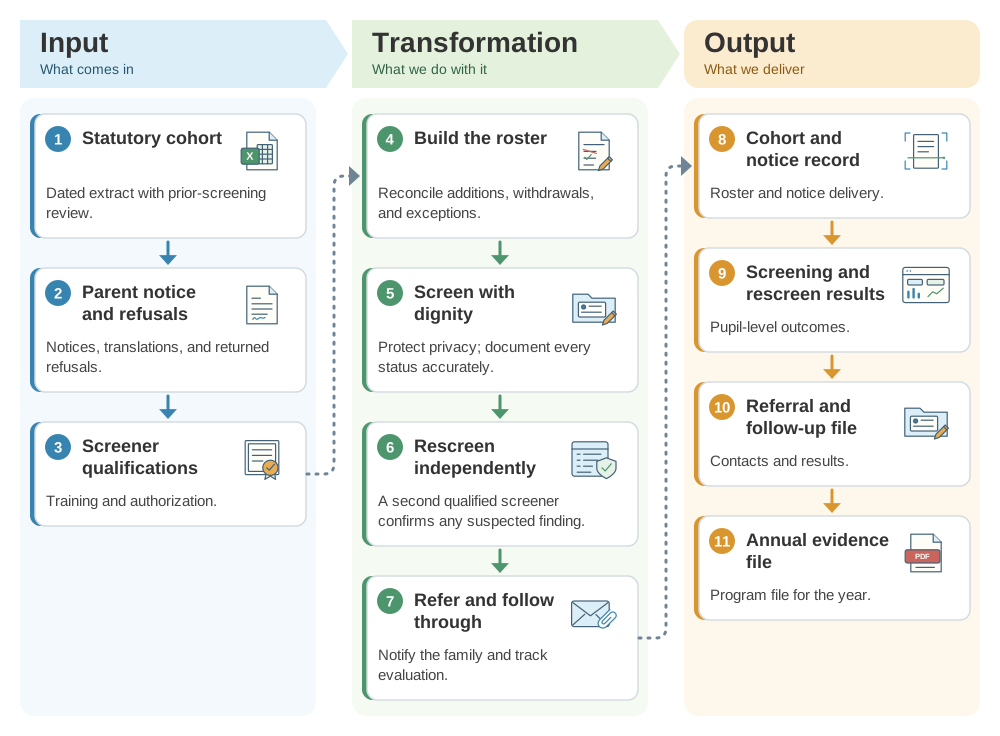
From the statutory cohort to a closed scoliosis screening record: the SDLA ITO workflow
Screening is dignified and private, an initial finding is confirmed by a second screener, and a refusal is never recorded as a normal result. This SDLA ITO (Input, Transformation, Output) graphic shows how the statutory grade cohort, parent refusals, and screener qualifications become the cohort and notice records, the screening and rescreen results, and the referral and follow-up file.
The annual screening cycle
- Before the school year or local screening windowAssign clinical governance. Name the qualified supervisor, confirm screener eligibility and current training, review CDE standards, establish privacy and emergency procedures, and verify any contractor’s authority and conflict-of-interest controls.
- Before family noticeBuild and reconcile the roster. Extract the statutory cohorts, account for new enrollments and transfers, review prior results and annual refusals, resolve duplicates and missing demographic data privately, and assign every pupil a trackable status.
- Before screeningNotify parents and prepare students. Send accessible advance notice, explain the non-diagnostic purpose and privacy arrangements, provide a nurse contact, receive and record refusals, and arrange individual disability, mobility, communication, cultural, and trauma-informed supports.
- On the screening dateVerify identity, consent status, privacy, and readiness. Use only trained authorized personnel, follow the CDE observation protocol, avoid unnecessary exposure, prevent peer viewing or commentary, and record the date and result directly into the controlled workflow.
- When an initial finding is suspectedArrange an independent rescreen. Keep the result provisional; rescreen at a separate session, on the same day when possible, using a qualified person other than the original screener and the same established procedure.
- After rescreen confirmationCounsel and refer the family. Notify the parent or guardian in the primary language, explain the suspected finding and importance of early evaluation, identify public services and neutral community resources, and provide a provider-response form.
- Until referral disposition is knownFollow up without inventing closure. Confirm receipt, ask whether evaluation was sought, offer navigation or public-resource assistance, schedule another contact, and record the family’s verified response. Escalate concerns through the school nurse and current local policy.
- At cycle closeReconcile the program. Account for every eligible pupil; review refusals, absences, missed screenings, initial findings, rescreens, referrals, follow-up, returned provider information, and unresolved cases; correct records transparently and retain the required health documentation.
Privacy, dignity, and accessibility controls
- Private setting: prevent viewing by peers and unnecessary staff; use individual screening stations or visual barriers and control entry.
- Minimum exposure: follow current CDE technique while protecting the student’s body, clothing, religious practice, gender identity, trauma history, and comfort to the greatest extent consistent with an effective screen.
- Student communication: explain each step before it occurs, invite questions, and stop to obtain nurse guidance when the student is distressed, reports pain, or cannot safely assume a screening position.
- Disability access: plan reasonable modifications for mobility, balance, communication, sensory, cognitive, or health needs; do not record “pass” when the standard screen could not be completed.
- Language access: provide parent notice, referral communication, and follow-up in the family’s primary language using qualified interpretation or translation controls.
- Confidential records: enter results in the protected student health record and limit operational reports to the minimum necessary information.
- No public labeling: do not announce screening status, suspected findings, refusals, diagnoses, or follow-up needs in classrooms, group lines, shared spreadsheets, or unsecured messages.
Decision routes
The parent or guardian refuses screening
Action: Confirm that the refusal meets current Education Code section 49451 and local requirements, record its date and scope in the student health record, update the roster status, and protect the family’s confidentiality.
Control: Do not screen anyway, pressure the student to override the parent, or record the refusal as a completed or normal result.
The pupil is absent or transfers before screening
Action: Schedule a make-up screen or coordinate a privacy-safe records request and handoff. Retain ownership until prior completion is verified or the receiving school accepts the documented task.
Control: “Absent,” “transferred,” and “screened elsewhere” are different statuses; do not convert any of them to “complete” without evidence.
The initial screener observes a possible deviation
Action: Document the observed screening finding without diagnosing, protect the student from peer disclosure, and arrange independent rescreening by another qualified screener, preferably the same day when feasible.
Control: Do not send a definitive diagnosis letter from the first observation or ask the original screener simply to confirm their own result.
The student cannot complete the standard screening position
Action: Stop and have the school nurse assess safe, accessible next steps. Document “unable to complete” and the reason at the minimum necessary level, then arrange an appropriate alternative or professional referral under current guidance.
Control: Do not force movement, assume a normal result, or classify inability as refusal unless that is factually and legally correct.
The rescreen supports referral
Action: Contact the student and parent or guardian promptly and privately; send primary-language written notice containing the required information; offer neutral public/community resources; and begin the follow-up log.
Control: State that scoliosis is suspected, not diagnosed. The screener may not solicit or encourage treatment by the screener or an entity in which the screener has a financial interest.
The family reports that care was sought but no provider form is returned
Action: Record exactly what the family reported and the date; request only information needed for school follow-up or support; obtain authorization before contacting a provider when required; and keep clinical facts unverified until reliable documentation is received.
Control: Do not invent a diagnosis, treatment, appointment date, or referral closure to complete the tracker.
The family needs help obtaining an evaluation
Action: Offer current public services, health coverage navigation, local health department or community-clinic information, language assistance, and other neutral access supports. Continue respectful follow-up.
Control: Do not condition school access on medical follow-through or steer the family to a financially connected provider.
The provider reports a diagnosis or school-related restriction
Action: Route the information to the school nurse, update the confidential health record, identify any activity, pain, mobility, attendance, Section 504, special education, or emergency-plan implications, and share only what authorized staff need to implement supports.
Control: A diagnosis does not automatically establish disability eligibility or a particular accommodation; use the appropriate individualized process.
Program evidence file
- Board policy and current operating procedure aligned to Education Code sections 49451, 49452.5, 49426, and 49456 and current CDE standards.
- Named qualified supervisor, screener credentials or eligibility, training content, completion dates, contractor authorization, and conflict-of-interest controls.
- Dated statutory-cohort extract, additions and withdrawals, prior-screening review, roster reconciliation, and exception reason for every pupil.
- Parent-notice template, translations, distribution dates and methods, returned refusals, and delivery exceptions.
- Site plan covering space, privacy, student flow, accessibility, supplies, infection control, incident response, and secure data entry.
- Student-level screening date and result, original screener, rescreen date and result, independent rescreener, and any inability to complete.
- Referral notice, primary-language delivery evidence, counseling contact, resources provided, and provider-response form.
- Follow-up attempts, verified family responses, access assistance, returned clinical information, unresolved status, and nurse review.
- End-of-cycle totals reconciled to the student-level roster without exposing personally identifiable health information.
Official resources
- California Department of Education: Health Services and School Nursing
- California Department of Education: Scoliosis Screening in California Public Schools
- California Education Code § 49452.5: Scoliosis Screening
- California Education Code § 49451: Parent Refusal of Physical Examination
- California Education Code § 49426: School Nurse Health Services
- California Education Code § 49456: Notice and Referral Following Health Findings
Local implementation questions
- Who certifies that every screener is legally eligible, currently trained, supervised, and free of prohibited referral incentives?
- How are late enrollees, transfers, repeaters, refusals, known diagnoses, and incomplete demographic records reconciled?
- Can each screening site provide genuine visual and conversational privacy and accessible alternatives?
- Who verifies that a second qualified person—not the original screener—performs each required rescreen?
- Are referral notices current, non-diagnostic, available in families’ primary languages, and neutral about provider choice?
- What follow-up cadence distinguishes “family reports care sought,” “provider information received,” and “unable to verify”?
- Can the district reconcile aggregate completion without exporting identifiable student health information into general-purpose spreadsheets?
Source review completed August 29, 2026. Verify current Education Code, CDE screening standards, board policy, student-record and privacy requirements, screener qualifications and training, contractor authorization, primary-language procedures, public referral resources, and pupil-specific health and accessibility needs before acting. CDE’s scoliosis publication is an official implementation guide but is older; current statute controls where language differs. This operational resource does not provide medical or legal advice.