



SDLA Compliance Resource
Complete the Annual 1.0 Percent Threshold Reporting Requirement and Justification Survey
An implementation guide for projecting alternate-assessment participation, validating individual IEP decisions, explaining an anticipated exceedance, submitting the annual CDE survey, and retaining a defensible record.
In Plain Language: Every LEA must annually estimate the percentage of assessed pupils expected to take the California Alternate Assessments in English language arts/literacy, mathematics, and science and report through the CDE survey—even when the LEA expects to remain at or below 1.0 percent or expects no alternate-assessment participants. If an LEA anticipates exceeding 1.0 percent in any subject, it must justify the exceedance and be able to show that each pupil’s active IEP appropriately designates the alternate assessment.
Why this matters
The requirement is intended to prevent pupils who could participate in the general assessment—with appropriate accessibility resources—from being assigned to an alternate assessment. The percentage is a district-level signal; the validity of participation still rests on careful, pupil-specific IEP-team decisions.
Joint ownership
Assessment lead: survey, projections, TOMS data, and submission evidence. Special education lead: IEP-team guidance, participation criteria, case review, training, and corrective action. Data partners: enrollment, grade, testing, IEP, and student-setting reconciliation. Neither office should certify the response from its own system alone.
From student roster to state submission: the SDLA ITO workflow
The annual survey is the end of a data process that begins with student records. This SDLA ITO (Input, Transformation, Output) graphic shows how a roster of expected CAA participants, the matching assessed population, and reporting instructions become reviewed calculations and a submitted CDE response.
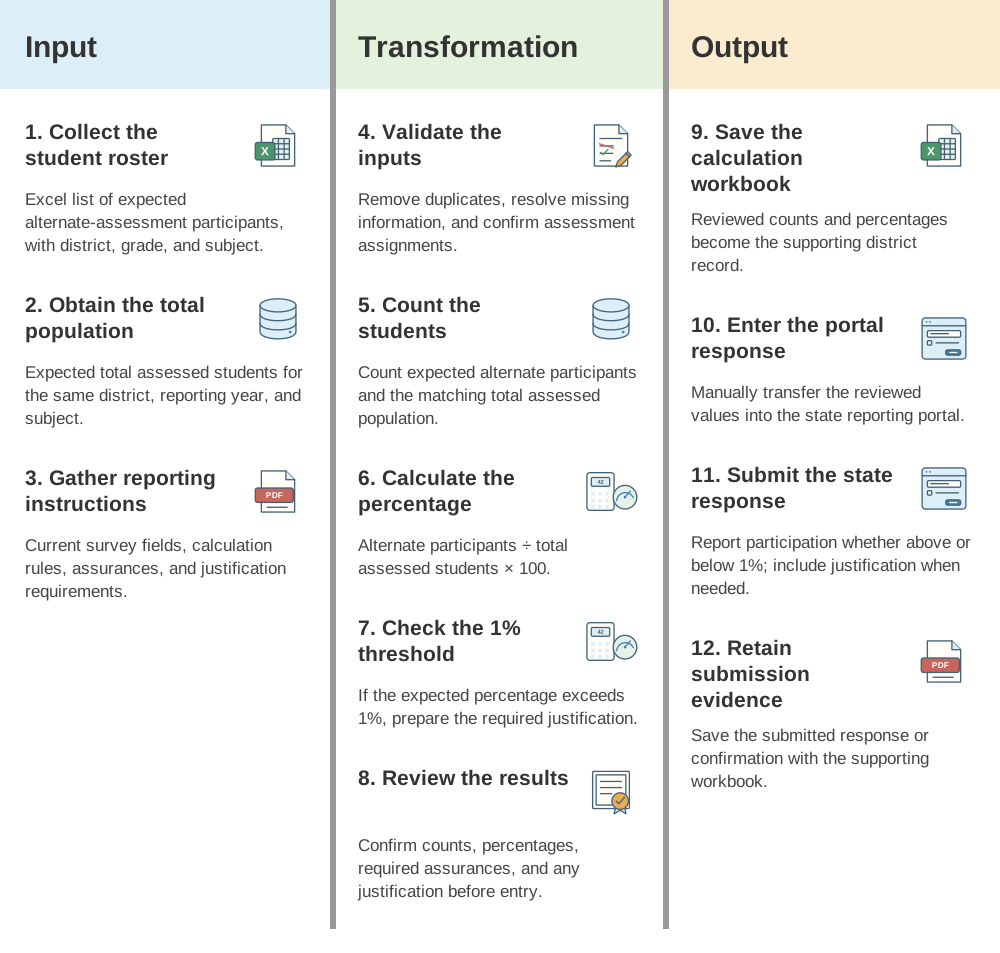
Open the full-size workflow graphic · Go to the subject-by-subject calculation guidance
What has changed or become more important since 2024?
| Development | Current significance | LEA response |
|---|---|---|
| Updated California decision tool · April 2025 | CDE replaced or substantially updated its alternate-assessment participation resource with the Alternate Assessment Participation Decision-Making Tool for California. It is designed to support—not replace—the IEP team’s decision. | Use the current April 2025 tool in annual training and pupil-level review; retire locally stored older worksheets unless a documented reason requires retention. |
| Continuing federal grant condition · documented August 2025 | California reported that the federal Title I grant condition first imposed in 2019 remained because the state had not yet achieved compliance with the state-level cap. CDE described increased monitoring, outreach, and possible findings of noncompliance. | Treat the survey and supporting review as a substantive control—not a coordinator-only attestation. Current public materials reviewed for this page did not establish that the condition has since been removed. |
| Three-year TOMS trend display | CDE reports that the TOMS landing page displays the percentage of pupils assigned an alternate assessment over the prior three years at LEA and state levels. | Use the trend before the survey, investigate changes, and retain the snapshot or export used for leadership review. |
| All-LEA reporting and public survey results | CDE continues to require every LEA to respond, including LEAs below the threshold and those with zero expected participants. Published files identify responding and nonresponding LEAs. | Do not wait for an exceedance notice. Place the survey on the annual calendar and preserve confirmation. |
| 2026–27 survey deadline confirmed | CDE’s October 9, 2026 Assessment Spotlight directs LEAs to complete the 2026–27 survey by October 31, 2026. | Set an earlier local review date so assessment and special education leaders can approve the response before the state deadline. |
Calculate the percentage correctly—by subject
Calculate English language arts/literacy, mathematics, and science separately. A pupil may appear in more than one subject numerator, but each subject has its own numerator and denominator. The CAA percentage does not use total district enrollment, the number of pupils with disabilities, or a single unduplicated count across all subjects.
Small-LEA example
An LEA expects 80 pupils to be assessed in a subject and one pupil to take the CAA:
1 ÷ 80 × 100 = 1.25 percent.
The LEA is above 1.0 percent and must justify the anticipated result. This does not mean the pupil was incorrectly assigned.
Larger-LEA example
An LEA expects 5,000 pupils to be assessed in a subject and 48 pupils to take the CAA:
48 ÷ 5,000 × 100 = 0.96 percent.
The LEA remains below 1.0 percent but must still submit the annual CDE survey.
Build three projections—not one blended percentage
| Subject | CAA numerator | Assessed denominator | Common complication |
|---|---|---|---|
| English language arts/literacy | Pupils expected to take the CAA for ELA in assessed grades. | All pupils expected to take the state ELA assessment in those grades, including general and alternate assessments. | Do not substitute enrollment or count only pupils with IEPs. Apply current participation and exemption rules when projecting the assessed population. |
| Mathematics | Pupils expected to take the CAA for mathematics in assessed grades. | All pupils expected to take the state mathematics assessment in those grades. | ELA and mathematics counts may look similar, but each subject must be validated and reported independently. |
| Science | Pupils expected to take the CAA for Science in grades 5 and 8 and the applicable high-school grade. | All pupils expected to take CAST or CAA for Science in the corresponding science-tested population. | High-school science is administered once in grade 10, 11, or 12, so grade assignment and prior completion can materially affect the projection. |
Scope boundary: This reporting requirement concerns alternate assessments aligned with alternate academic achievement standards in ELA, mathematics, and science. Do not automatically add Initial or Summative Alternate ELPAC participation to the CAASPP 1.0 percent calculation.
The annual survey-to-testing calendar
- Before the survey opensName the joint owners and retrieve prior-year evidence.Review the last survey, published CDE result, actual participation, TOMS three-year trend, monitoring communication, local corrective actions, and changes in enrollment or specialized programs.
- At fall enrollment stabilizationBuild subject-specific assessed-population projections.Use current enrollment, grade, school, IEP assessment designation, alternate-assessment eligibility, and science-testing history. Account for known transfers, new placements, and incomplete records.
- Before calculating percentagesReconcile every projected CAA participant.Confirm an active IEP, the correct subject assessment, current California participation criteria, parent information, and the absence of impermissible decision factors.
- Before survey certificationAnalyze patterns and disproportionality.Compare schools, grades, disability categories, race/ethnicity, English learner status, instructional settings, feeder patterns, and year-over-year changes while protecting pupil privacy.
- During the CDE survey windowReport for every LEA outcome.Submit whether the LEA anticipates exceeding, not exceeding, or having no pupils expected to participate. When any subject exceeds 1.0 percent, provide a specific, supportable justification and required assurances.
- Immediately after submissionPreserve the complete evidence package.Retain the response, confirmation, calculations, source snapshots, approvals, justification text, assurances, training evidence, and correction plan. Assume the LEA’s response or status may be made public.
- Before test assignment locksCorrect systems—not pupil decisions made for a quota.Resolve stale IEP records, incorrect test assignments, missing transfers, or inconsistent subject settings. Convene an IEP team when a pupil’s assessment designation requires reconsideration.
- During and after administrationCompare projection with actual participation.Explain material differences, evaluate overidentification patterns, complete required state monitoring, and carry verified findings into the next year’s training and survey.
The survey is a district control; assessment assignment remains an IEP-team decision
LEA leadership may
- Train teams on California participation criteria.
- Review assignments for completeness and procedural integrity.
- Identify inconsistent, stale, or unsupported records.
- Analyze patterns and possible disproportionality.
- Require an IEP team to reconsider a questionable designation through the proper process.
- Improve access to the general assessment and appropriate accommodations.
LEA leadership may not
- Set a pupil quota to force the LEA below 1.0 percent.
- Change an individual pupil’s assessment outside the IEP process.
- Use disability category, placement, low achievement, behavior, attendance, or anticipated difficulty as the sole basis.
- Assume every pupil in an alternate curriculum or specialized classroom qualifies.
- Use the justification survey as blanket approval for every pupil assignment.
Use the current California decision tool at the pupil level
The April 2025 CDE decision-making tool centers the analysis on whether the pupil has a most significant cognitive disability and requires extensive, direct individualized instruction and substantial supports to make measurable gains on grade-level alternate academic achievement standards. It also identifies factors that may not be used alone to make the decision.
| Confirm | Evidence to examine | Red flag |
|---|---|---|
| Most significant cognitive disability | Comprehensive evaluation information concerning cognitive functioning and adaptive behavior, considered by the IEP team. | Eligibility inferred from disability label, classroom placement, or a single score. |
| Extensive individualized instruction and substantial supports | Present levels, instructional intensity, supports across settings, communication, access, and measurable learning needs. | Alternate assessment selected because the general assessment is expected to be difficult or produce a low score. |
| Grade-level alternate academic achievement standards | The pupil’s instruction and assessment remain connected to the enrolled grade’s academic content through alternate achievement standards. | Decision based primarily on below-grade instruction or a locally adopted alternate curriculum. |
| Parent information and IEP documentation | The parent is clearly informed about alternate standards and possible diploma implications; the active IEP identifies the appropriate assessment. | Family notice treated as consent for a district quota decision or omitted because participation occurred previously. |
| Subject-specific assignment | Current IEP and test-assignment records agree for each relevant subject and testing window. | A global “alternate” flag automatically assigns every alternate assessment without subject review. |
Write a justification that explains the exceedance without excusing weak controls
Distinguish a plausible explanation from an adequate justification
| Local circumstance | Why it may affect the percentage | What the justification still must show |
|---|---|---|
| Small assessed population | One appropriately assigned pupil can place a small LEA above 1.0 percent. | Correct subject denominator, individual eligibility review, and safeguards against automatic continuation. |
| Regional or specialized program | The LEA may enroll a concentration of pupils with the most significant cognitive disabilities from a broader area. | Actual enrollment/service facts, responsibility for tested pupils, individual decisions, and analysis of whether program placement is being mistaken for eligibility. |
| Residential, county, charter, or transfer pattern | Mobility and specialized placements may produce an atypical tested population. | Correct LEA attribution, current IEP and test assignments, record-transfer controls, and no double counting. |
| Year-over-year cohort change | A small number of entries, exits, or grade changes can materially alter the percentage. | A roster-level bridge from the prior year and explanation of each aggregate change. |
| Historical local practice | Longstanding assignments may explain the trend. | This is a risk indicator—not an adequate justification by itself. Show renewed IEP-team review, current criteria, training, and corrective action. |
Reconcile the same pupils across five records
| Record | Authoritative question | Compare with | Correction |
|---|---|---|---|
| Active IEP | What assessment does the current IEP designate by subject, and what participation analysis supports it? | Decision tool, parent information, pupil needs, prior IEP, and meeting record. | Convene the IEP team when reconsideration or correction requires team action; do not overwrite the decision administratively. |
| IEP system | Does the structured assessment field accurately represent the active IEP? | Final signed/implemented IEP and amendment history. | Correct data-entry or status errors while preserving the legal record and audit history. |
| TOMS assignment | Is the pupil assigned to the correct current-year assessment for each subject? | IEP system, enrollment, grade, test registration, and prior completion. | Resolve mismatches before administration under current TOMS procedures. |
| Projection workbook | Are subject numerators and denominators complete, current, and reproducible? | Enrollment roster, TOMS trend, IEP roster, school totals, and science grade history. | Refresh data, document assumptions, and preserve the dated version used for submission. |
| CDE survey | Does the submitted response match the approved projection, justification, and assurances? | Final calculation, leadership approval, and confirmation receipt. | Use the CDE correction route promptly if a material error is discovered. |
Pre-submission control checklist
- Current 2026–27 survey link and deadline confirmed from CDE.
- Prior survey, published status, actual results, and three-year trend reviewed.
- ELA, mathematics, and science calculated separately.
- Numerators contain only expected CAA participants for the subject.
- Denominators contain all pupils expected to be assessed in the same subject.
- Science projection addresses the high-school grade and prior testing history.
- Every projected CAA pupil has an active, consistent IEP designation.
- Current April 2025 California decision tool used in review and training.
- Potential disproportionality and school/program patterns reviewed.
- Justification contains aggregate facts and no personally identifiable information.
- Assessment and special education leaders approve the final response.
- Submission confirmation and reproducible evidence package retained.
Evidence to retain
- CDE announcement, survey link, instructions, opening date, and deadline.
- Prior-year survey response, published result, and monitoring correspondence.
- TOMS three-year trend and current test-assignment extracts.
- Dated enrollment and assessed-population projections by subject.
- CAA pupil roster keyed to active IEP and subject assignment.
- Individual review or confirmation records maintained under appropriate access controls.
- IEP-team and staff training materials, attendance, and current decision tool.
- Disproportionality, school, grade, program, and year-over-year analyses.
- Final calculations, assumptions, exception log, and leadership approval.
- Submitted survey, justification, assurances, and confirmation.
- Post-administration projection-to-actual reconciliation.
- Corrective actions, IEP-system repairs, and state monitoring evidence.
Official guidance and help
- CDE 1.0 Percent Threshold on Alternate AssessmentsAnnual reporting requirement, all-LEA response rule, justification requirement, monitoring notice, contacts, and published survey results.
- CDE Alternate Assessment Participation Decision-Making Tool for CaliforniaCurrent April 2025 pupil-level participation guidance for IEP teams.
- CDE Alternate Assessment IEP Team GuidanceCalifornia guidance concerning appropriate participation decisions, active IEP designation, instruction, alternate assessments, and diploma considerations.
- California’s August 29, 2025 Response to Federal Grant Award Notification ConditionsState status, federal condition, monitoring actions, survey response rates, TOMS trend reporting, and California’s improvement plan.
- 34 CFR section 200.6State subject-specific cap, prohibition on an LEA cap, LEA justification, state oversight, public availability, participation guidelines, and state waiver requirements.
- 20 USC section 6311Federal alternate academic achievement standards and assessments, IEP-team authority, parent information, state cap, local justification, and prohibition on a local cap.
- CDE Assessment SpotlightCurrent survey opening, deadline reminders, assessment-system changes, and coordinator notices.
Implementation questions: Contact the CDE CAASPP Office at or 916-445-8765. For pupil-specific participation, follow current IEP procedures and obtain special education administrative or SELPA guidance rather than using the LEA percentage as the deciding factor.
Original source review completed August 28, 2026. SDLA ITO workflow added and the 2026–27 survey deadline updated October 15, 2026, using CDE Assessment Spotlight, Issue 383. The broader guidance was not re-audited as part of this graphic update. Verify the current survey, instructions, TOMS configuration, California decision tool, federal/state monitoring status, assessment windows, and pupil-specific IEP records before acting.