



SDLA Compliance Resource
Adopt the 2027–28 LCAP and Annual Update
Complete the 2027–28 plan and required annual update, adopt the complete package in public and make the correct budget, submission and posting handoffs.
In Plain Language: Complete the 2027–28 plan and required annual update, adopt the complete package in public and make the correct budget, submission and posting handoffs.
Why this matters
Next-year planning must use the applicable adopted template while accounting for the prior year’s implementation and results.
Primary ownership
Superintendent or charter leader with LCAP, fiscal, board-office and data owners
Required distinctions and controls
- Confirm the final SBE-adopted 2027–28 template, instructions and transition annual update before finalizing. As of this review, CDE’s template index lists the November 2024 adoption; September 2026 SBE materials describe revisions as drafts.
- Districts and COEs must complete their consultation, written-comment and hearing processes; their adoption meeting occurs after, and not on the same day as, the required hearing. Charter procedures differ: CDE permits hearing and adoption at one meeting when the hearing precedes adoption.
- Coordinate LCAP, Budget Overview for Parents and budget action order. Identify the correct recipient: district to COE; COE/single-district county to CDE; charter to authorizer and county superintendent, with the charter July 1 reporting obligation checked separately.
From drafts to an adopted and transmitted 2027–28 LCAP package: the SDLA ITO workflow
The LCAP, annual update, and Budget Overview are adopted together and handed to the right reviewer. This SDLA ITO (Input, Transformation, Output) graphic shows how the final template version, engagement and committee records, and the draft LCAP, BOP, and tables become the adopted package, the agenda and minutes, and the submission receipts and public URLs.
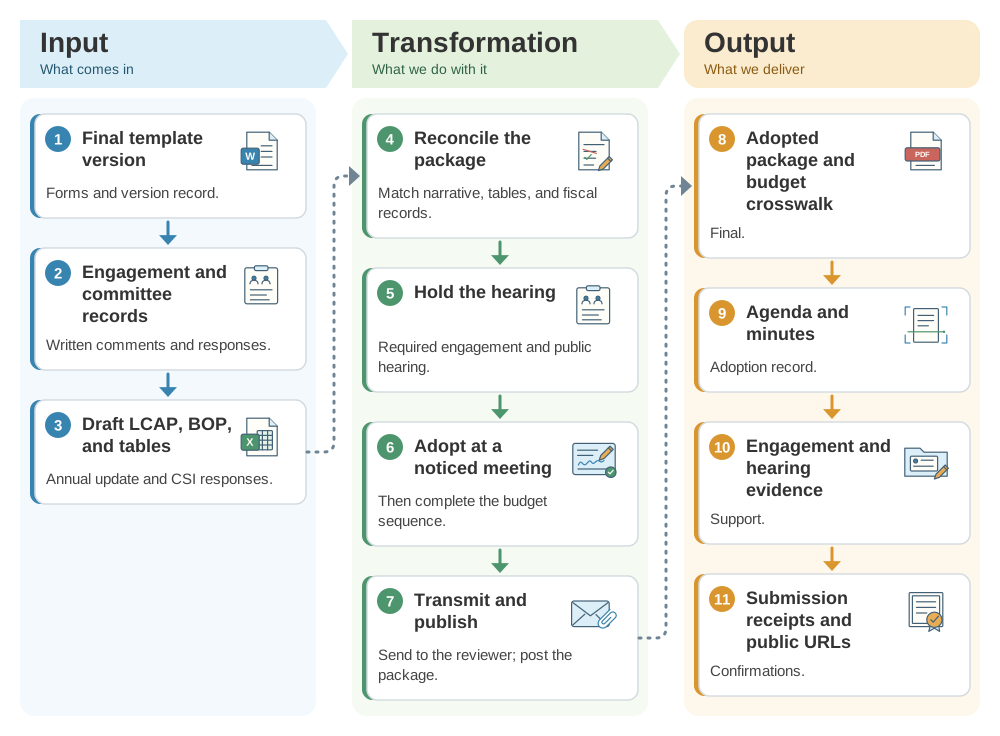
Recommended LEA workflow
- Confirm entity, cycle and final adopted forms; preserve a version/date record.
- Complete required engagement, committee review/responses, written comments, hearing and fiscal reconciliation.
- Assemble the LCAP, BOP, required action tables, annual update and applicable CSI responses.
- Adopt at the correctly noticed public meeting on or before July 1 and complete the entity-specific budget sequence.
- Transmit to the responsible reviewer/recipient, publish the public package and retain all receipts and approvals.
Evidence to retain
- Final template version
- Engagement and hearing evidence
- Adopted package and budget crosswalk
- Agenda and minutes
- Submission receipts and public URLs
Related calendar resources
- Adopt and Attach the 2027–28 Budget Overview for Parents
- Hold the 2027–28 LCAP Public Hearing
- Adopt and Submit the 2027–28 Budget: LEA Pathways
Official guidance and help
- CDE LCAP adopted templates and public posting
- CDE LCFF annual adoption and entity FAQs
- CDE annual LCAP/BOP assembly and recipient guidance
- SBE September 2026 revision-draft agenda
Return to the Annual Compliance Calendar
Reviewed October 21, 2026. Confirm the current agency instructions, applicable funding year, recipient scope, local policy and final submitted or approved state before acting. Recommended preparation steps support the named requirement and do not create an additional statewide filing deadline.