



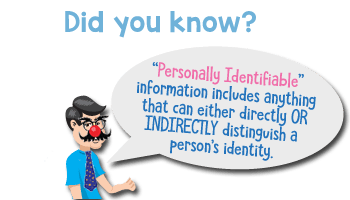
Think beyond individual data fields
A single detail may appear harmless on its own. When combined with other information—such as a grade level, school, birth date, activity, or demographic characteristic—it may identify an individual student with reasonable certainty.
PII under FERPA includes, but is not limited to:
Names
The student’s name, as well as the names of the student’s parents or other family members.
Addresses
The address of the student or the student’s family, including information that could identify where they live.
Personal identifiers
Identifiers such as a Social Security number, student number, account identifier, or biometric record.
Indirect identifiers
Details such as date of birth, place of birth, or a parent’s family name, along with other characteristics that may help distinguish one student from another.
Linked or linkable information
Information that, alone or in combination, would allow a reasonable person in the school community—without personal knowledge of the circumstances—to identify the student with reasonable certainty.
Identity-revealing requests
Information requested by someone whom the school or educational agency reasonably believes already knows the identity of the student connected to the education record.
The combination matters
PII is contextual. A dataset does not necessarily become anonymous simply because names and student numbers have been removed. Schools must also consider whether the remaining information could be combined with other reasonably available information to identify a student.
How FERPA protects this information
FERPA applies to educational agencies and institutions that receive funds under programs administered by the U.S. Department of Education. It generally requires consent before personally identifiable information from education records is disclosed, although the law contains specific exceptions. Parents—and eligible students after the rights transfer—also have rights to inspect education records and request correction of records they believe are inaccurate or misleading.
Directory information still requires care
Certain information may be designated and disclosed as “directory information” only after the school follows FERPA’s notice and opt-out requirements. A directory-information designation does not mean that the information is risk-free or appropriate for every use.
A practical question for data teams
Before sharing or publishing student-level information, ask:
Could a reasonable person in our school community identify a student from this information, either by itself or when combined with other information that is reasonably available?
If the answer may be yes, treat the information as potentially identifiable and complete an appropriate privacy review before releasing it.