


Scratch Paper During State Assessments
Scratch paper is a non-embedded universal tool that schools provide locally during many CAASPP and ELPAC assessments. Students may use it to organize their thinking, record notes, work through calculations, or plan a response.
A tool available to students
Students may use approved blank paper to make notes, write computations, record temporary responses, or create their own graphic organizers while testing. Because scratch paper is non-embedded, it is supplied by the school rather than displayed inside the online testing system.
Basic guidelines
- Plain or lined paper may be used for English language arts/literacy and ELPAC assessments.
- Graph paper may be used for mathematics assessments and must be provided beginning in grade 6.
- A blank whiteboard and erasable marker may be used when permitted by the applicable assessment instructions.
- Students may create their own notes, diagrams, computations, and organizers during the assessment.
Preprinted instructional material is not allowed
Scratch paper must not contain preprinted instructions, formulas, prompts, graphic organizers, writing guides, multiplication tables, reference material, or other information that could guide a student’s response unless that specific resource is separately authorized for the student and assessment.
Approved paper types

Plain paper
Blank, unlined paper may be used as scratch paper on applicable CAASPP and ELPAC assessments. It is useful for notes, calculations, diagrams, and student-created organizers.

Lined writing paper
Blank lined paper may be used on applicable CAASPP and ELPAC assessments. The paper must not contain writing prompts, sentence starters, instructional labels, or other guidance.
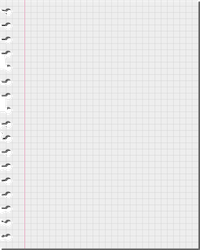
Graph paper
Graph paper may be used as a universal tool for mathematics in grades 3–5.
Beginning in grade 6, graph paper must be provided to students for mathematics assessments.
Universal tools and individual supports
Scratch paper is generally classified as a universal tool, meaning it is available without requiring an individualized education program (IEP) or Section 504 plan. Other paper-based resources may be designated supports or accommodations and should only be provided when authorized for the student and assessment.
Test administrators should consult the current California Assessment Accessibility Resources Matrix and the applicable test-administration manual whenever there is uncertainty about a resource.
Current accessibility guidance
Accessibility Resources Matrix
Review the current embedded and non-embedded universal tools, designated supports, and accommodations permitted for CAASPP and ELPAC assessments.
View the CDE matrixAccessibility questions
Find explanations of embedded and non-embedded resources, test settings, special-form assessments, and how supports are assigned.
Read the accessibility FAQ