



SDLA Compliance Resource
Apply the Year-End Special Education Referral Rollover Rule
An implementation guide for identifying referrals received during the final 30 days of a pupil’s regular school year, applying the correct 10-day and 30-day controls, preserving the case through summer, and completing the resulting IEP on time.
In Plain Language: A special education referral received near the end of a pupil’s regular school year does not disappear for summer. The LEA must determine how many calendar days before year-end the referral was received, apply the correct assessment-plan rule, keep the referral active through a documented handoff, and develop the IEP required by the assessment within 30 calendar days after the pupil’s subsequent regular school year begins.
Why this matters
These cases cross staff contracts, school calendars, system years, and summer access. A referral can be acknowledged in May or June yet lose its owner, assessment assignments, consent status, or meeting plan before school resumes. The year-end rule changes the calculation; it does not authorize the LEA to close the referral and begin again in the fall.
Joint ownership
Accountable owner: special education director or assessment administrator. Student-level owner: school psychologist, assessment coordinator, or assigned case manager. Referral intake: site administrator or designated intake staff. Calendar owner: timeline-tracking staff. Summer handoff: designated district or SELPA contact. Partners: evaluators, IEP team, records staff, and IEP-system staff.
From late-year referral to resulting IEP: the SDLA ITO workflow
A special education referral received near the end of the school year does not disappear for summer. This SDLA ITO (Input, Transformation, Output) graphic shows how the late-year referral, the pupil's school calendar, and assessment-plan and consent status become the dated calculation, the rollover tracker, the resulting IEP, and the exception log.
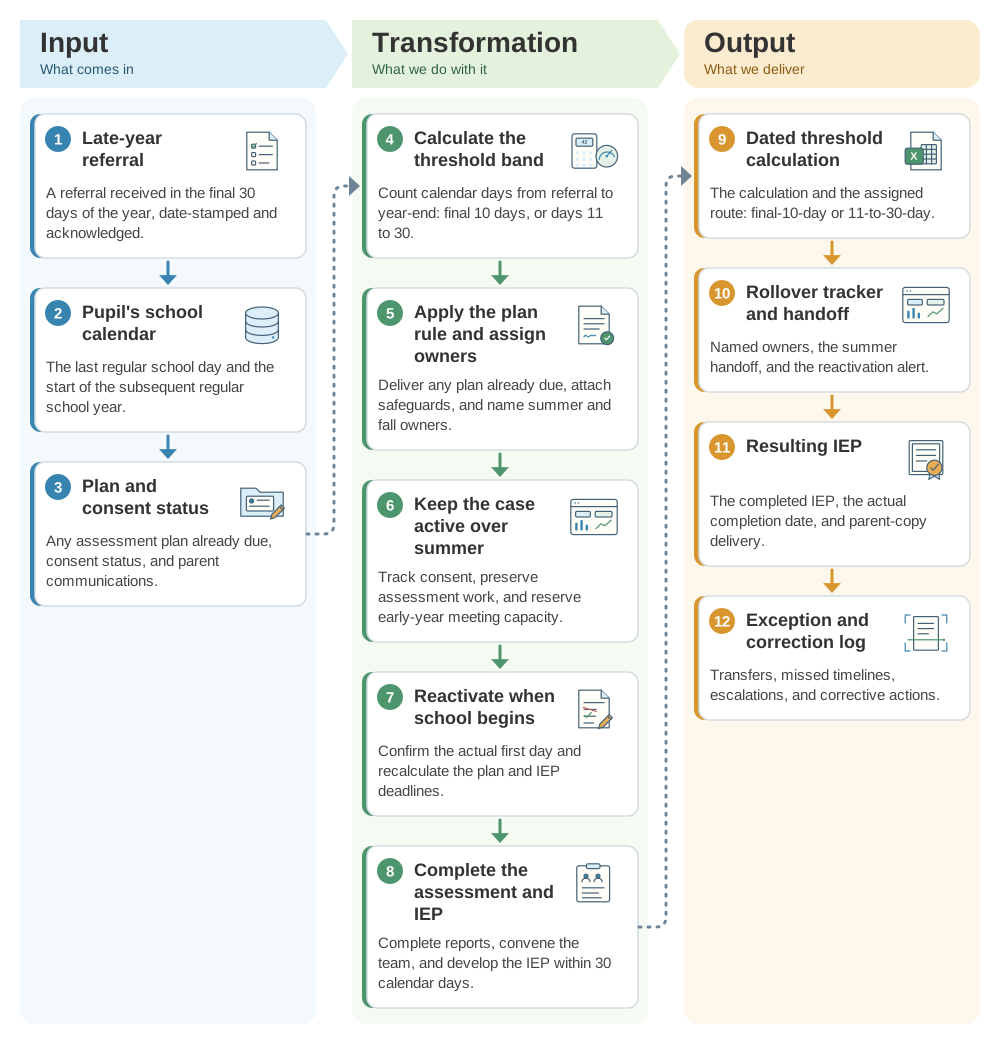
The year-end implementation calendar
- On receipt of every late-year referralDate-stamp, acknowledge, and preserve the actual referral date.Identify the pupil, referral source, reason, school calendar, last regular-school day, responsible intake staff, and any immediate language or accessibility need.
- Immediately after intakeCalculate the threshold band.Count the calendar days from the referral date to the end of the pupil’s regular school year and classify the case as a final-10-day referral or an 11-to-30-day referral.
- Before staff leave for summerApply the assessment-plan rule and assign the case.Deliver any assessment plan already due, attach procedural safeguards, name every required assessment discipline, establish consent tracking, and identify the summer and fall owners.
- During the summer handoffKeep the case visible and actionable.Maintain secure records, track consent and parent communications, preserve assessment work, document outstanding actions, and reserve early-year meeting capacity.
- When the subsequent regular school year beginsActivate the pupil-specific return clock.Confirm the actual first regular-school-year date, recalculate the assessment-plan and resulting-IEP deadlines, alert all owners, and resume or complete pending work immediately.
- Within 10 days after school begins · if applicableComplete the special assessment-plan control.For a referral made 10 days or fewer before the prior regular school year ended, develop and provide the assessment plan within 10 days after the subsequent regular school year begins.
- Within 30 days after school beginsDevelop the IEP required as a result of the assessment.Complete assessment reports, convene the team, address eligibility and educational need, develop the IEP when required, provide parent documents, and record actual completion.
- Immediately after completionReconcile the case and begin required services.Verify the IEP-system record, parent-copy delivery, staff access, service assignments, implementation dates, and closure of every outstanding timeline item.
Two year-end thresholds—not one generic summer deadline
Referral received 11–30 days before year-end
Assessment plan: Calculate and meet the ordinary 15-day assessment-plan requirement using the applicable statutory school-session and vacation exclusions. This referral does not qualify for the special final-10-day assessment-plan provision.
Resulting IEP: Develop the IEP required by the assessment within 30 calendar days after the pupil’s subsequent regular school year begins.
Referral received 0–10 days before year-end
Assessment plan: Develop the assessment plan within 10 days after the subsequent regular school year or the pupil’s regular term begins.
Resulting IEP: Develop the IEP required by the assessment within 30 calendar days after the pupil’s subsequent regular school year begins.
Key control: This case can be subject to both year-end provisions.
Do not confuse the referral date with parent consent
| Date | What it controls | Required evidence |
|---|---|---|
| Referral received | Determines whether the case falls in the final 10-day or 11-to-30-day year-end band. | Date-stamped referral, intake record, source, recipient, and pupil identity. |
| Assessment plan delivered | Shows whether the LEA met the applicable assessment-plan deadline and gave the parent the required proposal and safeguards. | Final plan, delivery method, actual delivery date, language used, and safeguards delivery. |
| Parent consent received | Authorizes the assessment to begin and ordinarily triggers the evaluation timeline calculations associated with written consent. | Signed consent, attributable receipt date, scope, and any documented questions or limitations. |
| Subsequent regular school year begins | Starts the pupil-specific post-return 10-day assessment-plan control when applicable and the 30-day resulting-IEP control. | Official pupil calendar, first regular-school-year date, and documented deadline calculation. |
| IEP developed | Shows completion of the required post-return outcome from the assessment. | IEP meeting and completion record, final documents, participants, parent delivery, and actual date. |
Two-threshold year-end decision pathway
Pupil-specific rollover tracker
Use a protected district system for pupil information. This field structure is a control model, not a public student-data collection form.
| Tracker field | Purpose | Quality control |
|---|---|---|
| Pupil and case identifier | Maintains one traceable case across intake, summer handoff, assessment, meeting, and system records. | Use an approved protected identifier and prevent duplicate rollover entries. |
| Referral received date | Establishes the year-end threshold trigger. | Match the date-stamped referral—not the later data-entry or assignment date. |
| Last regular-school day | Provides the endpoint for determining the threshold band. | Use the calendar assigned to the individual pupil. |
| Calculated days and route | Classifies the referral as final 10 days or days 11–30. | Retain the calculation and reviewer rather than storing only a manually selected label. |
| Assessment-plan due and delivered | Tracks the applicable proposal-and-safeguards control. | Store calculated and actual dates separately. |
| Consent status and receipt | Shows whether assessment is authorized and when evaluators may begin. | Distinguish sent, pending, returned incomplete, consented, declined, and disputed. |
| Assessment disciplines and owners | Assigns each required evaluation component. | Require a named evaluator, status, outstanding input, and escalation date. |
| Next regular-school-year start | Provides the pupil-specific post-return trigger. | Reconfirm before deadlines are activated if enrollment or calendar assignment changed. |
| Resulting IEP deadline | Tracks the 30-day post-return outcome. | Keep the calculated deadline visible to evaluators, meeting staff, and administrators. |
| Meeting and completion status | Tracks notice, scheduling, reports, IEP completion, parent documents, and implementation. | Do not mark complete merely because a meeting invitation was sent or a meeting was placed on a calendar. |
Before staff leave for summer
- Every referral is date-stamped, acknowledged, and entered in the protected intake system.
- The pupil’s last regular-school day and subsequent start date are documented.
- The final-10-day or 11-to-30-day route is calculated and reviewed.
- A responsible case owner and administrative escalation contact are assigned.
- Any assessment plan already due has been provided with procedural safeguards.
- Parent consent status, contact attempts, language needs, and pending questions are current.
- All required assessment disciplines have named evaluators and accessible records.
- Parent, teacher, provider, and outside-record inputs have been requested or secured.
- An early-year IEP meeting window and participant-notification plan are reserved.
- The summer handoff identifies completed work, pending work, deadlines, owners, and reactivation date.
- Secure access and privacy controls remain available to authorized summer and returning staff.
Route unusual or disrupted cases immediately
Pupil transfers to another LEA
Route: Notify the special education administrator, send records promptly under the applicable transfer process, and provide the receiving LEA the original referral and timeline history.
Preserve: Referral date, threshold calculation, plans, consent, assessments, parent contacts, completed actions, and outstanding responsibilities.
Pupil changes school or program calendar
Route: Send the case to the special education timeline owner or SELPA for a pupil-specific recalculation.
Preserve: Both calendar assignments, the reason for the change, the calculation used, responsible reviewer, and parent communications.
Referral is withdrawn, declined, or disputed
Route: Involve the special education administrator and follow SELPA procedures for consent, prior written notice, child-find responsibilities, and dispute resolution.
Do not: Delete or relabel the original referral as though it was never received.
Parent cannot be reached or consent remains pending
Route: Continue documented reasonable efforts using accessible and understandable communication methods and seek SELPA guidance when the case remains unresolved.
Preserve: Every contact attempt, method, language, response, returned communication, and next action.
Outside or independent evaluation is pending
Route: Determine with the special education administrator or SELPA how the outside information affects the assessment plan, team review, and statutory timeline.
Do not: Pause all district action merely because another report may arrive.
Multiple assessment disciplines are required
Route: Assign a lead evaluator and a named owner for each discipline; establish internal completion dates earlier than the resulting-IEP deadline.
Control: Reconcile reports, parent input, observations, records, and meeting materials before the scheduled IEP meeting.
Another independently fixed deadline applies
Route: Escalate immediately when the case involves a third birthday, court order, complaint remedy, transfer requirement, disciplinary timeline, or another controlling date.
Do not: assume the year-end rollover rule overrides a separate fixed obligation.
Reconcile the referral, assessment, and resulting IEP
| Control point | Authoritative evidence | Compare with | Corrective action |
|---|---|---|---|
| Referral receipt | Date-stamped referral: actual date received, source, recipient, and reason. | Intake log, email or paper receipt, case record, and IEP-system trigger. | Resolve inconsistent dates without back-dating; document the evidence and approved correction. |
| Pupil calendar and route | Official enrollment/calendar assignment: last and subsequent first regular-school dates. | Threshold calculation, route label, school assignment, and any calendar change. | Recalculate deadlines, notify owners, and preserve the prior calculation history. |
| Assessment plan and safeguards | Final delivered documents: content, language, and actual delivery evidence. | Calculated due date, system status, family communication, and consent tracker. | Deliver or correct the materials promptly and document any missed timeline and response. |
| Parent consent | Actual signed response: scope and attributable receipt date. | Evaluator activation, assessment assignments, extension record, and parent-contact log. | Correct status, activate appropriate work, and escalate unresolved consent questions under SELPA procedures. |
| Assessment completion | Completed multidisciplinary reports: all required disciplines and parent input. | Assessment plan, evaluator tracker, records reviewed, meeting packet, and missing components. | Assign or escalate outstanding work and protect the resulting-IEP deadline. |
| Resulting IEP | Final IEP and meeting record: eligibility, needs, program, participants, and completion date. | Thirty-day post-return deadline, parent-copy delivery, IEP system, service assignments, and implementation. | Complete missing action, correct inaccurate records, provide required documents, and verify services begin as required. |
Recommended LEA workflow
- Create a late-year referral report. Identify every referral received during the final 30 calendar days of each pupil’s regular school year.
- Calculate the correct route. Use actual referral and pupil-calendar dates to classify final-10-day and 11-to-30-day cases.
- Complete all work already due. Do not postpone an assessment plan, safeguards, parent communication, or evaluator assignment merely because the year is ending.
- Assign summer and return owners. Make responsibility explicit when the ordinary school-year case owner will be unavailable.
- Maintain a protected rollover tracker. Preserve dates, documents, consent, assessment status, meeting plans, and escalations in one reviewable source.
- Prepare the first-month workload. Reserve evaluator capacity, meeting dates, interpreters, records access, and administrative review before the subsequent year begins.
- Reactivate on the pupil’s first regular-school-year date. Confirm enrollment and calendar, issue owner alerts, apply the post-return deadlines, and resume pending work immediately.
- Complete and verify the resulting IEP. Finish the assessment and IEP action, provide parent documents, update systems, inform staff, and ensure services are made available as soon as possible after development.
Evidence to retain
- Date-stamped referral, source, reason, and intake acknowledgment.
- Pupil-specific last regular-school day and subsequent start date.
- Calendar-day threshold calculation and assigned route.
- Named case, assessment, summer-handoff, and administrative owners.
- Assessment plan, procedural safeguards, language-access actions, and delivery evidence.
- Parent-consent record, actual receipt date, and contact attempts.
- Assessment disciplines, evaluator assignments, records reviewed, and completion status.
- Written parent extension and revised date, when applicable.
- Summer handoff, reactivation alert, and early-year workload plan.
- Meeting notice, scheduling, interpretation, and participation evidence.
- Completed assessment reports and multidisciplinary reconciliation.
- Resulting IEP, actual completion date, and parent-copy delivery.
- Service-start and responsible-staff implementation evidence.
- Transfer, exception, escalation, missed-timeline, and corrective-action log.
Official guidance and help
- California Education Code section 56344Sixty-day assessment/IEP rule, year-end provision for referrals made 30 days or fewer before the end of the regular school year, and post-IEP service availability.
- California Education Code section 56321Assessment-plan timing, final-10-day year-end provision, procedural-safeguards attachment, plan contents, consent, and reasonable-efforts documentation.
- California Education Code section 56043California’s consolidated summary of primary special education timelines.
- 34 CFR section 300.301(c)Federal initial-evaluation timeframe and required evaluation purposes.
Implementation questions: Follow current SELPA procedures for deadline calculations, consent disputes, written extensions, transfers, fixed-date conflicts, and corrective action.
Source review completed August 28, 2026. Verify current statutes, federal regulations, pupil calendars, SELPA procedures, forms, and local timeline-calculation rules before acting.