



SDLA Compliance Resource
Complete the Initial Assessment and Resulting IEP Meeting
A practical guide to the LEA’s obligations, the parent’s rights and choices, and the coordinated assessment, eligibility, and IEP actions required after written consent.
In Plain Language: An initial evaluation answers two connected questions: does the pupil meet the criteria for a disability, and does the pupil need special education and related services? The LEA must propose and conduct a sufficiently comprehensive assessment after informed parental consent. The parent participates in the eligibility decision. If the pupil is eligible, the team develops an IEP; special education services cannot begin without the required consent for initial services.
Why this matters
This process connects child find to an actual educational response. An assessment can be timely yet inadequate if it omits a suspected area, relies on one score, overlooks parent information, or never produces a team eligibility decision and usable IEP. The purpose is not testing—it is an accurate decision about disability, educational need, and an appropriate program.
Joint ownership
Accountable owner: special education director or assessment administrator. Case owner: school psychologist or assessment coordinator. Discipline owners: qualified evaluators. Meeting owner: IEP case manager. Partners: parent, general and special educators, related-service staff, interpreter, records staff, IEP-system staff, CALPADS staff, and SELPA support.
The LEA and parent have different legal roles
| Evaluation issue | LEA or school district | Parent or guardian |
|---|---|---|
| Requesting an initial evaluation | May initiate a request and must respond appropriately to referrals from authorized sources. | May initiate a request for an initial evaluation. |
| Proposed assessment plan | Generally must provide a written plan within 15 days after referral, with procedural safeguards and the proposed assessment areas. | Has at least 15 days after receiving the proposed plan to decide and may ask questions or seek changes before responding. |
| Initial assessment consent | Must make reasonable efforts to obtain informed consent and may not begin the individualized initial assessment without the required consent or lawful authorization. | May consent, decline, or seek clarification. Assessment consent is not consent for placement or initial services. |
| Information used | Must use multiple tools and strategies and assess every area related to suspected disability and educational need. | May provide evaluations, developmental history, observations, concerns, priorities, cultural and linguistic information, and other relevant evidence. |
| Eligibility determination | Provides qualified professionals and ensures all sources are documented and carefully considered. | Participates as a member of the group determining disability and educational need. The decision is not reserved to one evaluator. |
| Evaluation and eligibility documents | Must provide the evaluation report and eligibility documentation to the parent at no cost. | May review, question, disagree with, and use procedural safeguards regarding the evaluation and decision. |
| Initial IEP | Must develop an IEP when the team determines that the pupil has a disability and needs special education and related services. | Participates in developing the proposed goals, services, supports, placement, and other IEP components. |
| Initial services | Must seek informed consent before the initial provision of special education and related services and make approved services available as soon as possible after IEP development. | May consent to or refuse the initial provision of services. The LEA may not override a refusal of initial services through due process. |
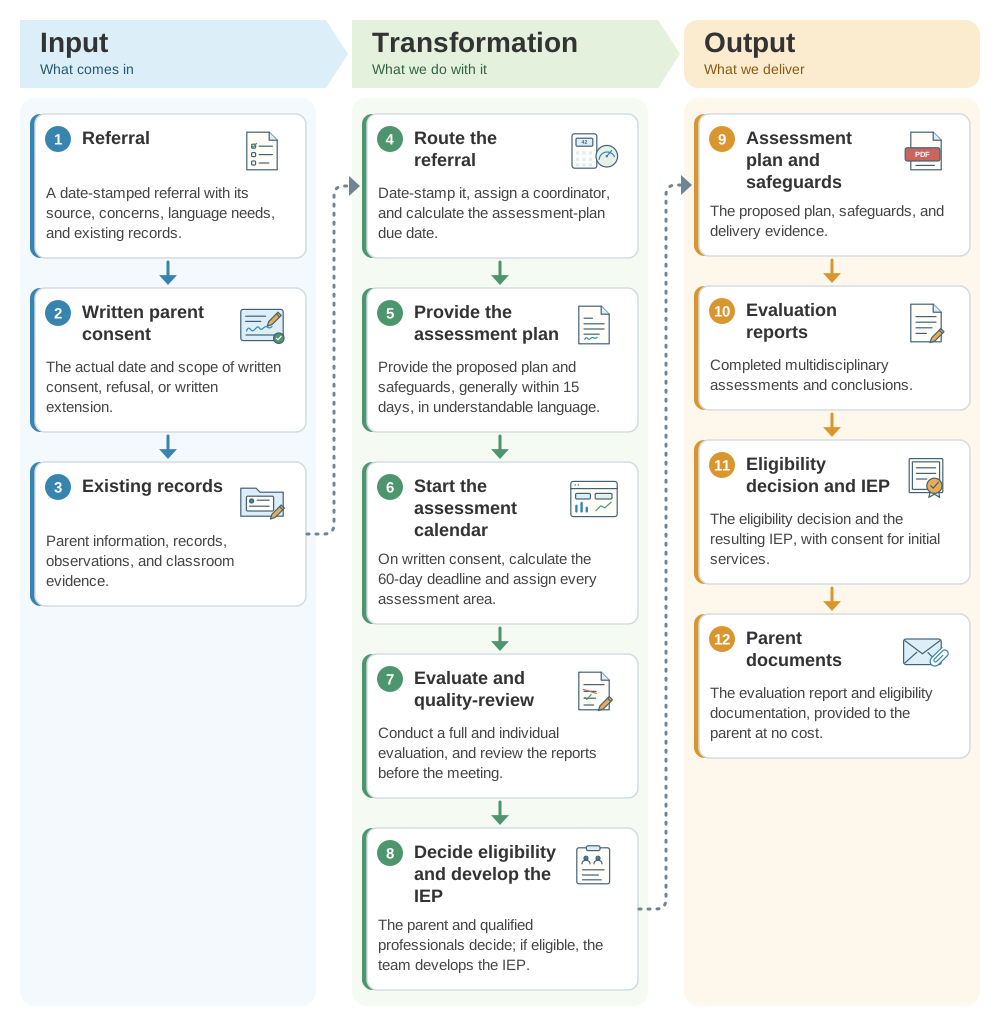
From referral to eligibility and IEP: the SDLA ITO workflow
An initial evaluation asks whether the pupil meets the criteria for a disability and whether the pupil needs special education and related services. This SDLA ITO (Input, Transformation, Output) graphic shows how the referral, the parent's written consent, and existing records become the assessment plan, evaluation reports, the eligibility decision and IEP, and the parent documents.
The referral-to-IEP calendar
- On receipt of the referralDate-stamp and route the request.Record the actual receipt date, source, concerns, pupil calendar, language and accessibility needs, existing records, assigned coordinator, and the assessment-plan due date.
- Generally within 15 days after referralProvide the proposed assessment plan and safeguards.Describe the types of assessment, use understandable language and the parent’s native language or mode of communication when required, and preserve delivery evidence.
- During the parent response periodSupport informed choice without predetermination.Answer questions, consider requested changes, document communications, and record the actual date and scope of written consent, refusal, or written extension.
- Day 0 · Written assessment consent receivedActivate the pupil-specific assessment calendar.Calculate the California 60-day deadline and every applicable exclusion or special rule; assign all assessment disciplines and internal completion targets.
- During the assessment windowConduct a full and individual evaluation.Gather parent information, records, observations, classroom evidence, and valid assessment data across every suspected area; coordinate the multidisciplinary conclusions.
- Before the meetingQuality-review reports and prepare participation.Confirm completeness, language access, required team members, understandable parent materials, meeting notice, eligibility criteria, determinant factors, and sufficient time for an informed team discussion.
- By the controlling deadlineDetermine eligibility and develop the resulting IEP.The parent and qualified professionals consider all information. If eligible and in need of services, the team develops the IEP; provide the report and eligibility documentation at no cost.
- As soon as possible after IEP developmentObtain initial-services consent and implement.Document the parent’s response, make consented services available, give staff access to responsibilities, update systems, and reconcile the completed process.
Two connected clocks
Referral → proposed assessment plan
General California rule: Provide the written proposed assessment plan within 15 days after the referral for assessment, applying the statutory school-session and vacation exclusions. Attach procedural safeguards.
Parent response: The parent has at least 15 days after receipt to arrive at a decision.
Written consent → assessment and resulting IEP
General California rule: Develop the IEP required as a result of the assessment within 60 days after receiving written assessment consent, applying the statutory school-session and vacation exclusions.
Written extension: A parent may agree in writing to an extension. Preserve the actual agreement and revised date.
Full and individual evaluation pathway
Assessment quality controls
- Use a variety of tools and strategies, including information supplied by the parent.
- Do not use a single measure or assessment as the sole criterion for eligibility or program decisions.
- Assess all areas related to suspected disability, not only the concern named in the original referral.
- Make the evaluation sufficiently comprehensive to identify all special education and related-service needs, whether or not commonly linked to a disability category.
- Select and administer assessments so they are not racially or culturally discriminatory.
- Use the pupil’s native language or other mode of communication and the form most likely to yield accurate information when required.
- Use valid and reliable measures for their intended purposes, administered by trained and knowledgeable personnel.
- Accommodate sensory, manual, communication, and other access needs so results measure the intended ability.
- Connect findings to educational need and the content of the resulting IEP.
Complete the whole process—not merely the testing
| Control point | Complete when | Not complete merely because |
|---|---|---|
| Assessment plan | The parent receives a complete, understandable plan and safeguards with delivery evidence. | A form was generated or uploaded. |
| Assessment consent | The LEA receives an attributable written response and confirms its scope. | The parent discussed assessment verbally or attended a meeting. |
| Multidisciplinary assessment | All suspected areas are evaluated and the combined information is sufficiently comprehensive. | Individual evaluators finished separate reports. |
| Eligibility | The parent and qualified professionals consider all sources and document disability and educational need. | An evaluator recommends an eligibility category. |
| Resulting IEP | When eligible, the team develops present levels, goals, services, supports, placement, and implementation responsive to the evaluation. | The eligibility field or meeting date is entered. |
| Initial services | The required informed consent is documented and approved services are made available as soon as possible. | The proposed IEP was offered or signed by LEA staff. |
| System reconciliation | Final reports, eligibility, IEP, consent, implementation, IEP system, and CALPADS records agree. | A MEET or PLAN record posted successfully. |
Neither party decides eligibility alone
Route exceptions immediately
Parent does not consent to the initial assessment
LEA options: Continue reasonable efforts and provide appropriate notice. The LEA may, but is not required to, pursue the initial assessment through applicable IDEA consent-override procedures.
Parent position: The parent may refuse assessment. Consent for an initial assessment cannot be inferred from silence alone.
Parent does not respond
LEA action: Document reasonable efforts through calls, correspondence, visits when appropriate, accessible communication, and other SELPA procedures. Seek administrative guidance before deciding whether to pursue assessment.
Control: The LEA does not violate the cited child-find and evaluation provisions if it declines to pursue the initial assessment under the applicable rule, but it must preserve the documented response to the referral.
Parent refuses initial special education services
Parent right: The parent may refuse consent for the initial provision of special education and related services even after agreeing to assessment and participating in IEP development.
LEA limit: The LEA may not use mediation or due process to override refusal of initial services. Provide prior written notice, preserve the proposed offer, and follow current SELPA procedures.
Referral or consent occurs near the end of the school year
Route: Apply the pupil-specific California year-end assessment-plan and resulting-IEP rules rather than a generic 60-day calculation.
Related guide: Use the completed year-end referral rollover solution to distinguish final-10-day and final-30-day requirements and preserve the summer handoff.
Pupil transfers during the evaluation
Route: Coordinate assessments promptly with the prior or subsequent LEA, transfer records and completed work, make sufficient progress toward prompt completion, and establish the specific completion date required under the applicable transfer exception.
Control: Do not restart or abandon the assessment merely because enrollment changed.
Parent repeatedly fails or refuses to produce the pupil for evaluation
Route: Document each assessment appointment, alternative offered, communication, response, access barrier, and reasonable effort. Escalate to the special education administrator and SELPA.
Control: Apply the federal timeline exception only to supported pupil-specific facts; do not label ordinary district scheduling difficulty as parent nonproduction.
Reconcile referral, assessment, eligibility, and implementation
| Record | Authoritative evidence | Compare with | Corrective action |
|---|---|---|---|
| Referral and plan | Date-stamped referral and delivered plan: concerns, actual dates, scope, language, safeguards, and delivery. | Intake log, IEP system, parent communication, and evaluator assignment. | Correct unsupported dates or missing scope and preserve actual evidence without back-dating. |
| Consent and deadline | Written assessment consent: attributable receipt date and scope. | Sixty-day calculation, exclusions, written extension, pupil calendar, and meeting date. | Recalculate promptly, alert owners, and document the controlling rule. |
| Assessment | Final multidisciplinary record: all suspected areas, parent input, observations, tools, findings, and educational needs. | Assessment plan, discipline tracker, eligibility criteria, and IEP present levels. | Complete missing assessment or reconcile conflicting information before the decision. |
| Eligibility and IEP | Team documentation: group decision, report, eligibility, educational need, and resulting program. | Parent copies, IEP system, meeting record, CALPADS outcome, PLAN, and SERV records. | Correct inconsistent records and complete omitted team or parent-delivery action. |
| Initial services | Initial-services consent and implementation: parent response, approved offer, staff responsibilities, and actual start. | Proposed IEP, service schedules, providers, parent notice, pupil program, and CALPADS. | Do not implement unconsented initial services; activate consented services as soon as possible. |
Evidence to retain
- Date-stamped referral, source, concerns, acknowledgment, and pupil calendar.
- Proposed assessment plan, safeguards, language access, and delivery evidence.
- Parent questions, proposed changes, written response, and consent scope.
- Sixty-day calculation, exclusions, year-end rule, or written parent extension.
- Parent input, existing records, observations, classroom evidence, and assessment data.
- Qualified evaluator assignments and completed multidisciplinary reports.
- Eligibility criteria, determinant-factor review, team participation, and final decision.
- Evaluation report and eligibility documentation provided to the parent.
- Meeting notice, interpretation, participation, and resulting IEP.
- Initial-services consent, refusal, prior written notice, and implementation evidence.
- IEP-system, CALPADS MEET/outcome, PLAN/SERV, provider, and service-start reconciliation.
- Transfer, parent nonresponse, refusal, pupil availability, delay, and escalation records.
Official guidance and help
- California Education Code section 56321Assessment-plan timing, content, language, safeguards, parent response period, consent, reasonable efforts, and year-end rule.
- California Education Code section 56344Sixty-day resulting-IEP requirement, school-break and year-end provisions, initial IEP, and service availability.
- 34 CFR section 300.301Full and individual initial evaluation, who may request it, 60-day federal framework, purpose, and transfer and parent-availability exceptions.
- 34 CFR section 300.304Evaluation notice, multiple tools and strategies, nondiscrimination, language, validity, qualified personnel, all suspected areas, and comprehensive educational-need assessment.
- 34 CFR section 300.306Group eligibility determination, parent copies, multiple sources, determinant factors, and development of an IEP when eligible.
- 34 CFR section 300.300Informed consent for initial evaluation and initial services, refusal, reasonable efforts, and limitations on consent override.
Implementation questions: Follow current SELPA procedures for referral response, assessment planning, consent, timeline calculations, written extensions, eligibility criteria, parent refusal, transfers, year-end cases, and initial-services implementation.
Source review completed August 28, 2026. Verify current federal and California requirements, pupil calendars, SELPA procedures, assessment forms, IEP-system rules, CALPADS guidance, and case-specific facts before acting.