


SDLA Compliance Resource
Conduct Child Find and Timely, Meaningful Private-School Consultation
An operational guide for locating and evaluating parentally placed private-school children with suspected disabilities, consulting before decisions are fixed, and documenting equitable services throughout the year.
In Plain Language: The LEA in which a private school is located must actively locate, identify, and evaluate children with suspected disabilities who are enrolled there by their parents—including eligible home-school students—whether or not the children live in that LEA. The LEA must also consult private-school representatives and representatives of parents early enough for their views to influence the child-find and equitable-services program, then continue that consultation during implementation. This is not satisfied by a once-a-year invitation, a signed form without substantive discussion, or a private-school list that is never reconciled.
Why this matters
Children do not lose access to IDEA child find because their parents chose private education. A weak process can leave referrals unrecognized, evaluations delayed, families sent to the wrong LEA, eligible children omitted from the annual count, and services designed before required participants are heard.
Joint ownership
Accountable owner: the LEA where the private school is located. Program partners: SELPA, special education fiscal staff, assessment teams, service providers, records/privacy staff, private-school officials, and representatives of parents of parentally placed private-school children with disabilities. Coordination partner: the child’s LEA of residence when residence-based FAPE or record exchange is implicated.
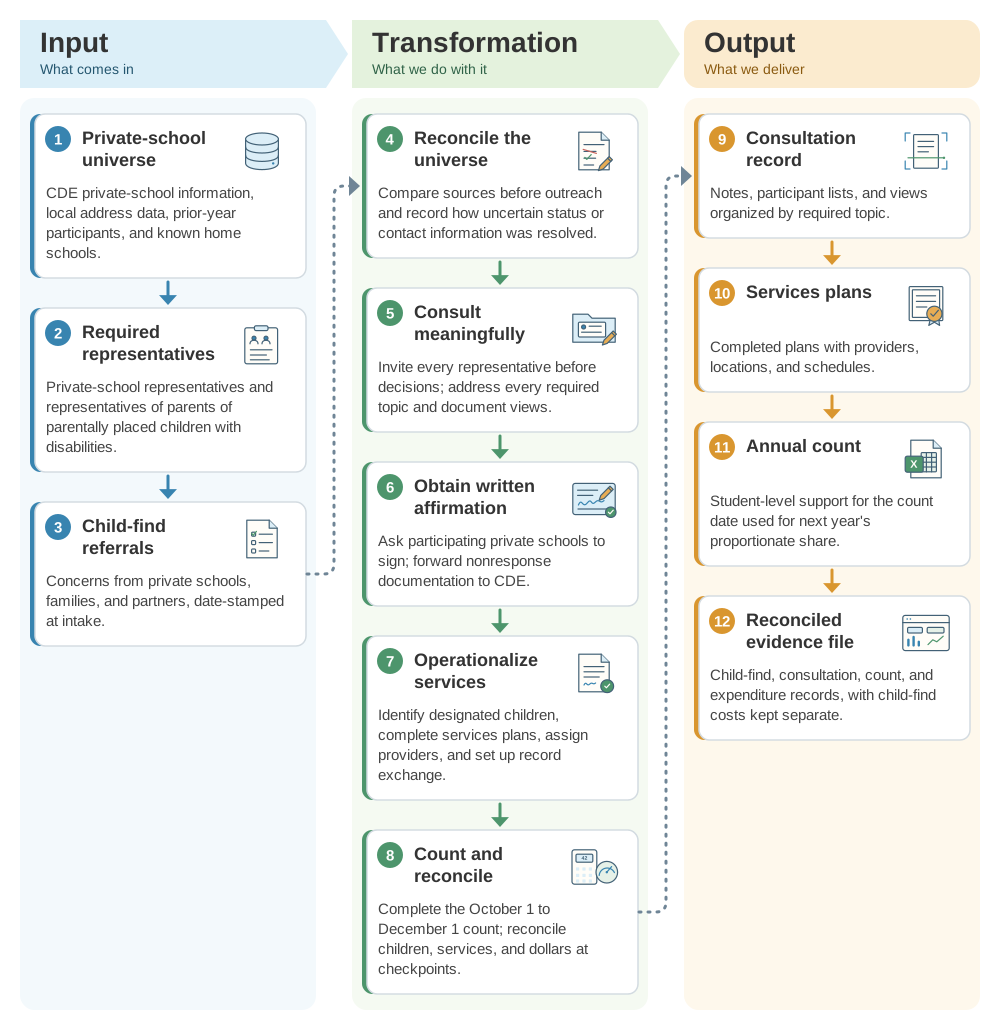
From the private-school universe to a reconciled evidence file: the SDLA ITO workflow
Child find and consultation run all year; the annual count supports the next year's calculation but is not a cutoff for child find. This SDLA ITO (Input, Transformation, Output) graphic shows how the private-school and home-school universe, required representatives, and referrals become the consultation record, services plans, the annual count, and the reconciled evidence file.
Start with the correct student and agency pathway
| Situation | Primary IDEA pathway | Operational treatment |
|---|---|---|
| Parent enrolls the child in a qualifying private elementary or secondary school | Parentally placed private-school child | The LEA where the private school is located conducts child find and consultation. If the child is designated to receive equitable services, that LEA develops and implements a services plan. |
| Public agency places or refers the child to a private school to provide special education | Public placement and FAPE | Do not process the child as parentally placed for equitable-services purposes. The responsible public agency remains accountable for FAPE and the IEP. |
| Parentally placed child attends a private school in another LEA | Location-LEA child find; residence-LEA FAPE responsibilities may also arise | Route the child-find request promptly to the LEA where the private school is located, coordinate without making the family carry records between agencies, and separately clarify any residence-LEA FAPE process. |
| Child is home-schooled in California | Treated as parentally placed in a private school for these IDEA provisions | Include home schools in the location LEA’s outreach, child-find, consultation, count, and equitable-services analysis. |
| Child age three through five attends private preschool | Depends on whether the school meets the IDEA elementary-school definition | CDE states that in California the provisions appear to apply when the private school offers preschool and TK or a higher grade, but not to a stand-alone private preschool. Confirm the program facts before routing. |
What meaningful consultation must address
| Required topic | Questions to resolve together | Evidence to retain |
|---|---|---|
| Child find | How will children suspected of disability be identified, referred, evaluated, and told about available pathways? How will parents, private-school staff, and home schools receive information? | Outreach plan, materials, distribution lists, referral instructions, response records, evaluation tracking, and annual child count. |
| Proportionate share | How was the amount calculated using the eligible population and IDEA section 611 and, when applicable, section 619 funds? What carryover remains? | Source counts, calculation worksheets, grant amounts, fiscal reconciliation, carryover schedule, and explanation shared during consultation. |
| Consultation throughout the year | Who will meet, how often, how will new referrals or changed needs be raised, and how will participants receive decisions and implementation data? | Annual schedule, named contacts, agendas, minutes, decision log, follow-up communications, and progress reviews. |
| Services and delivery | What services will be provided; how, where, and by whom; whether direct or alternate delivery will be used; how limited funds will be apportioned; and when decisions will be made? | Options considered, needs and location data, participant views, selection criteria, written decisions, contracts, and service-delivery plan. |
| LEA disagreement | If the LEA does not adopt a private-school official’s preferred service or delivery method, why? | The LEA’s written explanation of the reasons for its decision, including why it did not provide services directly or through a contract when that issue is disputed. |
The annual operating cycle
- Before annual outreachReconcile the private-school universe.Compare CDE private-school information, local address data, prior-year participants, newly opened or closed schools, schools spanning multiple sites, and known home schools. Record how uncertain status or contact information was resolved.
- Before program design and budget decisionsInvite all required representatives.Contact private-school representatives and representatives of parents of parentally placed private-school children with disabilities. Provide accessible background information, proposed topics, data, and enough time to prepare and participate.
- During design and developmentConduct substantive consultation.Address every required topic, surface student needs and geographic constraints, document options and participant views, identify follow-up work, and schedule continuing consultation.
- After meaningful consultationObtain written affirmation.Ask representatives of participating private schools to sign an affirmation that consultation occurred. If a representative does not provide it within a reasonable period, forward documentation of the consultation or attempted consultation to CDE under the applicable procedure.
- Before services beginIssue and operationalize decisions.Identify children designated to receive services, complete services plans, assign providers and locations, establish privacy-safe record exchange, and align contracts, schedules, transportation, materials, and progress reporting.
- October 1–December 1 count windowComplete the annual count.Choose and document one date within the federal window; count parentally placed private-school children with disabilities attending qualifying private schools located in the LEA; preserve the student-level support for the count used to calculate the next fiscal year’s proportionate share.
- Throughout the yearKeep child find and consultation active.Receive and triage referrals, meet evaluation timelines, update the decision log, monitor services and expenditures, consult about emerging issues, and communicate material program changes before implementation when feasible.
- At fiscal checkpoints and year endReconcile children, services, and dollars.Compare designated children, services plans, provider evidence, expenditures, remaining proportionate share, and any one-year carryover. Do not count child-find costs as proportionate-share services expenditures.
Minimum child-find operating controls
- Public awareness: maintain understandable referral information for private-school officials, staff, families, parent representatives, community partners, and home schools.
- Comparable process: use child-find activities comparable to those used for children in public schools and complete the process in a comparable time period.
- Immediate intake: date-stamp each concern, identify the private-school location and residence LEA, provide procedural information, assign an owner, and track every handoff.
- Evaluation control: obtain required consent, use qualified assessors, consider all suspected areas, provide language and disability access, and monitor applicable federal and California timelines.
- Privacy control: disclose personally identifiable information between the location LEA, residence LEA, private school, and providers only with the authority and parental consent required by IDEA and student-record law.
- Count integrity: reconcile the annual count to eligibility records and school location, not merely to children receiving services. CDE states that eligible children are included even if they do not receive an IEP or services plan.
- Fiscal separation: account for child-find costs separately; those costs cannot be used to satisfy the proportionate-share expenditure requirement.
Decision routes
A referral arrives after the annual consultation or count
Action: Begin child-find intake immediately; do not wait for the next annual meeting or count. Determine the correct location-LEA pathway, obtain consent as applicable, and add the issue to continuing consultation and fiscal/service planning.
Control: The annual count supports the next fiscal year’s calculation; it is not a cutoff for child find.
The child lives in this LEA but attends private school in another LEA
Action: Help the family reach the LEA where the private school is located for parentally placed child find and equitable services. Separately address the residence LEA’s FAPE responsibilities and coordinate consent-based record exchange.
Control: Do not close the inquiry with only “not our student,” and do not promise that both agencies will provide duplicate evaluations or services.
The child attends a home school
Action: Treat a California home school as a private elementary or secondary school for these IDEA provisions, determine its location, provide referral access, and include eligible children in the appropriate consultation and count processes.
Control: Filing a Private School Affidavit is not CDE approval or verification of the school; resolve the relevant facts without using the affidavit as a disability-eligibility screen.
The child attends a private preschool
Action: Determine whether the private school offers TK or a higher grade in addition to preschool and document the program structure. Coordinate the child’s FAPE pathway and the location LEA’s equitable-services analysis.
Control: Do not treat every private preschool identically. Use current CDE guidance and consult counsel or the SELPA when the school’s status is unclear.
A private-school representative declines or does not respond
Action: Preserve dated invitations, delivery evidence, follow-up attempts, offered formats, materials, and responses. Continue child find. If affirmation is not returned within a reasonable period after consultation or documented attempts, forward the required documentation to CDE.
Control: Nonresponse does not erase the LEA’s child-find duty or justify inventing a signature, meeting, waiver, or participation decision.
The parties disagree about the services program
Action: Record the private-school and parent-representative views, the information considered, and the LEA decision. Provide the required written explanation when the LEA disagrees with private-school officials about services or service delivery.
Control: Inform private-school officials that they may submit a complaint to the CDE if they believe the LEA did not engage in timely and meaningful consultation or did not give due consideration to their views.
The LEA has no identified participating private schools or children
Action: Preserve the reconciled school universe, outreach, responses, child-find publicity, referral access, consultation attempts, and count methodology. Recheck during the year for new schools, home schools, and referrals.
Control: A zero result is a documented outcome, not a reason to skip outreach and child find.
Whole-process evidence file
- Current private-school and home-school outreach universe, source dates, reconciliation notes, and responsible staff.
- Accessible notices, referral materials, invitations, agendas, participant lists, delivery evidence, and follow-up attempts.
- Consultation notes organized by every required IDEA topic, including parent-representative participation and views.
- Annual child count date and student-level reconciliation to eligibility, age, private-school location, and school type.
- Separate section 611 and section 619 proportionate-share calculations, grant-source evidence, and carryover.
- Written affirmations, nonresponse documentation forwarded to CDE, and written explanations of disputed decisions.
- Referral and evaluation tracker with consent, assessment, eligibility, notices, timelines, and cross-LEA coordination.
- Selection criteria and roster of children designated for services, completed services plans, progress information, and reevaluation records.
- Provider assignments, contracts, schedules, service logs, invoices, expenditures, and evidence that public control of funds and services was maintained.
- Continuing-consultation calendar, meeting records, issue log, program changes, complaints, corrective actions, and year-end reconciliation.
Official resources
- California Department of Education: Equitable Services for Students with Disabilities
- Electronic Code of Federal Regulations: 34 CFR §§ 300.130–300.144
- U.S. Department of Education: Students with Disabilities in Private Schools
- U.S. Department of Education: Questions and Answers on Serving Children Placed by Their Parents in Private Schools
- California Department of Education: Private School Data
- California Department of Education: IDEA Proportionate Share Calculation Worksheet
- California Department of Education: Summary of Procedural Safeguards and Parental Rights
Local implementation questions
- Who owns the authoritative private-school universe, and how are home schools and multi-site schools added during the year?
- How can a parent or private-school staff member make a referral without knowing which LEA owns the process?
- Who represents parents in consultation, and how is participation made accessible rather than merely offered?
- What review gate prevents budgets, vendors, and service models from being finalized before consultation?
- How are annual-count records reconciled to eligibility and location without confusing “eligible” with “served”?
- Where are child-find costs separated from equitable-services expenditures?
- What triggers reconvened consultation when referrals, needs, funds, locations, providers, or delivery conditions change?
Source review completed August 29, 2026. Verify current IDEA regulations, CDE guidance, SELPA policy, fiscal allocations, private-school status and location, residence-LEA responsibilities, evaluation timelines, consent and student-record requirements, complaint procedures, and child-specific facts before acting. This operational resource does not replace legal advice.