



SDLA Compliance Resource
Close and Report the 2023–24 AMS Allocation
Reconcile the 2023–24 allocation separately and report its unexpended balance after the three-fiscal-year availability period.
In Plain Language: Reconcile the 2023–24 allocation separately and report its unexpended balance after the three-fiscal-year availability period.
Why this matters
Keep the allocation, reporting cycle, responsible entity and receiving system explicit. A county planning date, a historical portal window and a statutory deadline are different kinds of evidence.
Ownership and recipient
Responsible owner: Business services with AMS program and schoolsite owners. Recipient: CDE through its applicable AMS reporting process.
Requirement, applicability and cycle controls
- Allocation: 2023–24. Availability: 2023–24, 2024–25 and 2025–26; spending ends June 30, 2026. Do not confuse the annual report with the allocation-specific final report.
- The report addresses unexpended funds and supports reversion/reallocation. CDE may withhold a new allocation until the required report is submitted.
- AB 2440, Chapter 606, 2026, is a regular statute effective January 1, 2027. It moves this closeout provision from EC 8820(f) to (g) while retaining October 1. It separately establishes a September 30 annual board/body-approved report deadline; that is a different report.
- If a charter school ceases operation, the statute provides a separate 60-day closure report rule. Confirm applicable closure instructions.
From the 2023–24 AMS ledger to a reported unexpended balance: the SDLA ITO workflow
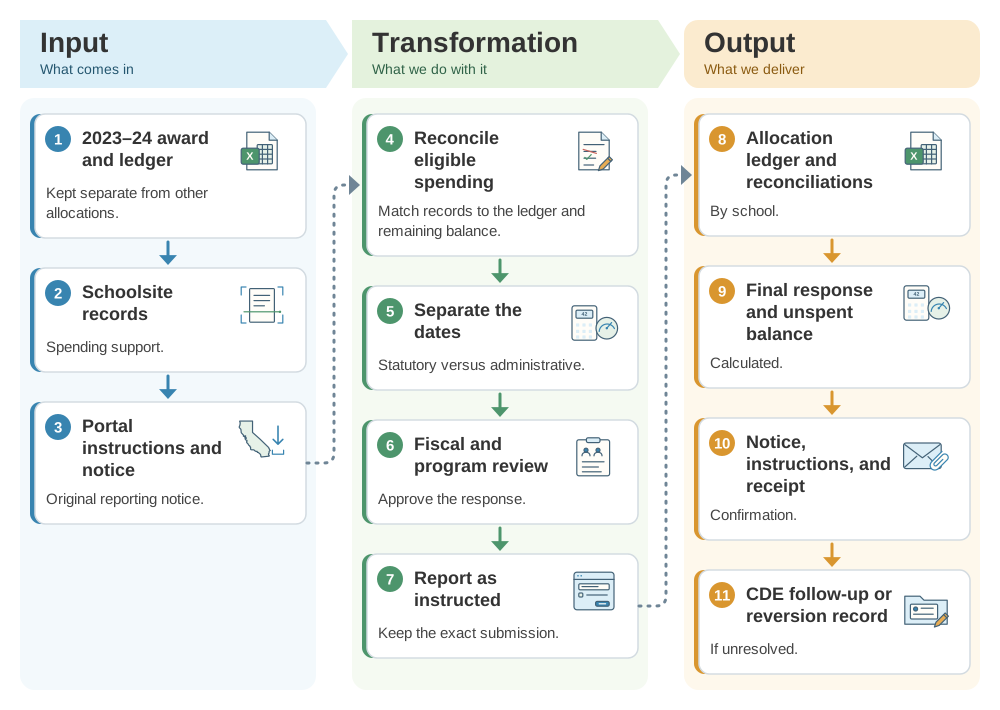
The allocation is reconciled separately, and statutory and administrative dates are kept distinct. This SDLA ITO (Input, Transformation, Output) graphic shows how the 2023–24 award, a separate allocation ledger, and schoolsite records become the final expenditure response, the unspent-balance calculation, and the CDE follow-up record.
Operational workflow
- Identify the 2023–24 award and maintain a separate allocation ledger.
- Reconcile eligible spending through June 30, 2026 and the remaining balance to schoolsite records.
- Retrieve the applicable CDE portal instructions and any original reporting notice; distinguish statutory and administrative dates.
- Obtain fiscal/program review, report through the instructed process, and retain the exact submission.
- If unresolved after closeout, contact the responsible CDE program office for instructions rather than inventing an extension.
Evidence to retain
- Allocation ledger and schoolsite reconciliations
- Final expenditure response and unspent-balance calculation
- Issuing notice, portal instructions and receipt
- CDE follow-up/reversion record
Sources and authority
- CDE AMS: allocation-specific final expenditure reporting
- Final AB 2440: retained October 1 closeout and separate annual report rule
Authority and source-version guide · Annual Compliance Calendar
Targeted source/conflict review: October 21, 2026. Pending items above are unresolved verification questions, not confirmed statewide deadlines. Local preparation steps do not create new statewide filings.