

SDLA Compliance Resource
Present the LCAP and Budget Overview for Parents Midyear Update
An operational guide to the midyear implementation step in the 2026–27 LCAP accountability cycle.
State requirement · 2027 timing change
AB 2496, Chapter 615, Statutes of 2026, sections 5–7, retains an annual LCAP and Budget Overview for Parents report as a nonconsent item at a regularly scheduled meeting. Effective January 1, 2027, it removes the February 28 deadline. Set the meeting locally within the annual planning process; a February meeting may remain a local target, but is no longer the statewide statutory deadline.
The report must include all available midyear outcome data for current LCAP metrics and all available midyear expenditure and implementation data for every current LCAP action. Retain the agenda showing nonconsent placement, presentation, minutes and supporting evidence.
The Riverside County Office of Education planning document is a secondary reference. Its publisher does not make this a county-only duty. The chaptered law controls where an older FAQ or planning calendar still gives February 28.
| Responsible actor | Recipient | State authority |
|---|---|---|
| District superintendent | District governing board | EC 52062(a)(6) |
| County superintendent, for the COE’s own LCAP | County board of education | EC 52068(a)(6) |
| Charter school | Charter governing body | EC 47606.5(e) |
In Plain Language: As a nonconsent item at a regularly scheduled governing-body meeting, present the required midyear report on LCAP annual-update metrics, expenditures, and implementation progress, together with the Budget Overview for Parents midyear information.
Why this matters
This is where the LEA demonstrates that it is living the plan. A narrative progress report without reconciled metrics and expenditures cannot reveal delayed actions, underspending, or emerging student needs.
Primary ownership
Primary owner: superintendent/LCAP lead with business services. Partners: action owners, data and assessment leads, school leaders, advisory groups, board office, communications, and student/family engagement staff.
From midyear evidence to a public LCAP midyear presentation: the SDLA ITO workflow
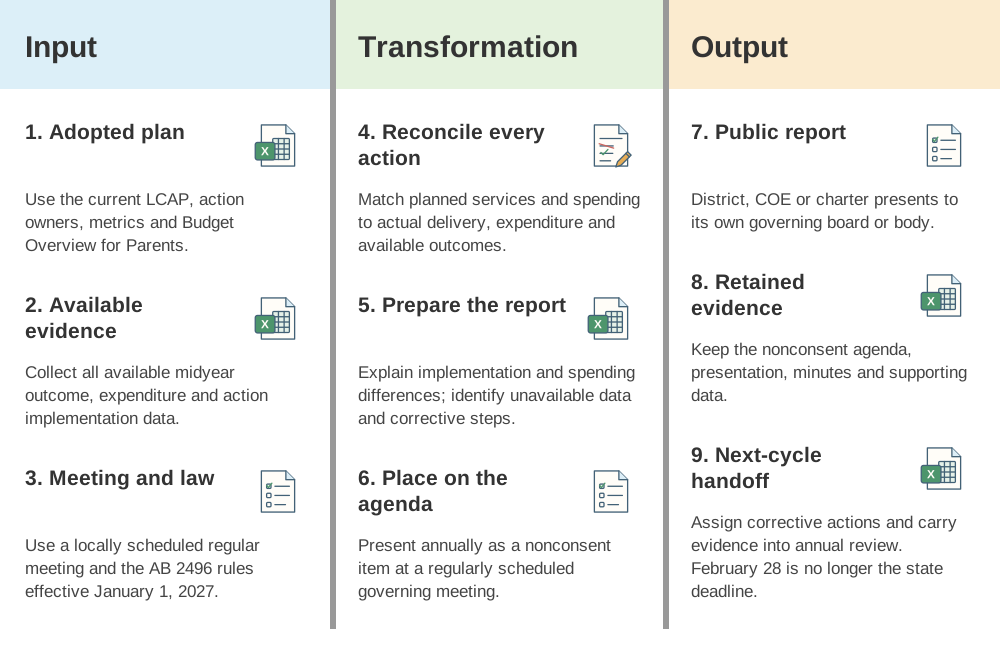
The governing body hears a plain-language midyear report that reconciles each action to what actually happened. This SDLA ITO (Input, Transformation, Output) graphic shows how the midyear cutoff, action-level implementation evidence, metric extracts, and budget-to-actual data become the action-level status record, the public presentation record, and the corrective-action handoff.
Operational workflow
- Establish a midyear cutoff and collect implementation, metric, and expenditure evidence.
- Reconcile each LCAP action to actual status, beneficiaries, spending, and available outcome data.
- Prepare the required midyear presentation and Budget Overview information in plain language.
- Present annually as a nonconsent item at a regularly scheduled meeting and retain the public presentation record.
- Assign corrective actions and carry evidence into annual update and next-cycle development.
Implementation pathway
Evidence to retain
- Action-level implementation status
- Metric extracts and validation notes
- Budget-to-actual reconciliation
- Public presentation, agenda, and minutes
- Corrective-action and next-cycle handoff
Official guidance and help
- CDE Local Control and Accountability PlanCurrent templates, instructions, and resources
- CDE LCFF Frequently Asked QuestionsState review and approval context
- Education Code section 52062District consultation, hearing, adoption, submission, and posting
- Education Code section 52070County review, clarification, recommendations, and approval
Targeted authority/source review: October 21, 2026. Checked AB 2496 sections 5–7, annual nonconsent reporting, entity-specific actors and the January 1, 2027 effective date. See the source-version register. Other source history is retained in the publication record.