



SDLA Compliance Resource
Consult All Statutorily Required Educational Partners During LCAP Development
An annual engagement system for bringing required voices, disaggregated evidence, proposed choices, and documented influence into the LCAP before the plan is finalized for advisory review and adoption.
In Plain Language: An LCAP cannot be written first and “engaged” afterward. During development, the LEA must give every statutorily required educational partner group a genuine opportunity to understand relevant evidence, examine needs and choices, and provide input while goals, actions, services, metrics, and expenditures can still change. Preserve who was invited, what they received, what they said, what the LEA learned, and how the information affected—or did not affect—the developing plan. A survey count, open microphone, bargaining meeting, committee signature, or polished narrative cannot substitute for the required process.
Why this matters
The LCAP links student outcomes, equity needs, programs, and public resources. Consultation improves that link only when educational partners receive understandable information early enough to question assumptions, identify barriers, compare options, and influence decisions. Weak engagement can hide unmet needs and create a Uniform Complaint Procedures vulnerability.
Joint ownership
Accountable owner: superintendent, county superintendent, or charter administrator. Process owner: LCAP/accountability lead. Evidence partners: fiscal, research/data, programs, special education, multilingual education, student services, and human resources. Access partners: family and student engagement, communications, language access, technology, transportation, and site staff.
Apply the correct entity-specific consultation list
| Entity or condition | Minimum development consultation | Additional control |
|---|---|---|
| School district | Teachers, principals, administrators, other school personnel, local bargaining units of the district, parents, and pupils. | Complete the separate PAC, applicable English learner parent advisory committee, student advisory, SELPA, written-comment, public-hearing, and governing-board processes required by current law. |
| County office of education | Teachers, principals, administrators, other school personnel, local bargaining units of the COE, parents, and pupils. | Apply the COE provisions in Education Code sections 52066, 52068, and 52069 rather than copying district governance language. |
| Charter school | Teachers, principals, administrators, other school personnel, parents, and pupils. | The general charter consultation list in section 47606.5 does not list local bargaining units. Other labor or charter-specific obligations may still apply. |
| LEA receiving Equity Multiplier funds | The entity-specific list above, plus educational partners at each school generating Equity Multiplier funds for development of that school’s required focus goal. | Keep school-specific evidence showing that the focus goal was developed with partners at the generating school, not only through districtwide engagement. |
| Single-school district or charter using the LCAP as the SPSA | Meet the applicable LCAP consultation list and the educational-partner requirements of Education Code section 52062(a). | Apply the additional PAC, applicable English learner parent advisory committee, applicable student advisory, written-comment, SELPA, and other school-plan conditions identified by current CDE guidance. |
What consultation should produce from each required group
| Educational partner | Questions their perspective should inform | Evidence to retain |
|---|---|---|
| Teachers | Instructional needs, curriculum access, interventions, assessment evidence, class conditions, implementation feasibility, professional learning, and direct effects on pupils. | Representative outreach, role/site/grade or program coverage, materials, participation, themes, proposals, and plan influence. |
| Principals | Site needs, resource alignment, implementation capacity, school climate, staffing, scheduling, improvement plans, and cross-site variation. | Site-by-site participation, data reviewed, constraints, proposed actions, and alignment decisions. |
| Administrators | Program coherence, compliance, operations, staffing, fiscal feasibility, measurement, implementation dependencies, and risks. | Department participation, analysis, cost and capacity assumptions, decisions, and unresolved issues. |
| Other school personnel | Student access and daily experience across paraprofessional, counseling, health, transportation, food service, custodial, clerical, library, safety, and other functions. | Inclusive role coverage, accessible participation opportunities, themes, and operational changes considered. |
| Local bargaining units, for districts and COEs | Workforce experience and implications, working conditions, implementation feasibility, professional capacity, and represented-employee perspectives. | Each applicable unit contacted, information exchanged, consultation dates and themes, and clear separation from collective-bargaining records. |
| Parents | Access, family experience, school climate, communication, supports, barriers, priorities, trust, service quality, and outcomes for distinct pupil groups. | Outreach by school and pupil group, language and access support, participation, input, representativeness limits, and influence. |
| Pupils | Belonging, safety, instruction, relationships, participation, access, opportunity, services, unmet needs, and whether proposed actions match lived experience. | Age-appropriate review and comment process, pupil groups reached, safeguards, themes, proposals, and influence. |
| Equity Multiplier school partners, when applicable | Root causes, disparities, school-specific need, focus-goal outcomes, actions, metrics, resource choices, and implementation at the generating school. | School-level partner map, disaggregated evidence, development sessions, alternatives considered, and focus-goal revisions. |
Design engagement that can influence the plan
- Start with decisions: identify which needs, goals, actions, metrics, service designs, and expenditures are still open to influence at each stage.
- Provide usable evidence: share disaggregated outcomes, prior action implementation, expenditure information, student-group and site differences, local indicators, qualitative evidence, and known limitations in understandable formats.
- Ask decision-linked questions: move beyond “what do you want?” to priorities, causes, tradeoffs, barriers, success measures, implementation conditions, and alternatives.
- Reach beyond regular attendees: map required roles, schools, geographic areas, pupil groups, programs, languages, work schedules, and access needs; do not equate a convenient sample with full representation.
- Remove participation barriers: provide translation and interpretation, disability access, varied formats and times, technology and non-digital options, child care or transportation when locally available, and age-appropriate student formats.
- Show influence: connect input to a proposed goal, action, metric, expenditure, implementation choice, additional analysis, or documented reason the proposal did not change.
- Return to partners: report themes, corrections, tradeoffs, revisions, unresolved disagreements, and the next decision point before the plan is final.
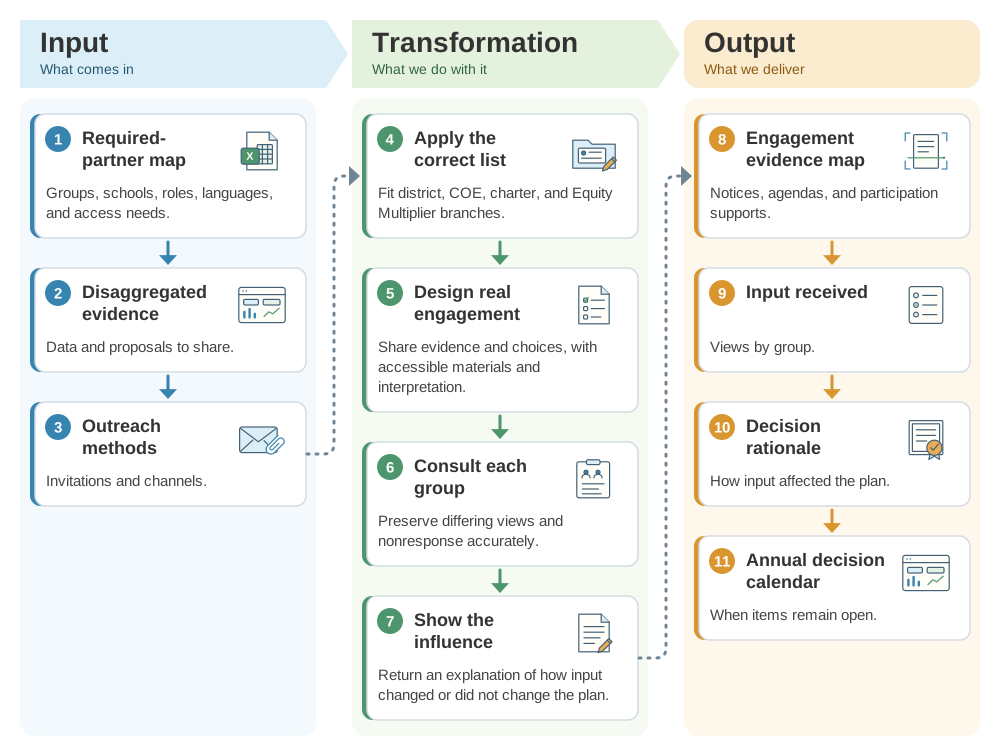
From the required partner list to documented influence on the LCAP: the SDLA ITO workflow
Consultation happens during development, so it can change the plan before it is finalized. This SDLA ITO (Input, Transformation, Output) graphic shows how the entity-specific list of required educational partners and disaggregated evidence become the engagement map and invitations, the input received, and the evidence that it shaped decisions.
The annual consultation cycle
- At annual process launchResolve applicability and governance. Identify the LEA type, required groups, bargaining units, advisory committees, pupil grade spans, English learner thresholds, Equity Multiplier schools, LCAP-as-SPSA status, SELPA dependency, and adoption calendar.
- Before outreachBuild the educational-partner map. Name each required group, population and site coverage, responsible liaison, contact source, language and access needs, engagement method, decision point, and evidence standard.
- During needs assessmentShare evidence and test the problem definition. Present current outcomes and implementation evidence, ask what the data miss, identify disparities and root causes, and correct factual errors before solutions are selected.
- During goal and action designConsult on choices and tradeoffs. Present alternatives, likely beneficiaries, evidence base, staffing and fiscal implications, implementation dependencies, proposed metrics, and what will stop or change.
- During budget alignmentConnect priorities to resources. Explain available and restricted resources, increased-or-improved-services obligations, action costs, capacity constraints, and material changes from the prior plan in understandable language.
- Before the draft is lockedReconcile coverage and influence. Identify missing groups or schools, low-response populations, contradictory input, unresolved questions, and proposals lacking evidence; conduct targeted follow-up while revision is still possible.
- At draft transitionPublish the engagement-to-plan trail. Summarize the process, groups reached, input received, and aspects of the LCAP influenced by specific input, consistent with the current template instructions and privacy requirements.
- Before adoptionHand off to formal review. Present the entire draft separately to the PAC, applicable English learner parent advisory committee, and applicable student advisory committee; obtain comments and prepare required written responses. Continue the public written-comment, hearing, and adoption sequence.
Consultation, advisory review, public participation, and labor relations are different controls
| Process | Purpose | Why it does not substitute for the others |
|---|---|---|
| Development consultation | Required groups review evidence and comment while the LCAP is being developed. | It must occur early and iteratively enough to influence the plan; a final-draft presentation alone is too late for this function. |
| Formal advisory-committee review | Official PAC and applicable English learner parent and student advisory bodies review the entire draft and submit comments before adoption. | These governing-board-established bodies have composition, meeting, presentation, and written-response requirements beyond general outreach. |
| Public written comments and hearing | The broader public comments on proposed actions and expenditures and the governing body receives public review before adoption. | An open public channel does not prove that every named statutory group was consulted during development. |
| Collective bargaining | The employer and exclusive representative fulfill labor-relations rights and duties. | LCAP consultation with local bargaining units does not waive bargaining duties, and negotiations do not automatically document consultation on LCAP development. |
| General communications | The LEA informs the community about priorities, progress, and decisions. | One-way newsletters, websites, presentations, and social posts do not enable review and comment by themselves. |
Decision routes
A required group does not respond or participation is very low
Action: Check contact accuracy, timing, format, language, accessibility, trust and relationship barriers, work or school schedules, and whether the request was understandable and decision-linked. Conduct targeted follow-up through credible messengers and additional methods.
Control: Preserve outreach and nonresponse accurately. Do not manufacture attendance, attribute views to absent partners, or describe an unrepresentative response as consensus.
Survey responses are numerous but not representative
Action: Compare respondents with the educational-partner map by group, school, role, language, grade span, geography, and relevant pupil populations. Weight the limitation in analysis and supplement with targeted qualitative engagement.
Control: Do not claim that a high raw response count satisfies consultation when required voices or affected schools are missing.
Educational partners disagree with one another
Action: Preserve the competing perspectives, underlying needs and evidence, affected populations, tradeoffs, fiscal and implementation constraints, and the LEA’s decision rationale. Return the explanation to participants.
Control: Consultation seeks informed input; it does not require fabricated consensus or guarantee adoption of every recommendation.
A bargaining unit asks to negotiate an LCAP proposal
Action: Route the labor-relations question to authorized personnel while continuing the LCAP consultation record. Keep consultation materials and bargaining communications in their proper governed processes.
Control: Do not use LCAP engagement to avoid collective bargaining or treat a bargaining obligation as proof that broader educational-partner consultation occurred.
The LEA receives Equity Multiplier funds
Action: Identify each school generating funds and engage educational partners at that school specifically in developing its required focus goal, including outcomes, actions, metrics, root causes, and implementation conditions.
Control: Districtwide engagement or a central-office focus-goal draft does not replace school-level consultation evidence.
A charter school or single-school district uses its LCAP as the SPSA
Action: Apply Education Code section 64001(j) and current CDE guidance. Confirm the required PAC, applicable English learner parent advisory committee, applicable student advisory structure, public written comments, SELPA consultation, federal schoolwide-plan content, and other section 52062(a) controls.
Control: Do not assume ordinary charter LCAP consultation alone satisfies the LCAP-as-SPSA option.
Student consultation is conducted only through student government
Action: Determine whether participants represent the LEA’s geographic, socioeconomic, cultural, physical, and educational diversity and whether students most affected by disparities had a meaningful route to comment. Add targeted forums, surveys, advisory groups, classroom protocols, or supported participation as needed.
Control: Student government may be one valid method, but its existence does not prove representative pupil consultation.
The draft was substantially changed after consultation
Action: Identify whether the changes affect the problems, goals, actions, beneficiaries, metrics, services, or expenditures partners reviewed. Reengage the affected groups and formal advisory bodies as necessary before adoption.
Control: Do not rely on input about a materially different proposal or hide late changes in a technical revision.
LCAP engagement evidence map
- Entity and applicability analysis covering district, COE, charter, Equity Multiplier, LCAP-as-SPSA, committee, student, English learner, and SELPA branches.
- Required-group and representativeness map with schools, roles, pupil groups, languages, geographic coverage, access needs, liaisons, and outreach methods.
- Annual decision calendar showing when evidence, needs, goals, actions, metrics, expenditures, draft review, public comment, hearing, and adoption remain open.
- Invitations, distribution evidence, public notices when applicable, agendas, accessible materials, translations, interpretation, accommodations, and participation supports.
- Data and proposal versions shared, source dates, definitions, disaggregation, limitations, alternatives, costs, and decision questions.
- Attendance or participation evidence that minimizes personal data while supporting group, site, role, and representation review.
- Input records, themes, minority or conflicting views, corrections, proposals, unanswered questions, and follow-up.
- Input-to-plan crosswalk linking educational-partner information to goals, actions, services, metrics, expenditures, analysis, or documented nonadoption rationale.
- Engaging Educational Partners narrative reconciled to the underlying evidence and current LCAP template.
- Formal PAC, applicable English learner parent advisory committee, student advisory, written-response, public-comment, hearing, adoption, and posting handoff records.
Official resources
- California Department of Education: Local Control and Accountability Plan
- California Department of Education: LCAP Template Instructions
- California Department of Education: Planning for the LCAP and School Plan
- California Department of Education: Engaging Educational Partners
- California Department of Education: LCFF Frequently Asked Questions
- California Department of Education: Parent Involvement and Family Engagement
- California Education Code § 52060: School District LCAP Development
- California Education Code § 52066: County Office LCAP Development
- California Education Code § 47606.5: Charter School LCAP
- California Education Code § 64001: School Plan and LCAP-as-SPSA Conditions
Local implementation questions
- Which conditional branches—Equity Multiplier, LCAP-as-SPSA, English learner threshold, middle/high school student advisory, or SELPA consultation—apply this year?
- Can the LEA prove consultation with every named group separately rather than describing “the community” in aggregate?
- Which goals, actions, metrics, services, and expenditures are genuinely open to influence at each engagement point?
- What evidence shows parents and pupils from affected and underserved groups could participate meaningfully?
- How does the district distinguish local bargaining-unit consultation from collective bargaining?
- Can every material claim in the Engaging Educational Partners narrative be traced to dated source evidence?
- What triggers reengagement when the draft changes materially after partners reviewed it?
Source review completed August 29, 2026. Verify current Education Code, State Board-adopted 2026–27 LCAP template and instructions, CDE guidance, entity type, Equity Multiplier status, LCAP-as-SPSA election, advisory-committee applicability and composition, student grade spans, English learner enrollment thresholds, SELPA and labor-relations requirements, language and disability access, Greene Act or open-meeting duties, UCP procedures, and local adoption calendar before acting. This operational resource does not replace legal advice.