



SDLA Compliance Resource
Complete and Locally Approve Applicable CSI, TSI, or ATSI Plans for Implementation
An implementation guide for turning an ESSA school-support designation into a locally approved, properly resourced, measurable improvement program that is ready to begin on the first day of school.
In Plain Language: CSI, TSI, and ATSI are federal school-improvement designations. They identify schools where accountability results show that the school as a whole—or one or more student groups—needs organized improvement. The required plan turns that finding into an approved response: understand the problem, select evidence-based interventions, assign people and resources, begin implementation, monitor results, and change course when the work is not succeeding.
What CSI, TSI, and ATSI mean
| Designation | What triggered it | What the plan is intended to do |
|---|---|---|
| CSI Comprehensive Support and Improvement | Serious performance concerns affecting the school as a whole, including applicable low-performance or graduation-rate criteria. | Establish a comprehensive schoolwide improvement response based on a needs assessment, evidence-based interventions, and identified resource inequities. |
| TSI Targeted Support and Improvement | One or more student groups are consistently underperforming under the applicable accountability criteria. | Establish a targeted response addressing the needs and outcomes of the identified student group or groups. |
| ATSI Additional Targeted Support and Improvement | A student group is performing at a level comparable to the criteria used to identify schools for comprehensive support. | Establish a more intensive targeted response that also identifies and addresses resource inequities affecting the identified group or groups. |
What the plan is supposed to accomplish
Why this matters
A designation identifies a performance concern; it does not correct it. Schools lose valuable time when the plan remains a compliance document, begins after the school year is underway, contains unfunded actions, or measures only end-of-year outcomes. The plan should create an executable improvement program with early evidence that implementation is—or is not—taking hold.
Joint ownership
Accountable owner: educational-services administrator. Program owner: federal-programs or school-improvement director. School owner: principal. Planning body: Schoolsite Council when the SPSA process applies. Partners: accountability/data lead, educational partners, fiscal services, board services, implementation owners, and COE support staff.
A concrete example: what a TSI plan actually does
Identification is the starting point
A middle school is identified for TSI because students with disabilities have experienced consistently poor mathematics outcomes. “Improve mathematics achievement” is not yet an improvement plan. It is only a desired outcome.
The plan creates the operational response
The school and LEA analyze disaggregated results, classroom experience, instruction, scheduling, staffing, supports, and implementation. They engage students, families, teachers, specialists, and administrators; select an evidence-based response; assign funding, staff, professional learning, and measures; then establish when results will be reviewed and what will change if the strategy is not working.
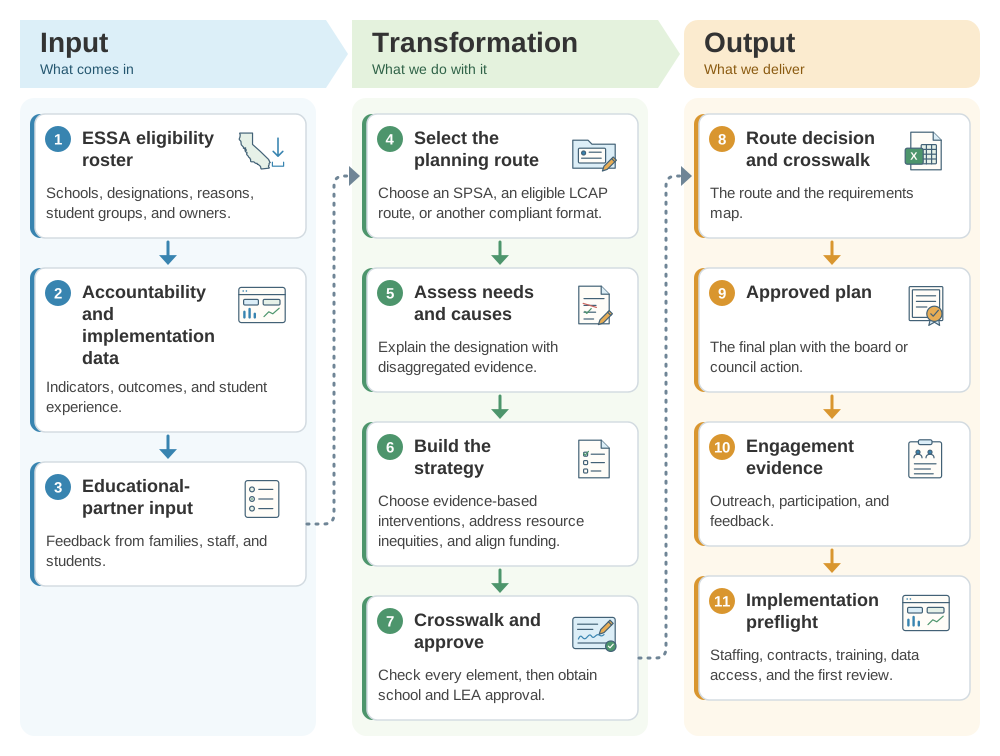
From an ESSA designation to a locally approved improvement plan: the SDLA ITO workflow
A designation becomes useful only when it leads to an approved plan that is ready to begin on the first day of school. This SDLA ITO (Input, Transformation, Output) graphic shows how the ESSA eligibility data, accountability indicators, and educational-partner input become the eligibility and route records, the approved plan, and the implementation preflight.
The plan-to-implementation calendar
- After the ESSA Assistance Status Data File is releasedEstablish the authoritative eligibility roster.Confirm each school, CDS code, designation, identification reason, identified student groups, continuing or exit status, required plan, and responsible district owner.
- At the start of planningSelect and document the compliant plan route.Determine whether the school will use an SPSA, an eligible LCAP route, or another local format meeting every applicable requirement.
- During needs assessmentEngage educational partners and understand the problem.Review accountability indicators, student-group outcomes, long-term goals, implementation evidence, student experience, contributing causes, and resource conditions.
- During plan developmentBuild a coherent improvement strategy.Select evidence-based interventions, address resource inequities when required, define outcomes and implementation measures, assign owners, and align funding.
- Before local approvalCrosswalk the plan against requirements.Verify that the document contains every applicable CSI, TSI, or ATSI element and is consistent with the SPSA, LCAP, CSI prompts, budgets, and implementation work plan.
- Before the first day of schoolComplete local approvals and implementation preflight.Secure school- and LEA-level approval as applicable; activate staffing, purchasing, contracts, training, communication, data access, and the first progress review.
- Beginning on Day 1Implement the approved actions.Launch the intervention, collect early implementation evidence, support staff, address barriers, and communicate with educational partners.
- Throughout 2026–27Monitor, learn, and revise.Review implementation, expenditures, student experience, and outcomes; continue, strengthen, replace, or stop actions based on evidence and complete required approval for material revisions.
Select the correct planning route
| LEA or school situation | Planning route | Required control |
|---|---|---|
| School in a multidistrict LEA | Use the SPSA process or another process meeting all applicable federal requirements. | Document school-level development, applicable Schoolsite Council action, LEA approval, and the complete requirements crosswalk. |
| Single-school district | May use the LCAP when it meets every applicable federal planning and educational-partner requirement. | Map each requirement to the exact LCAP section, action, expenditure, measure, and engagement evidence. |
| Charter school | May use the LCAP when all applicable requirements are satisfied. | Complete the correct local approval and, for CSI, submit the applicable LCAP CSI prompts to the COE as required. |
| CSI DASS CoP school identified for low graduation rate | Review the current CDE LCAP option and approved differentiated-improvement flexibilities. | Verify the school’s exact identification criterion, eligibility for the selected flexibility, required LCAP language, and effect on CSI funding. |
| CSI DASS CoP school identified as low performing | Generally use the SPSA or another compliant plan unless the single-school-district or charter option applies. | Do not apply a low-graduation-rate flexibility to a school identified under a different criterion. |
| TSI/ATSI special education school or program | Use the SPSA, applicable SELPA-plan content plus supplemental requirements, or another compliant local format. | Crosswalk the final package against every applicable federal requirement and document LEA approval. |
Apply the correct planning requirements
| Planning element | CSI | TSI | ATSI |
|---|---|---|---|
| Partnership with school and educational partners | Required | Required | Required |
| School-level needs assessment | Required | Address identified needs using applicable indicators and evidence | Address identified needs using applicable indicators and evidence |
| Informed by statewide accountability indicators, student-group results, and long-term goals | Required | Required | Required |
| Evidence-based interventions | Required | Required | Required |
| Identify and address resource inequities through implementation | Required | Not identified as the same distinct TSI plan element | Required |
| LEA approval and implementation monitoring | Required | Required | Required |
| CSI prompts in the LCAP | Required as applicable | Not applicable | Not applicable |
| ESSA Section 1003 school-improvement funding | Potentially available through the separate CSI funding process | Not available based on TSI status | Not available based on ATSI status |
Build a needs assessment that explains—not merely restates—the designation
Document meaningful educational-partner engagement
- Identify the students, families, educators, staff, administrators, and community partners engaged.
- Ensure the student groups producing the designation are represented meaningfully in the process.
- Provide understandable information, language access, disability access, and participation options.
- Share the relevant evidence, preliminary analysis, proposed interventions, resource questions, and measures.
- Record the feedback received and the plan element it addressed.
- Explain how feedback changed the analysis, intervention, resource allocation, implementation, or monitoring.
- When feedback was not incorporated, preserve a clear and supportable explanation.
- Schedule continued engagement during implementation and progress review.
Select and operationalize evidence-based interventions
| Decision field | What the plan should establish | Quality control |
|---|---|---|
| Need and contributing cause | The outcome, population, setting, and actionable cause the intervention addresses. | Reject an action that cannot be traced to the needs assessment. |
| Evidence base | The research or other evidence supporting the intervention and its relevance to this population and context. | Distinguish evidence of impact from popularity, testimonials, or vendor descriptions. |
| Implementation conditions | Staffing, time, schedule, training, materials, leadership support, data, and intensity required. | Verify that the local implementation design matches the conditions under which the evidence was produced. |
| Responsible owner | A named role accountable for launch, support, monitoring, barrier removal, and reporting. | A department or school name alone is not a complete assignment. |
| Resources | Funding source, amount, personnel, procurement, and continuing-cost implications. | Reconcile the plan narrative, budget, SPSA or LCAP actions, and fiscal system. |
| Implementation measures | Early evidence that the action reached the intended participants at the expected quality and intensity. | Do not wait for annual student outcomes to discover that implementation never occurred. |
| Student outcome measures | Disaggregated short-, intermediate-, and longer-term outcomes and expected progress. | Monitor the identified student groups, not only an all-student average. |
| Decision trigger | When and how leaders will continue, strengthen, replace, or stop the intervention. | Establish the trigger before results are reviewed. |
Identify and address resource inequities for CSI and ATSI
Examine whether the school or identified student groups have equitable access to the conditions needed for success. The review may include both school- and LEA-level budgeting and should connect each material inequity to a corrective action in the improvement plan.
- Experienced, appropriately assigned, and effective teachers and leaders.
- Staffing ratios, vacancies, turnover, substitutes, specialists, counselors, and support personnel.
- Core instruction, intervention, advanced coursework, electives, and pathways.
- Instructional time, master schedule, class size, grouping, and access to additional learning time.
- Standards-aligned instructional materials, technology, facilities, and learning conditions.
- Professional learning, coaching, collaboration time, and implementation support.
- School- and district-level allocations, restricted resources, and actual expenditures.
- Access to social-emotional, behavioral, attendance, health, family, and community supports.
- Discipline, exclusion, opportunity, participation, and service patterns by student group.
Complete the correct approval route
CSI plan developed through the SPSA
Route: Complete the school-level development and approval process, obtain LEA governing-board approval, and align the resulting plan with the LCAP CSI prompts that support California’s state-level approval mechanism.
Preserve: Schoolsite Council records when applicable, requirements crosswalk, final plan, board action, LCAP prompts, and implementation authorization.
TSI or ATSI plan developed through the SPSA
Route: Complete the school planning process and the LEA’s documented local approval route; ensure the LEA can monitor implementation and act when improvement is unsuccessful.
Preserve: Identification notice, identified student groups, engagement, final plan, approval, monitoring schedule, and response triggers.
Single-school district or charter school using the LCAP
Route: Map every applicable federal planning and engagement requirement into the LCAP and complete governing-board or governing-body approval through the LCAP process.
Control: For CSI, complete the applicable CSI prompts and required COE submission; do not assume ordinary LCAP content automatically satisfies the improvement-plan requirements.
Alternative locally selected plan format
Route: Establish the school and LEA approval method and crosswalk the document against all applicable federal requirements.
Control: A locally preferred template does not waive needs assessment, educational-partner, evidence-based intervention, resource-inequity, approval, or monitoring requirements.
DASS CoP CSI low-graduation-rate flexibility
Route: Verify current eligibility and the exact CDE flexibility before using the LCAP or forgoing applicable improvement activities.
Control: Record the educational-partner process, required LCAP language, governing decision, and effect on associated CSI funding.
Special education school or program using SELPA-plan content
Route: Map relevant SELPA content to the TSI or ATSI requirements and add any missing school-specific analysis, engagement, interventions, resources, approval, implementation, and monitoring.
Control: Referencing the SELPA plan alone is insufficient unless the combined record addresses every applicable requirement.
Align actions, funding, and operational readiness
| Control | Confirm before implementation | Evidence |
|---|---|---|
| Plan alignment | The intervention appears consistently in the adopted SPSA or LCAP, improvement work plan, and applicable CSI prompts. | Crosswalk with exact document sections, goals, actions, and measures. |
| Funding | Funding source, amount, allowable use, accounting code, availability, and continuing obligation are approved. | Budget detail, allowability review, award or allocation evidence, and fiscal approval. |
| Staffing and ownership | Named owners and implementers have accepted responsibilities and have sufficient time and authority. | Assignment record, staffing plan, schedule, vacancies, and escalation contact. |
| Procurement | Contracts, materials, technology, and services can be available when the action begins. | Procurement status, agreement, delivery schedule, and contingency plan. |
| Professional learning | Initial and continuing preparation addresses the practice staff must implement. | Schedule, participants, facilitators, materials, coaching, and follow-up. |
| Data readiness | Baseline, implementation, student experience, expenditure, and outcome data can be accessed and disaggregated. | Measure definitions, source systems, owners, refresh schedule, and access confirmation. |
| First review | The first implementation review occurs early enough to correct launch problems. | Meeting date, participants, evidence packet, decision rules, and follow-up owner. |
Implementation-readiness preflight
- The authoritative eligibility roster and identified student groups are confirmed.
- The selected SPSA, LCAP, or alternative route is legally and procedurally appropriate.
- Every applicable federal requirement is mapped to final plan content.
- Educational-partner feedback and its effect on the plan are documented.
- The needs assessment identifies actionable contributing causes rather than merely restating low outcomes.
- Evidence-based interventions fit the need, student population, setting, and implementation capacity.
- CSI and ATSI resource inequities are identified and addressed through specific actions.
- School-, Schoolsite Council-, LEA-, governing-board-, and COE-related approvals are complete as applicable.
- CSI prompts accurately describe and reconcile to the actual CSI plans.
- Funding, allowability, staffing, procurement, contracts, materials, and professional learning are ready.
- Implementation and outcome measures have baselines, owners, sources, and review dates.
- Schools, staff, families, students, and implementation partners know what begins and when.
- The first progress review and decision triggers are scheduled.
Reconcile identification, planning, approval, and implementation
| Control point | Authoritative evidence | Compare with | Corrective action |
|---|---|---|---|
| Eligibility | ESSA Assistance Status Data File: school, CDS code, designation, criterion, and student groups. | District roster, school notification, plan type, LCAP, and assigned owner. | Correct the roster and route; notify affected school leaders and planning teams. |
| Needs and requirements | Completed needs assessment and requirements crosswalk: evidence, causes, engagement, and applicable federal elements. | Final SPSA, LCAP, or alternative plan; CSI prompts; actions; and measures. | Add missing analysis or content and repeat approval when the change is material. |
| Interventions and resources | Approved improvement strategy: evidence base, population, conditions, owners, funding, and measures. | Budget, staffing, procurement, contracts, professional learning, and implementation calendar. | Resolve unfunded, unowned, unavailable, or poorly matched actions before marking ready. |
| Approval | Final approval record: school, Schoolsite Council, LEA, governing body, and COE actions as applicable. | Final plan version, public materials, CSI prompts, implementation authorization, and submission evidence. | Complete missing approval or correct version inconsistencies before launch. |
| Implementation | Work plan and early evidence: dates, owners, participation, dosage, quality, barriers, and expenditures. | Adopted actions, intended population, implementation measures, staff reports, and student experience. | Restore fidelity, remove barriers, reallocate resources, or revise the action through the proper process. |
| Outcomes and revision | Disaggregated progress evidence: short-, intermediate-, and long-term measures. | Targets, decision triggers, educational-partner feedback, expenditures, and continuing designation. | Continue, strengthen, replace, or stop the intervention; document rationale and required reapproval. |
Monitor implementation and revise when needed
- Review implementation early. Confirm that intended participants are receiving the intervention at the planned frequency, duration, quality, and intensity.
- Review student experience. Ask whether the intervention is accessible, responsive, coherent, and reaching the identified student groups.
- Reconcile expenditures and resources. Determine whether spending, staffing, time, and materials match the adopted plan and are producing the intended conditions.
- Examine disaggregated progress. Compare short- and intermediate-term outcomes to baselines and targets without hiding identified-group results inside all-student averages.
- Apply predetermined decision rules. Continue, intensify, modify, replace, or stop actions based on the combined implementation and outcome evidence.
- Reengage educational partners. Share results, barriers, proposed adjustments, and the effect of feedback on the next implementation cycle.
- Approve material revisions appropriately. Align the revised plan, budget, SPSA or LCAP, CSI prompts when applicable, work plan, and public record.
Evidence to retain
- Official ESSA eligibility, identification criterion, student groups, and exit or continuing status.
- LEA and school notification of CSI, TSI, or ATSI status.
- Planning-route decision and applicable-requirements crosswalk.
- Educational-partner outreach, participation, accessibility, feedback, and effect on the plan.
- School-level needs assessment, disaggregated evidence, implementation evidence, and contributing-cause analysis.
- Resource-inequity review and corrective actions for CSI and ATSI.
- Evidence-base review and intervention-selection rationale.
- Draft and final SPSA, LCAP, or alternative plan.
- Schoolsite Council records and recommendations when applicable.
- School-, LEA-, governing-board/body-, COE-, and other approval evidence as applicable.
- Final LCAP CSI prompts and submission evidence for CSI.
- Funding, allowability, budget coding, staffing, procurement, contracts, and professional-learning records.
- Implementation-readiness certification and Day 1 work plan.
- Implementation, participation, fidelity, expenditure, student-experience, and outcome evidence.
- Educational-partner progress reviews, decisions, revisions, approvals, and corrective actions.
Official guidance and help
- CDE – 2026–27 LCFF and Title I Planning CrosswalkCurrent 2026–27 plan purpose, document options, approval expectations, LCAP CSI prompts, implementation timeline, and SPSA guidance.
- CDE – Comprehensive Support and ImprovementCSI eligibility, planning requirements, DASS CoP flexibilities, LCAP options, funding, technical assistance, and current resources.
- CDE – Targeted and Additional Targeted Support and ImprovementTSI and ATSI eligibility, student-group planning requirements, resource inequities, LEA responsibilities, monitoring, and funding distinctions.
- CDE – ESSA School Support Frequently Asked QuestionsCalifornia planning alignment, LCAP and SPSA options, approval expectations, special education program options, and program-specific technical assistance.
- CDE – TSI/ATSI Planning SummaryGuidance for eligible single-school districts and charter schools using the LCAP to address TSI or ATSI requirements.
Implementation questions: Contact the appropriate CDE office or current COE support lead for eligibility, program, funding, LCAP, SPSA, DASS, approval, or monitoring questions. Preserve the advice received when it affects the selected planning route.
Source review completed August 28, 2026. Verify the current ESSA Assistance Status Data File, CDE planning guidance, LCAP and SPSA instructions, funding requirements, COE procedures, templates, and local approval calendar before acting.