



SDLA Compliance Resource
Complete the Conference Effort and Habitual-Truancy/SARB Referral Controls
An implementation guide for moving from repeated statutory truancy reports to a support-focused conference, defensible habitual-truant determination, and complete School Attendance Review Board referral.
In Plain Language: A pupil does not become a habitual truant simply because an attendance total crosses a locally configured number. The pupil must have been reported as a truant at least three times during the same school year, and an appropriate district employee must have made a conscientious effort to hold at least one conference with the parent or guardian and the pupil. If attendance remains unresolved, the district may move the case to SARB or another authorized referral pathway with complete notice, intervention, and records evidence.
Why this matters
The habitual-truancy stage is both a support escalation and a legal control point. Moving too early can bypass required notice and engagement. Moving too late can allow barriers and disengagement to deepen. A compliant process proves more than absence counts: it shows accurate records, repeated reporting, meaningful outreach, offered support, and a fair opportunity to participate.
Joint ownership
Accountable owner: district attendance supervisor or child-welfare-and-attendance administrator. Site operator: principal, attendance lead, or School Attendance Review Team. Support partners: counselor, social worker, nurse, transportation, homeless/foster liaison, special education, language access, and community agencies. Referral partner: district or county SARB coordinator.
A short primer: truancy, habitual truancy, and SARB
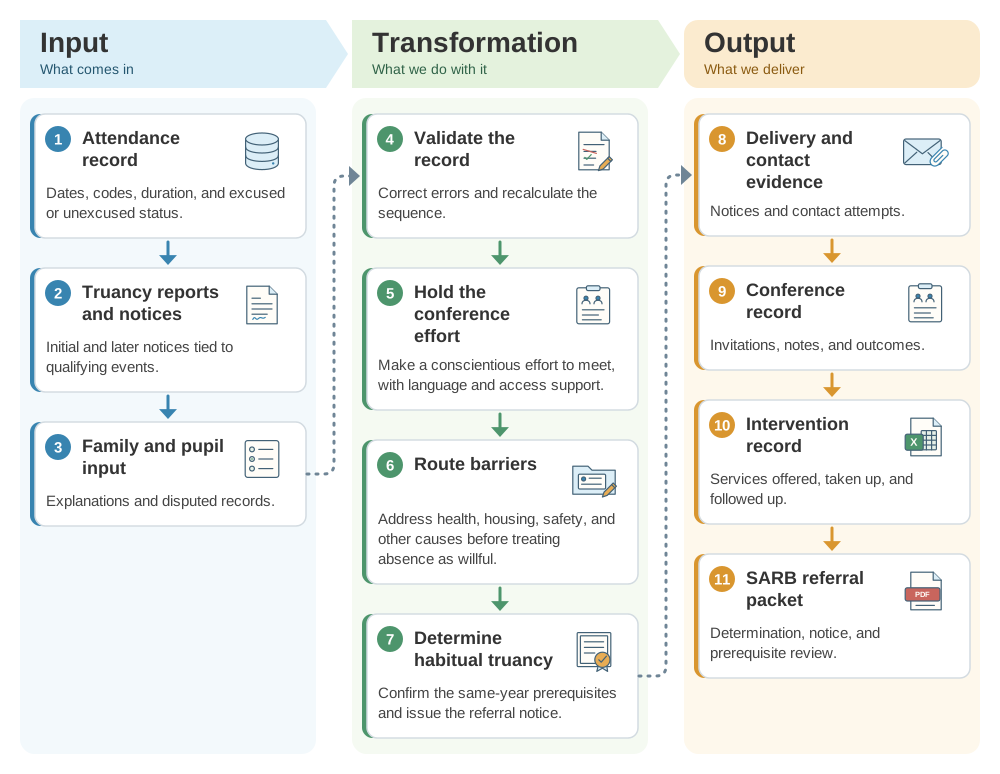
From repeated truancy reports to a complete SARB referral: the SDLA ITO workflow
A pupil becomes a habitual truant only through the statutory sequence, not through a locally configured absence number. This SDLA ITO (Input, Transformation, Output) graphic shows how the attendance record, the truancy reports, and the family's explanation become the report and conference records, the barrier routing, and the referral packet.
The familiar three-stage parent-letter sequence
CDE, county offices, and districts continue to publish examples organized as Letter 1, Letter 2, and Letter 3. The sequence is useful when each document is tied to the correct statutory event and current law—not merely to a vendor’s fixed absence count.
| Stage | Purpose | Essential control |
|---|---|---|
| Letter 1 · Initial classification | Tell the family that the pupil has met the statutory truant definition and begin support-oriented intervention. | Use the operative July 1, 2025 Education Code section 48260.5 content. Older samples containing prosecution warnings or the recommendation that a parent attend classes for a day are obsolete for this notice. |
| Letter 2 · Continued truancy and conference | Notify the family after a later unexcused absence or tardy and schedule a meeting with the parent or guardian and pupil. | Tie the notice to a subsequent qualifying event, provide usable meeting information and access support, and document the conscientious effort and interventions—not just delivery. |
| Letter 3 · Habitual truancy and referral | Notify the family that the same-year reporting and conference prerequisites support habitual-truant designation and direct participation in SARB or an authorized mediation pathway. | Complete the three-report and conference-effort preflight first. Include the reason, referral destination, meeting requirement, and intervention documentation required by the applicable process. |
Sample sources: Start with the CDE SARB forms page. The Mendocino County Office of Education and Tehama County Department of Education publish three-stage letter sets. Treat all samples as drafting aids: confirm their revision dates, replace superseded initial-notice language, align thresholds with California law and local policy, and complete language-access and legal review before use.
Keep four attendance concepts separate
| Term | Basic California meaning | Operational consequence |
|---|---|---|
| Truant | A pupil subject to compulsory education has three full unexcused days, three unexcused tardies or absences exceeding 30 minutes, or any combination during one school year. | Report the pupil to the attendance supervisor or superintendent and provide the required initial family notice. |
| Subsequent truancy report | After the pupil has once been reported as truant, another unexcused day or tardy must again be reported. | Continue notice, intervention, conference scheduling, and accurate episode tracking. |
| Habitual truant | The pupil has been reported as truant three or more times in the school year and the district has made the required conscientious effort to hold a conference with the family and pupil. | The district may issue the habitual-truancy/SARB directive and make the supported referral. |
| Chronic absentee | A pupil is absent for 10 percent or more of the schooldays since enrollment, for any reason, when the statutory minimum enrollment period is met. | Triggers attendance support and may support SARB referral, but it is not the same as truancy because excused absences count. |
| Chronic truant | A pupil has unexcused absences equaling 10 percent or more of schooldays since enrollment after the district has completed the enumerated truancy and referral steps. | A later legal classification requiring a complete procedural record; do not label a pupil chronic truant from percentage alone. |
What changed recently?
Attendance, ADA, donations, and lawful recovery are different records
| Action | Attendance record | ADA treatment | Truancy treatment |
|---|---|---|---|
| Voluntary donation | No change. | No ADA generated or restored. | No change to excused/unexcused status or statutory sequence. |
| Makeup assignments | The original absence remains unless a separate law authorizes attendance. | Academic credit does not itself create ADA. | Does not erase a qualifying unexcused event. |
| Attendance-record correction | Correct when evidence shows the pupil attended or the code/classification was erroneous. | Revise ADA only through the authorized attendance-accounting process supported by source records. | Recalculate notices and classifications from the corrected record. |
| Compliant Attendance Recovery | The original absence remains recorded; separate recovery participation is documented. | Beginning in 2025–26, an eligible LEA may recoup limited ADA after the pupil completes the required supplementary instructional time under Education Code section 46211. | Attendance Recovery does not change compulsory-education attendance records or eliminate required truancy reporting. |
The SDLA Cost of Student Absences calculator can help leaders and communities visualize the estimated fiscal effect of missed attendance. Present the result as an estimate based on the selected assumptions—not a family bill, fine, donation request, pupil-level debt, or basis for changing attendance. Update the calculator’s explanation to recognize the separate Attendance Recovery option available beginning in 2025–26.
The habitual-truancy gate
| Required control | Evidence of completion | Not sufficient by itself |
|---|---|---|
| Pupil is subject to the applicable compulsory-education rule | Age, enrollment, educational program, and school calendar establish that the statutory process applies. | A generic attendance alert generated for every enrolled pupil. |
| Underlying events are unexcused and accurate | Dates, full-day or over-30-minute events, attendance codes, corrections, and valid-excuse review support the classification. | Total absences, chronic-absence percentage, or ADA loss. |
| Initial truancy report and notice completed | The first threshold, report, current statutory notice content, delivery method, date, language/access support, and family response are documented. | A dashboard flag or obsolete notice template. |
| Two subsequent truancy reports completed | Each new qualifying unexcused event after the prior report is identified, reported, and connected to continuing intervention. | Counting the same original three events as three separate reports. |
| Conscientious conference effort completed | At least one documented attempt to communicate with the parent or guardian using the most cost-effective method possible, directed toward a conference involving the parent/guardian and pupil. | A letter with no conference purpose, an undocumented call, or a meeting attended only by staff. |
| Attendance remains unresolved | Subsequent attendance and intervention records show continuing concern after notice, outreach, and offered supports. | An automatic referral created the moment the third report posts. |
Legal minimum versus a productive conference
Minimum conference-effort control
Education Code section 48262 defines a conscientious effort as attempting to communicate with the pupil’s parent at least once using the most cost-effective method possible, which may include email or a telephone call. Preserve the date, method, destination, purpose, staff member, result, and next action.
If the family does not respond or attend, document the attempt and continue reasonable outreach under local procedures.
Recommended support-focused SART conference
Meet with the pupil and family; verify the attendance record; listen for transportation, health, safety, housing, caregiving, disability, language, bullying, mental-health, academic, or school-connectedness barriers; assign services; create a realistic attendance plan; and set a follow-up date.
A technically sufficient attempt should not become the district’s service standard.
The pupil-specific intervention calendar
- Before initial classificationValidate the attendance record.Review enrollment, calendar, compulsory-education status, dates, duration, attendance codes, legally required and locally approved valid excuses, independent-study or instructional participation, family communications, and pending corrections.
- At the first statutory thresholdReport and send the current initial notice.Use the operative July 1, 2025 notice content, document delivery, provide understandable communication, and begin support-oriented problem solving.
- When another unexcused day or tardy occursCreate the next truancy report and schedule the meeting.Notify the family through the district’s compliant process and give the parent/guardian and pupil a real opportunity to meet with school officials.
- Before habitual-truant designationComplete and document the conscientious conference effort.Attempt communication through a cost-effective method, identify the conference purpose, seek participation by both the pupil and family, offer language and access support, and retain the outcome.
- At the SART or school conferenceVerify, listen, support, and plan.Correct attendance errors, distinguish excused and unexcused causes, identify barriers, connect services, document agreed actions, and establish a follow-up date.
- After the third report and unresolved attendanceComplete the habitual-truancy determination.Confirm the same-school-year sequence and every prerequisite. Issue the applicable habitual-truancy and SARB/hearing notice using current local and county procedures.
- Before transmitting the referralBuild a complete, minimal, relevant referral packet.Provide the required intervention documentation to the pupil, family, and SARB or probation department; include written referral reason, meeting requirement, SARB name and address, and protected supporting records.
- After SARB dispositionImplement and monitor the directive.Assign services, record responsibilities and dates, monitor attendance, follow up on barriers, reconvene as appropriate, and use mediation or legal escalation only through the authorized pathway.
What SARB is—and what it is not
SARB is a multidisciplinary intervention process
A district or county SARB brings education and community partners together to determine why attendance has not improved through ordinary school intervention. It can direct the pupil or family to available community services, require evidence of participation, establish an attendance agreement, and monitor the response.
SARB is not an automatic prosecution referral
The purpose is to solve attendance and behavioral barriers and divert pupils from the juvenile-justice system. Further mediation or legal referral occurs only through applicable statutory and local pathways when services cannot resolve the problem or the pupil or family fails to respond to SARB directives or services.
Build a referral packet that proves the pathway
- Pupil identity, enrollment, grade, school, calendar, and compulsory-education applicability.
- Attendance detail showing dates, event duration, codes, and excused/unexcused status.
- Initial threshold calculation, first truancy report, and current statutory notice.
- Second and third truancy reports tied to later qualifying events.
- Delivery, returned-mail, email, telephone, and other contact evidence.
- Conference invitations, conscientious-effort record, attendance, notes, and outcome.
- Family and pupil explanations, disputed records, and resulting corrections.
- Interventions, referrals, services offered, access barriers, uptake, and follow-up.
- SART plan or attendance agreement, responsible staff, review date, and results.
- Habitual-truancy determination and same-school-year prerequisite review.
- Written SARB referral notice, reason, SARB name/address, and meeting requirement.
- Relevant health, disability, housing, foster, transportation, safety, or language routing—shared only as permitted and necessary.
Route barriers before treating them as noncompliance
The family disputes the attendance record
Action: Review the specific dates, codes, duration, valid-excuse information, enrollment, and supporting documentation. Correct errors promptly and recalculate the statutory sequence.
Control: Do not preserve a truancy classification merely because notices were already generated. If the district upholds the record, provide the applicable student-record challenge information and document the decision.
Health, disability, or mental-health concerns may be driving absence
Action: Route the concern to qualified health, Section 504, special education, or student-support personnel; determine whether evaluation, accommodations, services, or updated medical information are needed.
Control: Do not use truancy escalation as a substitute for child-find, disability access, or health-support obligations.
Housing instability, foster care, transportation, or caregiving is involved
Action: Engage the homeless or foster-youth liaison and appropriate transportation, enrollment, or social-service supports. Assess whether absences were coded and addressed correctly under applicable protections.
Control: Remove access barriers before characterizing the family’s response as willful noncompliance.
Bullying, school safety, discrimination, or school avoidance is reported
Action: Activate the appropriate safety, complaint, investigation, counseling, and school-climate processes while continuing supportive attendance planning.
Control: A direction to “return to school” is not a complete response to an unresolved safety concern.
The parent or pupil does not attend the conference
Action: Preserve the conscientious-effort evidence, attempt additional reasonable contact, consider access barriers and alternative meeting formats, and follow the district/SARB continuation procedure.
Control: Do not fabricate participation or erase the support work offered. CDE guidance permits SARB to attempt contact during the hearing, proceed and later deliver the contract, reschedule, or use an authorized next step.
The pupil transfers or the school year changes
Action: Transfer relevant attendance and intervention records promptly under applicable student-record rules. The habitual-truant definition requires three reports within the same school year; preserve the dates and do not merge separate-year report counts.
Control: CDE notes that a SARB hearing responding to a prior habitual-truancy report may occur at the start of the next year when necessary; confirm the receiving agency’s current procedure.
Reconcile attendance, notices, intervention, and referral
| Record | Authoritative evidence | Compare with | Corrective action |
|---|---|---|---|
| SIS attendance | Enrollment dates, instructional calendar, event dates, duration, attendance codes, and corrections. | Teacher records, family documentation, health office, independent study, transportation, and school calendar. | Correct unsupported codes and rerun all statutory thresholds without back-dating. |
| Truancy reports | First, second, and third report dates tied to qualifying events in the same school year. | SIS alerts, attendance-supervisor log, and notice history. | Remove duplicate or premature reports and reconstruct the supported sequence. |
| Family notice | Current content, method, destination, date, language/access support, and delivery outcome. | Template version, communication platform, returned mail, contact information, and family response. | Reissue an accurate notice and document the correction when material content or delivery failed. |
| Conference effort | Purposeful attempt to communicate and hold a conference with the parent/guardian and pupil. | Calls, emails, invitations, meeting log, interpreter request, attendees, notes, and next steps. | Complete additional outreach and do not mark the prerequisite complete from an unsupported checkbox. |
| Intervention record | Barriers identified, services offered, responsible staff, family/pupil input, follow-up, and result. | SART plan, counseling, health, transportation, liaison, 504/IEP, and community referrals. | Close service gaps and update the plan before escalating solely on attendance counts. |
| SARB referral | Habitual-truancy gate review, written reason, intervention documentation, required recipients, SARB address, and meeting directive. | SARB intake checklist, pupil/family copy, packet transmission, hearing date, and disposition. | Return incomplete cases for correction; share only relevant records through the authorized process. |
Pre-referral checklist
- Compulsory-education applicability and enrollment dates confirmed.
- All threshold events are unexcused and longer-than-30-minute events are measured correctly.
- Valid excuses and administrator discretion were considered on the facts.
- Three distinct truancy reports exist in the same school year.
- The current July 1, 2025 initial-notice language was used.
- Family contact details, language, accessibility, and delivery issues were addressed.
- A conscientious effort to hold the required family/pupil conference is documented.
- Attendance records and family disputes were reviewed and corrected where warranted.
- Root causes, services, and school-level interventions are documented.
- Health, disability, housing, foster, transportation, and safety protections were routed.
- Habitual-truancy determination was approved by authorized staff.
- SARB notice and packet meet current district, county, and privacy procedures.
Official guidance and help
- Education Code section 48260Initial truant definition, report to the attendance supervisor or superintendent, and valid-excuse framework.
- Education Code section 48260.5Operative July 1, 2025 initial truancy notice and required support-focused content.
- Education Code section 48261Subsequent truancy reporting after another unexcused absence or tardy.
- Education Code section 48262Three-report habitual-truant definition and conscientious conference-effort prerequisite.
- Education Code section 48263SARB or probation referral, intervention documentation, written referral notice, meeting requirement, community services, and later escalation.
- CDE Enforcement of Compulsory Education LawsCalifornia’s three-stage notification and habitual-truancy/SARB implementation guidance.
- CDE School Site Prevention and Intervention StrategiesSART conference practices, restorative engagement, root-cause work, services, and attendance agreements.
- CDE SARB Frequently Asked QuestionsConference prerequisite, number of letters, record disputes, year transitions, SARB procedure, and common implementation questions.
- CDE SARB FormsSuggested attendance and SARB documents plus the July 1, 2025 notice-change reminder.
- CDE Attendance RecoveryOptional 2025–26-and-later program requirements, eligible LEAs and pupils, instructional-time controls, limited ADA recovery, attendance reporting, and CALPADS treatment.
Implementation questions: Follow the district or county SARB’s current intake, notice, privacy, hearing, agreement, follow-up, mediation, and escalation procedures. Contact CDE Educational Options at for state attendance and SARB guidance.
Source review completed August 28, 2026. Verify current Education Code, district attendance policy, valid-excuse standards, SIS calculations, notice templates, county SARB procedures, language-access requirements, student-record protections, and pupil-specific facts before acting.