



SDLA Compliance Resource
Complete the Eligibility Reevaluation
An implementation guide for reviewing current information, obtaining additional assessment data when needed, determining continued eligibility and educational need, and completing the reevaluation on time.
In Plain Language: An eligibility reevaluation determines whether a pupil continues to have a disability, continues to need special education and related services, has changed academic or functional needs, and requires additions or modifications to services. It begins with a review of what is already known. New testing is conducted only when additional information is needed.
Why this matters
A reevaluation is not simply a three-year paperwork checkpoint. It protects the pupil from continuing under an outdated understanding of disability and need, from receiving services that no longer fit, or from being exited without a sufficiently comprehensive evaluation and team decision.
Joint ownership
Accountable owner: special education director or assessment administrator. Case owner: school psychologist, program specialist, or case manager. Assessment owners: qualified personnel for each required area. Meeting owner: IEP case manager. Partners: parent, teachers, related-service providers, IEP-system staff, CALPADS staff, and SELPA support.
Three different routes
| Route | When it applies | What the LEA completes |
|---|---|---|
| Existing data are sufficient | The team can answer the reevaluation questions from current records, observations, assessments, progress, and parent input. | Complete the reevaluation and notify the parent why no additional assessment data are needed and of the right to request an assessment. |
| Additional data are needed | The existing information cannot answer one or more required questions about disability, need, services, or current performance. | Develop the assessment plan, obtain informed consent when required, conduct the identified assessments, and complete the team determination. |
| Parent and LEA agree reevaluation is unnecessary | Both parties agree not to conduct the otherwise scheduled three-year reevaluation. | Document the agreement under current SELPA procedures. Do not confuse this agreement with completing a reevaluation through existing data. |
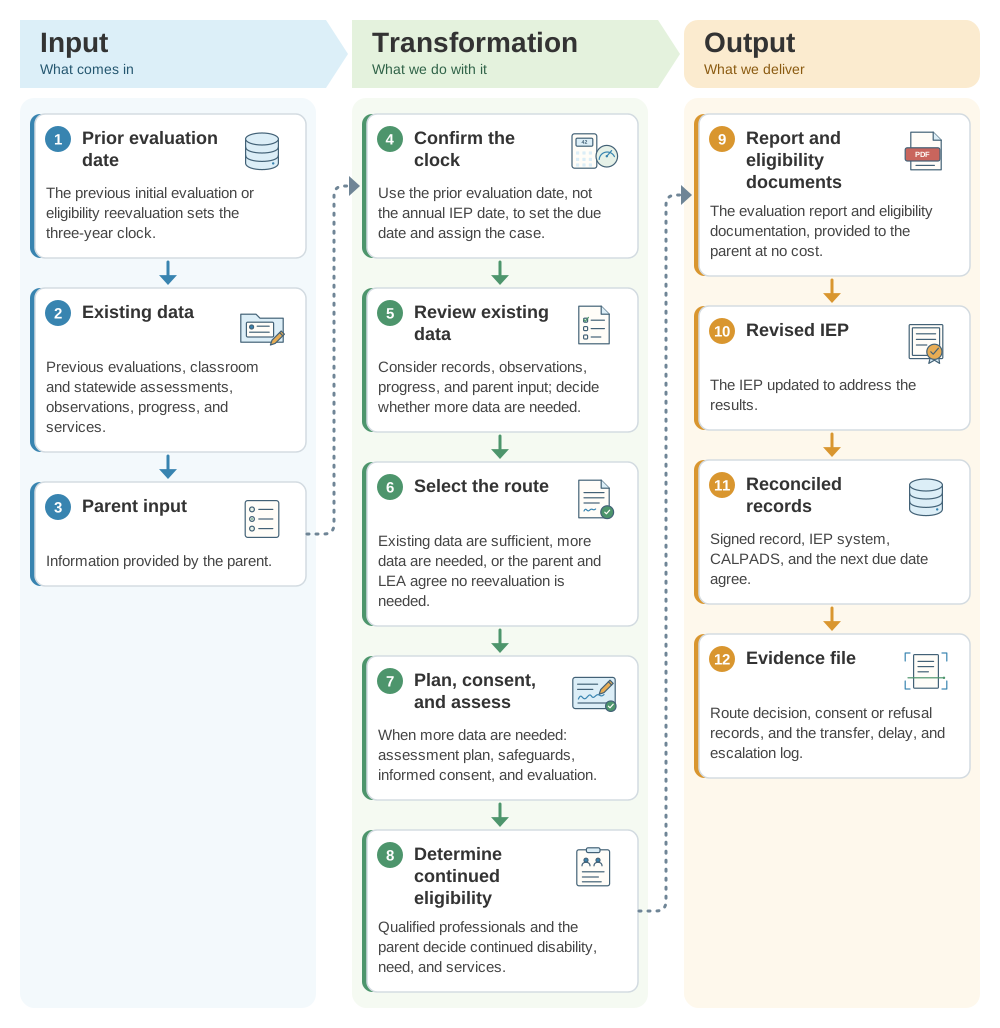
From prior evaluation to continued eligibility: the SDLA ITO workflow
A reevaluation begins with a review of what is already known; new testing is done only when more information is needed. This SDLA ITO (Input, Transformation, Output) graphic shows how the prior evaluation date, existing data, and parent input become the evaluation report, the revised IEP, and reconciled records.
The reevaluation calendar
- Well before the three-year due dateConfirm the clock and assign the case.Use the previous initial evaluation or eligibility reevaluation—not the annual IEP, amendment, assessment plan, or data-entry date—to establish the due date.
- At the start of planningReview existing data and obtain parent input.Consider previous evaluations, classroom and statewide assessments, observations, progress, services, current performance, and information provided by the parent.
- Early enough to complete any needed assessmentSelect the correct route.Determine whether existing data are sufficient, additional assessment data are needed, or the parent and LEA agree that the reevaluation is unnecessary.
- When additional data are neededPlan, consent, and assess.Identify every required evaluation area, provide the assessment plan and safeguards, obtain informed consent, assign qualified personnel, and complete a sufficiently comprehensive evaluation.
- By the reevaluation due dateComplete the eligibility determination.A group of qualified professionals and the parent consider the information and determine continued disability, educational need, and continued need for special education and related services.
- Immediately afterwardDeliver, implement, and reconcile.Provide the evaluation report and eligibility documentation, revise the IEP as appropriate, update IEP and CALPADS records, and establish the next reevaluation due date.
Review enough information to answer four questions
Consent at a glance
No consent required to review existing data
The team may review existing evaluation information without first obtaining parental consent. If the team determines that no additional data are needed, provide the required parent notice and explain the parent’s right to request an assessment.
Consent required before conducting reevaluation assessments
Obtain informed parental consent before administering the additional reevaluation measures, subject to the rules governing documented reasonable efforts, failure to respond, refusal, and applicable consent-override procedures.
Assessment quality controls
- Use multiple sources and do not make the decision from a single measure or score.
- Assess all areas related to suspected disability and current educational need.
- Use valid, reliable, nondiscriminatory tools for their intended purposes.
- Use the pupil’s native language or other mode of communication when required.
- Use trained and knowledgeable personnel and follow assessment instructions.
- Make the evaluation sufficiently comprehensive to identify all special education and related-service needs.
- Consider lack of appropriate reading or mathematics instruction and limited English proficiency; do not use them improperly as determinant factors for eligibility.
- Connect evaluation results to present levels, educational need, goals, services, supports, placement, and access to the general curriculum.
Complete the team decision—not merely the reports
| Control point | Complete when | Not complete merely because |
|---|---|---|
| Existing-data review | The required sources and parent input are considered and the need for additional data is decided. | Staff copied old scores into a new form. |
| Additional assessment | Every required area is evaluated and the multidisciplinary information is ready for team consideration. | Reports were assigned, drafted, or uploaded. |
| Eligibility determination | The parent and qualified professionals consider the information and document continued eligibility and educational need. | An evaluator recommends an outcome before the team meets. |
| Parent documentation | The parent receives the evaluation report and eligibility documentation at no cost. | The documents are available somewhere in the district system. |
| IEP response | The team addresses results through appropriate present levels, goals, services, supports, or other IEP changes. | The eligibility field was updated without reviewing the pupil’s program. |
| System reconciliation | The signed record, IEP system, CALPADS submission, and next due date agree. | A CALPADS record posted successfully. |
Route exceptions early
Parent refuses consent for additional assessment
Route: Provide required notice, document the refusal, and consult the special education administrator and SELPA regarding whether to pursue the reevaluation through applicable dispute procedures.
Control: Do not treat refusal as agreement that reevaluation is unnecessary or as an automatic end to services.
Parent does not respond
Route: Continue and document reasonable efforts through appropriate communication methods and languages. Apply current consent rules and SELPA procedures before proceeding.
Preserve: Calls, correspondence, visits when applicable, responses, returned communications, and next actions.
Parent or teacher requests an earlier reevaluation
Route: Review the request promptly. A reevaluation must be conducted when the pupil’s educational or related-service needs warrant it or the parent or teacher requests it, subject to the general limitation of no more than once a year unless the parent and LEA agree otherwise.
Control: If the LEA refuses the requested reevaluation, provide appropriate prior written notice.
Pupil transfers while the reevaluation is pending
Route: Send the complete reevaluation record promptly, identify the controlling due date and unfinished work, and coordinate responsibility with the receiving LEA under applicable transfer requirements.
Control: A transfer should not casually restart the three-year cycle or erase completed assessment work.
The due date has already passed
Route: Escalate immediately, complete the reevaluation without further avoidable delay, document the reason and corrective response, and use the appropriate IEP-system and CALPADS delay reporting.
Do not: back-date the meeting, assessment, agreement, or eligibility record.
Reconcile the reevaluation record
| Record | Authoritative evidence | Compare with | Corrective action |
|---|---|---|---|
| Due date | Prior initial or eligibility reevaluation: actual team determination date. | IEP-system due date, CALPADS MEET history, case tracker, and annual IEP date. | Correct the calculated date and notify all owners without altering the historical event. |
| Evaluation route | Existing-data review and team decision: additional data needed, not needed, or agreement that reevaluation is unnecessary. | Parent notice or agreement, assessment plan, consent, and evaluator assignments. | Complete missing notice, consent, documentation, or assessment action. |
| Eligibility outcome | Final evaluation and team documentation: continued disability, need, and outcome. | IEP eligibility, present levels, goals, services, parent copy, and CALPADS outcome. | Resolve inaccurate or inconsistent records and complete the required team action. |
| Next cycle | Completed eligibility reevaluation date: the new cycle anchor. | IEP-system alert, protected tracker, CALPADS, assigned case owner, and future calendar. | Establish one consistent next due date and preserve its calculation. |
Evidence to retain
- Previous initial-evaluation or eligibility-reevaluation date and new due-date calculation.
- Review of existing data, parent input, and decision regarding additional information.
- Parent notice when no additional assessment data are needed.
- Parent and LEA agreement that reevaluation is unnecessary, when applicable.
- Assessment plan, safeguards, consent, or documented reasonable efforts.
- Completed multidisciplinary assessments and reports.
- Eligibility criteria, team consideration, and continued-eligibility decision.
- Evaluation report and eligibility documentation provided to the parent.
- Resulting IEP review, revisions, notices, and implementation.
- IEP-system, CALPADS MEET and outcome, PLAN/SERV, and next-due-date reconciliation.
- Transfer, delay, refusal, disagreement, and escalation records.
Official guidance and help
- 34 CFR section 300.303When reevaluation is required, the one-year frequency limitation, and the three-year cycle.
- 34 CFR section 300.305Review of existing data, required reevaluation questions, additional data, parent notice, and evaluation before ending eligibility.
- 34 CFR section 300.300(c)Parental consent, refusal, and documented reasonable efforts for reevaluations.
- 34 CFR section 300.306Eligibility determination by qualified professionals and the parent, parent copies, multiple sources, and determinant-factor restrictions.
- CDE – Special Education File Submission ScenariosCALPADS MEET, eligibility-reevaluation, late-meeting, outcome, and plan reporting examples.
Implementation questions: Follow current SELPA procedures for due-date calculation, existing-data review, written agreements, assessment planning, consent, refusal, transfers, eligibility criteria, and delayed reevaluations.
Source review completed August 28, 2026. Verify current federal and state requirements, SELPA procedures, eligibility criteria, assessment forms, IEP-system rules, and CALPADS guidance before acting.