



SDLA Compliance Resource
Appoint a Qualified Surrogate Parent When Required
An implementation guide for recognizing when a pupil needs special education representation, documenting the determination date, selecting and preparing a qualified independent surrogate, and protecting the pupil’s rights throughout the appointment.
In Plain Language: When no parent or other authorized adult is available to protect a pupil’s special education rights, the LEA must determine whether a surrogate parent is required and, when required, make reasonable efforts to appoint a qualified person within 30 days. The surrogate represents the pupil in special education decisions—not in custody, guardianship, or every school matter.
Why this matters
Evaluation, eligibility, placement, services, and IEP decisions can move forward only when the pupil’s procedural rights are meaningfully protected. A missing or incorrectly identified educational decision-maker can delay needed support, produce invalid consent, exclude the pupil’s representative, and expose the LEA to preventable disputes.
Joint ownership
Accountable owner: special education director or designee. Process owner: designated surrogate-parent coordinator. Case partners: school psychologist, case manager, foster-youth liaison, records staff, and the IEP team. Advisory support: SELPA or legal counsel for disputed or unusual cases.
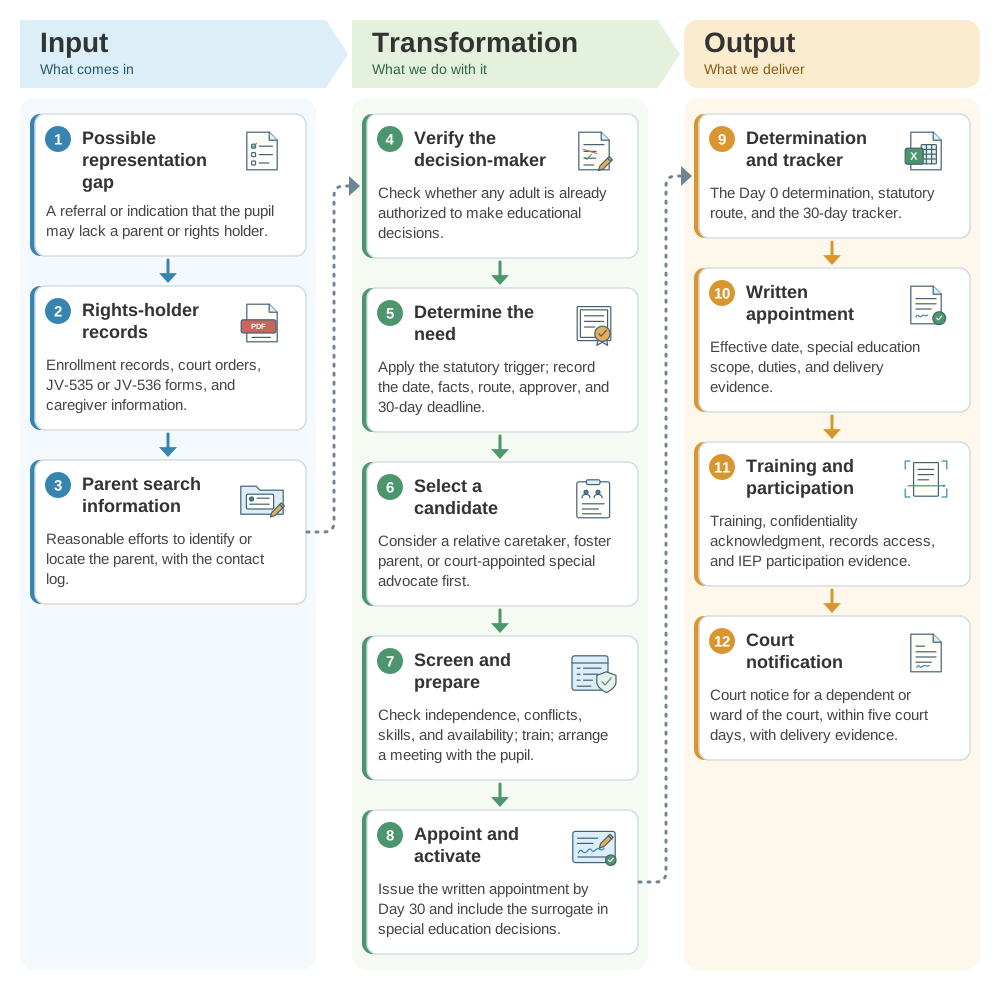
From representation gap to appointment: the SDLA ITO workflow
A surrogate parent represents the pupil in special education decisions—not in custody, guardianship, or every school matter. This SDLA ITO (Input, Transformation, Output) graphic shows how the representation gap, the rights-holder records, and the parent search become the determination and tracker, the appointment, training and participation evidence, and the court notice.
The 30-day appointment calendar
- At the first indication of a representation gapOpen a protected review.Identify the pupil, special education action underway, known parent or rights-holder information, referral source, assigned reviewer, and any immediate deadline.
- ImmediatelyVerify the existing educational decision-maker.Review enrollment records, court orders, available JV-535 or JV-536 forms, caregiver information, parent status, and any adult already authorized to make educational decisions.
- Before determining needDocument reasonable efforts and apply the statutory trigger.Confirm whether no parent can be identified, a parent cannot be located after reasonable efforts, or the California requirements for a dependent or ward of the court are satisfied.
- Day 0 · LEA determines needRecord the determination date.Enter the actual date, supporting facts, statutory route, responsible approver, 30-day deadline, and any other special education timeline requiring immediate coordination.
- Early in the 30-day windowConsider the preferred available candidate.When available, willing, and able, consider a relative caretaker, foster parent, or court-appointed special advocate before selecting another qualified person.
- Before appointmentScreen, prepare, and connect the candidate.Complete independence, conflict, knowledge, skills, availability, confidentiality, and training controls; arrange records access and ensure the candidate meets the pupil at least once.
- As soon as practicable · no later than Day 30Issue the written appointment.State the effective date, special education scope, responsible contacts, required duties, resignation process, and conditions for review or termination.
- After appointment and ongoingActivate, monitor, and reconcile representation.Include the surrogate in special education decisions, document participation, review continued need, address conflicts or performance concerns, and complete the separate court-notification process when applicable.
Determine whether an appointment is required
| Circumstance | General route | Control before acting |
|---|---|---|
| No parent can be identified | Determine whether the pupil needs a surrogate parent. | Document the records reviewed, inquiries made, and factual basis for the determination. |
| Parent cannot be located | Determine need after reasonable efforts to locate the parent. | Retain a dated, method-specific, language-accessible search and contact log. |
| Dependent or ward of the court | Appoint only when the California statutory conditions are satisfied. | Verify that the court limited parental educational rights and that no responsible adult represents the pupil. |
| Foster youth whose parent retains educational rights | Do not appoint solely because the pupil is in foster care. | Use the current court order and educational-rights record—not placement status alone. |
| Parent is identifiable but cannot attend one meeting | Do not treat temporary unavailability as an automatic surrogate trigger. | Use ordinary participation, scheduling, notice, and alternative-meeting methods. |
| LEA disagrees with the parent | Never use disagreement as a reason to replace the parent. | Follow procedural safeguards, prior written notice, and dispute-resolution procedures. |
| Parent designates another adult | Analyze the designation separately from an LEA surrogate appointment. | Verify the designation, its scope, and the parent’s continuing educational rights. |
| Pupil reaches age 18 | Review transfer of educational rights and any applicable exception. | Do not continue the surrogate appointment automatically after the legal basis ends. |
Surrogate-parent appointment pathway
Document reasonable efforts to locate the parent
No single locally invented number of attempts should substitute for a fact-specific, documented effort. Follow current SELPA procedures and preserve enough evidence for an independent reviewer to understand what was attempted and why the LEA reached its conclusion.
- Review available addresses, telephone numbers, email addresses, enrollment records, and emergency contacts.
- Record each contact date, method, destination, language, accessibility measure, outcome, and next action.
- Preserve returned correspondence, failed delivery notices, responses, and corrected contact information.
- Coordinate appropriately with child-welfare, probation, court, or other authorized contacts while observing confidentiality requirements.
- Use understandable communication and interpreters or translated information when needed.
- Record the evidence reviewed, reviewer, conclusion, and actual date the LEA determined the parent could not be located.
Apply California’s candidate preference without skipping qualification
Preferred available candidates
When one exists and is willing and able to serve, California law gives preference to a relative caretaker, foster parent, or court-appointed special advocate. Record who was considered, availability, willingness, ability to serve, and the resulting selection.
Another qualified person
If no preferred person is available and able to serve, the LEA may select another qualified individual. Payment solely for serving as a surrogate does not by itself make the person an employee for the statutory independence rule.
Candidate qualification and conflict preflight
| Control | Confirm before appointment | Evidence |
|---|---|---|
| Independence | The candidate is not disqualified as an employee of an agency involved in the pupil’s education or care, subject to applicable statutory exceptions. | Employment and agency-relationship disclosure reviewed by the designated approver. |
| No conflict of interest | No personal or professional interest restricts or biases advocacy for all services necessary to provide FAPE. | Signed conflict disclosure, review notes, and approval. |
| Knowledge and skills | The candidate can understand records, participate in meetings, ask questions, evaluate options, and represent the pupil adequately. | Training record and coordinator assessment of readiness. |
| Availability | The candidate can meet the pupil, review records, attend meetings, respond to requests, and serve for the anticipated period. | Availability confirmation and current contact information. |
| Practical and culturally responsive service | As practical, the appointment supports effective and culturally sensitive representation. | Candidate-selection notes and communication/access plan. |
| Confidentiality | The candidate understands the obligation to protect pupil and family information. | Signed confidentiality acknowledgment and records-access orientation. |
| Meeting the pupil | The surrogate will meet the pupil at least once rather than represent the pupil only from paperwork. | Date and confirmation of meeting, recorded without unnecessary sensitive detail. |
Activate the surrogate after appointment
- Issue a complete appointment letter. State the pupil, determination and effective dates, special education scope, LEA contacts, responsibilities, confidentiality, resignation process, and review conditions.
- Ensure the surrogate meets the pupil. Arrange at least one meaningful meeting and provide appropriate context about the pupil’s communication, culture, strengths, needs, and educational setting.
- Provide secure records access. Explain how to obtain and review evaluations, IEPs, progress information, notices, and other relevant special education records.
- Include the surrogate in every applicable decision. Send required notices and meeting materials, arrange interpretation or accessibility support, and provide meaningful time to prepare.
- Support informed participation without directing the outcome. Explain processes and options while preserving the surrogate’s independent advocacy for the pupil.
- Monitor performance and continuing need. Confirm participation, confidentiality, availability, conflicts, and the continuing legal basis for appointment.
Review, replace, or end the appointment when circumstances change
The surrogate resigns
Route: Require notice to the LEA, record the effective date, preserve current case information, and determine immediately whether a replacement is required.
Control: Do not leave active special education actions without an identified representative.
A conflict develops or the surrogate is not performing required duties
Route: Refer the concern to the designated special education administrator for documented review and termination when warranted.
Control: Protect the pupil from retaliation or loss of representation and appoint a replacement when continuing need remains.
The pupil leaves the relative or foster home
Route: When that caretaker served as surrogate, promptly reassess whether the appointment remains valid and appoint another surrogate if required.
Control: Update contact, court, placement, rights-holder, and IEP-team records consistently.
A parent’s rights are restored or another responsible adult is appointed
Route: Verify the controlling documentation, end the surrogate’s authority at the appropriate time, and transition records and meeting participation to the authorized decision-maker.
Control: Notify the surrogate and relevant staff in writing and prevent overlapping or conflicting consent authority.
The pupil no longer needs special education
Route: Confirm that the special education process supporting the conclusion is complete, record the end of surrogate service, and retain the appointment history.
The pupil reaches age 18
Route: Review transfer-of-rights requirements and any applicable exception before ending or changing representation.
Control: Do not assume that the prior appointment either continues or ends without reviewing the pupil-specific legal status.
Maintain readiness before a pupil needs an appointment
- Designate a surrogate-parent coordinator and backup with authority to manage the 30-day process.
- Recruit a diverse pool of potential candidates and maintain current availability and contact information.
- Provide initial and refresher training using the CDE model manual and current SELPA procedures.
- Maintain standardized determination, reasonable-efforts, conflict, confidentiality, appointment, resignation, and termination forms.
- Establish urgent referral and escalation routes for cases with active evaluation, IEP, placement, or service deadlines.
- Maintain a protected active-surrogate roster and review continued need at least annually and whenever circumstances change.
- Prepare secure records-access, interpretation, accessibility, meeting-notice, and reimbursement procedures.
- Identify backup candidates so one person’s unavailability does not consume the appointment window.
Reconcile the rights holder, appointment, and IEP record
| Control point | Authoritative evidence | Compare with | Corrective action |
|---|---|---|---|
| Educational decision-maker | Current rights-holder evidence: parent status, court order, JV form, or other controlling record. | Enrollment, foster-youth, special education, contact, and meeting-notice records. | Resolve inconsistencies before seeking consent or treating a person as the pupil’s representative. |
| Need determination | Approved determination record: statutory route, supporting facts, decision, and Day 0 date. | Reasonable-efforts log, court records, referral, and the 30-day tracker. | Correct unsupported conclusions, obtain missing documentation, and preserve the actual determination date. |
| Candidate selection | Selection record: preference review, qualifications, conflict disclosure, availability, and training. | Candidate pool, employment relationships, active caseload, and approval record. | Resolve the conflict or qualification gap and select another candidate when necessary. |
| Written appointment | Final appointment: pupil, scope, effective date, duties, contacts, and signatures. | Determination date, Day 30 deadline, active-surrogate roster, records access, and case assignment. | Issue or correct the document promptly and align all protected systems. |
| Active representation | Participation evidence: pupil meeting, notices, records review, IEP participation, and consent actions. | IEP-system participants, meeting records, document delivery, service decisions, and monitoring log. | Restore access and participation, correct inaccurate records, and address missed procedural actions. |
| Continued need or closure | Current legal status: restored rights, new responsible adult, age of majority, eligibility status, resignation, conflict, or move. | Active roster, court and enrollment records, IEP system, and appointment file. | Continue, replace, or terminate the appointment; notify affected parties and prevent conflicting authority. |
Evidence to retain
- Initial referral or indication that the pupil may lack special education representation.
- Parent, guardian, caregiver, foster placement, and educational-rights-holder verification.
- Current court orders and applicable JV-535 or JV-536 documentation.
- Reasonable-efforts search and parent-contact log.
- Need determination, statutory route, supporting facts, approver, and actual Day 0 date.
- Thirty-day appointment tracker and other independently running special education deadlines.
- Candidate-preference review, availability, qualifications, employment relationships, and conflict disclosure.
- Training record, confidentiality acknowledgment, and evidence the surrogate met the pupil.
- Written appointment, effective date, special education scope, and delivery evidence.
- Records-access, notice, interpretation, accessibility, meeting, consent, and IEP participation evidence.
- Required court-notification evidence when applicable.
- Monitoring, annual review, complaint, conflict, performance, resignation, replacement, and termination records.
- Transition evidence when parental rights are restored, another responsible adult is appointed, or rights transfer at age 18.
Official guidance and help
- California Government Code section 7579.5California appointment triggers, 30-day reasonable-efforts standard, candidate preference and qualifications, duties, authority, conflicts, replacement, termination, and court-notification provisions.
- 34 CFR section 300.519Federal requirements for determining need, selecting a qualified independent surrogate, the surrogate’s special education role, and reasonable efforts to assign one within 30 days.
- CDE – Surrogate Parents in California Special Education: An OverviewModel manual covering identification, appointment, recruitment, training, surrogate responsibilities, and sample materials.
- CDE – Foster Youth Special Education and Educational Rights FAQGuidance on educational decision-makers, court limitations of parental rights, foster-care cases, and related juvenile-court forms.
- CDE – Special Education Policy and InitiativesCurrent CDE policy resources, surrogate-parent materials, and state contact information.
Implementation questions: Follow current SELPA procedures for reasonable-efforts documentation, candidate screening, training, court-order interpretation, independently running timelines, consent, replacement, and termination.
Source review completed August 28, 2026. Verify current statutes, federal regulations, court forms and orders, CDE guidance, SELPA procedures, and local appointment materials before acting.