


SDLA Compliance Resource
Adopt Existing IEP or Develop and Adopt a New IEP After Outside-SELPA Transfer
An implementation guide for identifying the correct transfer pathway, beginning comparable services immediately, obtaining and reviewing records, consulting the parent, and completing the receiving LEA’s IEP decision within 30 calendar days.
In Plain Language: When a pupil with an IEP enrolls from a California district operating under a different Special Education Local Plan Area, the receiving LEA must not wait for a meeting or complete records before acting. It must enroll the pupil, consult the parent or guardian, begin services comparable to the prior IEP immediately, and—within 30 calendar days—either adopt the previously approved IEP or develop, adopt, and implement a new IEP.
Why this matters
A transfer creates two obligations at once: continuity now and a durable receiving-LEA decision within 30 days. If staff treat the first month as a waiting period, the pupil can lose instruction, related services, accommodations, behavior supports, transportation, or access while adults search for records and schedule a meeting.
Joint ownership
Accountable owner: special education director or designee. Case owner: assigned case manager or program specialist. Enrollment trigger: enrollment, registration, or records staff. Service owners: special education teacher and related-service providers. Records and systems partners: special education records, IEP-system, and SIS staff.
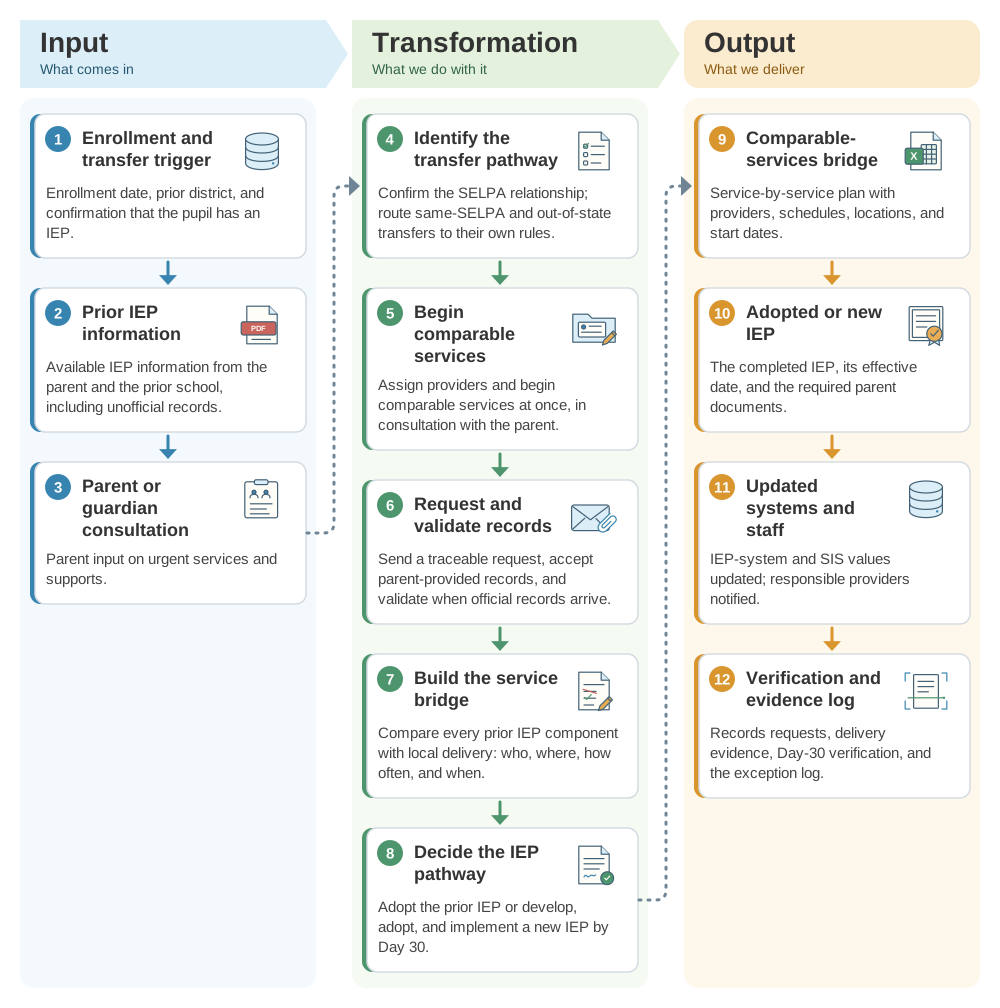
From enrollment to a completed IEP: the SDLA ITO workflow
A transfer creates two obligations at once: continuity now and a durable receiving-LEA decision within 30 days. This SDLA ITO (Input, Transformation, Output) graphic shows how the enrollment record, prior IEP information, and parent consultation become the comparable-services bridge, the adopted or new IEP, updated systems, and the verification log.
The 30-day implementation calendar
- Day 0 · EnrollmentEnroll and identify the transfer immediately.Capture the prior district, confirm the pupil has an IEP, determine whether the prior district operates under the same or a different SELPA, and alert special education leadership and the assigned case owner.
- Day 0–1 · Immediate activationConsult the parent and open the comparable-service bridge.Obtain available IEP information from the parent and prior school, identify urgent services and supports, assign providers, and begin comparable services without delay.
- Day 0–2 · Records pursuitRequest the complete special education record.Request the IEP, assessments, eligibility documentation, progress information, behavior and health-support records, service logs, and supporting documents. Accept parent-provided unofficial records pending validation.
- Early bridge periodCompare every IEP component with actual local delivery.Document how each prior service, accommodation, modification, support, and placement component will be provided comparably, by whom, where, how often, and beginning when.
- Well before Day 30Resolve the permanent IEP pathway.Determine whether the receiving LEA will adopt the prior IEP or develop, adopt, and implement a new IEP. Route questions involving possible assessment or unusual procedural complexity to the SELPA immediately.
- No later than Day 30Complete and implement the decision.Adopt the previously approved IEP or complete a legally compliant new IEP, provide required parent documentation, update systems, notify responsible staff, and verify implementation.
- Immediately after completionReconcile the written program with actual services.Compare the final IEP, provider schedules, service logs, accommodations, placement, transportation, parent documents, and student systems; correct any gap promptly.
First route the pupil to the correct transfer pathway
| Transfer pathway | Immediate responsibility | Required destination |
|---|---|---|
| California district operating under the same SELPA | Continue, without delay, services comparable to those in the existing approved IEP. | Continue the existing IEP unless the parent and LEA agree to develop, adopt, and implement a new IEP consistent with law. |
| California district operating under a different SELPA | Provide FAPE, including comparable services, in consultation with the parent or guardian. | Within 30 days, adopt the previously approved IEP or develop, adopt, and implement a new IEP. This is the pathway addressed by this page. |
| Educational agency outside California | Provide FAPE, including comparable services, in consultation with the parent or guardian. | Apply the separate out-of-state transfer, record, assessment, and IEP rules. Route to the special education administrator or SELPA rather than applying this page mechanically. |
Build a service-by-service comparable-services bridge
“Comparable” requires a deliberate bridge built from the prior IEP and consultation with the parent or guardian. It is not an invitation to postpone services, nor does it mean that the receiving LEA must copy unfamiliar service labels without deciding how the pupil will actually receive comparable access locally.
| IEP component | Document during the bridge | Immediate control |
|---|---|---|
| Specialized academic instruction | Prior frequency, duration, setting, goals supported, interim provider, local schedule, and start date. | Place instruction on an actual staff schedule and verify first delivery. |
| Related services | Each service, frequency, duration, group size, setting, provider, and any necessary local adjustment. | Contact providers immediately; escalate capacity or credentialing problems rather than leaving the service unassigned. |
| Accommodations and modifications | Classroom, assessment, communication, assignment, grading, environmental, and access supports. | Provide responsible staff an actionable interim implementation summary. |
| Behavior supports and plans | Behavior plan, goals, prevention strategies, reinforcement, response procedures, data collection, and safety information. | Brief receiving staff before the pupil encounters the relevant setting or trigger. |
| Transportation | Prior requirement, pickup and drop-off needs, specialized equipment or supervision, route owner, and start date. | Create an immediate safe-access solution while permanent routing is completed. |
| Health and emergency procedures | Orders, plans, trained personnel, medications or equipment, emergency response, and family/provider contacts. | Do not place the pupil in a setting that lacks a required health or safety control. |
| Placement and participation | Prior setting, time with nondisabled peers, campus access, electives, extracurricular access, and local interim setting. | Document why the interim arrangement is comparable and escalate material differences. |
| Progress and current performance | Recent progress, unfinished evaluations, current concerns, parent input, and information needed for the Day-30 decision. | Use current information to refine delivery without waiting to begin services. |
Choose the receiving LEA’s IEP pathway
Adopt the existing IEP
This pathway may be appropriate when the IEP is current and complete; eligibility and evaluation information are sufficient; the receiving LEA can implement the program; services, placement, goals, accommodations, and supports remain appropriate; and no material unresolved concern requires revision.
Completion control: Document the adoption, provide required parent materials, enter the adopted program accurately, notify every responsible provider, and verify actual implementation by Day 30.
Develop, adopt, and implement a new IEP
This pathway may be appropriate when the prior program cannot be implemented as written in the receiving setting; current needs require changes; records are incomplete or conflicting; or goals, placement, services, accommodations, or supports require team revision.
Completion control: Use the legally required IEP process. Do not perform an administrative rewrite merely to substitute local service labels. Route assessment and procedural-timeline questions to the SELPA early enough to protect the 30-day outcome.
The 30-day transfer bridge
Records retrieval is urgent—but it does not suspend services
- Send a traceable records request immediately.Request the current and prior IEPs, assessments, eligibility documents, progress reports, service information, behavior and health-support documents, and other supporting records.
- Accept parent-provided unofficial records.Use available records pending validation instead of treating the lack of an official file as permission to delay the transfer process.
- Track the prior agency’s response.California’s separate records-transfer control requires the former educational agency to send special education records within five working days after the receiving LEA’s request.
- Validate without restarting the clock.When official records arrive, compare them with the interim information, correct the service bridge if necessary, and document the resolution.
- Escalate missing records.Use direct district-to-district contact, administrator involvement, and SELPA assistance while continuing comparable services from the best available information.
Route high-risk or unusual transfers immediately
Residential or nonpublic-school placement
Route: Notify the special education administrator, SELPA, placement and fiscal staff immediately.
Control: Confirm current placement, contractual and funding responsibilities, related services, transportation, and the pupil’s immediate safe educational access.
One-to-one nursing or intensive health support
Route: Engage nursing leadership, the case owner, administrator, parent, and appropriate health providers immediately.
Control: Establish a safe comparable arrangement before the pupil enters a setting requiring the support; do not use staffing recruitment as a reason to leave the need unaddressed.
Specialized transportation
Route: Send the requirement to special education transportation and the case owner on Day 0.
Control: Arrange an immediate safe access solution, document the interim plan, and confirm the permanent route and start date.
Behavior intervention, crisis, or emergency plan
Route: Notify the administrator, behavior team, case owner, receiving teachers, and health or safety staff before exposure to the relevant environment.
Control: Obtain the plan, consult the parent and prior staff when possible, train receiving personnel, and begin necessary data and safety practices.
Required service cannot be reproduced immediately
Route: Escalate to the special education administrator and SELPA rather than silently reducing, omitting, or indefinitely substituting the service.
Control: Document the prior requirement, parent consultation, interim comparable response, responsible owner, resolution deadline, and actual service delivery.
Pending assessment, complaint, mediation, or due-process matter
Route: Contact the special education administrator and SELPA immediately and obtain the relevant procedural records.
Control: Preserve comparable services and applicable procedural obligations while determining the receiving LEA’s responsibilities.
Missing, conflicting, or expired eligibility and IEP records
Route: Use parent consultation, available unofficial records, prior-district contact, and SELPA support to resolve the conflict.
Control: Document what is known, what is disputed, the interim services being delivered, and the owner and deadline for each missing decision.
Reconcile the transfer decision with actual implementation
| Control point | Authoritative source or owner | Compare against | Corrective action |
|---|---|---|---|
| Transfer trigger and pathway | Enrollment record and special education lead: enrollment date, prior district, same-year transfer, and SELPA relationship. | Parent information, prior-school information, records request, and case assignment. | Correct the route immediately; do not reset the service obligation because the original classification was wrong. |
| Prior eligibility and IEP | Prior records validated with available parent-provided information. | Current pupil circumstances, parent consultation, official records when received, and unresolved procedural matters. | Resolve conflicts and missing information while continuing documented comparable services. |
| Comparable-services bridge | Case owner with parent consultation: service-by-service interim delivery plan. | Provider schedules, class schedules, transportation, accommodations, support plans, and actual service logs. | Assign the provider, start or restore delivery, escalate a material variance, and document any remedial response. |
| Adopted or new IEP | Receiving LEA’s completed IEP decision: final services, placement, goals, supports, and effective dates. | Parent documents, IEP system, staff implementation summaries, and Day-30 tracker. | Correct incomplete documentation, provide missing parent materials, and repair system or implementation discrepancies. |
| Service implementation | Responsible providers and administrators: actual delivery required by the final program. | IEP commitments, staff schedules, service logs, accommodations, placement, and pupil access. | Address missed or inaccurate delivery promptly and document the correction and follow-up. |
| Student systems and reporting | IEP-system and student-data staff: approved program values and dates. | SIS, CALPADS-related special education data, provider platforms, enrollment dates, and final IEP documentation. | Correct the authoritative source carefully, propagate the correction, and verify persisted values across systems. |
Recommended LEA workflow
- Create an enrollment trigger that cannot disappear. Require front-line enrollment staff to identify possible IEP status and alert special education immediately.
- Assign one accountable case owner. Give that person the enrollment date, Day-30 deadline, prior district, transfer type, parent contact, records status, and escalation authority.
- Start records and services in parallel. Request the record, accept parent documents, consult the parent, assign providers, and begin comparable services without sequencing one behind another.
- Build the written service bridge. Translate the prior IEP into actual interim providers, schedules, locations, supports, and start dates.
- Review implementation early. Confirm the pupil actually received the planned services and accommodations; resolve gaps before they become a month-long pattern.
- Select the permanent pathway with time to complete it. Decide between adoption and a new IEP early enough for required parent participation, documentation, SELPA consultation, and implementation before Day 30.
- Escalate complexity rather than pausing. Use the SELPA for assessment, procedural, placement, missing-record, and high-intensity service questions while maintaining the comparable-service bridge.
- Complete and verify. Finish the receiving-LEA IEP action, give required documents to the parent, inform staff, update systems, and reconcile actual delivery.
Evidence to retain
- Enrollment date and outside-SELPA transfer trigger.
- Prior district and same-SELPA/different-SELPA determination.
- Immediate internal referral and accountable case-owner assignment.
- Records request, follow-up, receipt dates, and validation log.
- Parent-provided unofficial records retained pending validation.
- Parent or guardian consultation and contact attempts.
- Prior-IEP component review and identified information gaps.
- Comparable-services bridge plan with providers, schedules, locations, and start dates.
- Actual first-service and ongoing delivery evidence.
- Transportation, health, behavior, placement, and other high-risk handoffs when applicable.
- Decision to adopt the prior IEP or develop a new IEP.
- Completed adoption or new IEP documentation and effective date.
- Required parent notices, final IEP, and delivery evidence.
- Day-30 completion and post-completion implementation verification.
- Exception, escalation, missed-service, and corrective-action log.
Official guidance and help
- California Education Code section 56325Transfer pathways, comparable services, the outside-SELPA 30-day requirement, out-of-state transfers, records retrieval, and acceptance of parent-provided unofficial records.
- California Education Code section 56043California’s primary special education timelines, including same-SELPA, outside-SELPA, out-of-state, and records-transfer controls.
- 34 CFR section 300.323(e)Federal same-state transfer requirement to provide FAPE, including comparable services in consultation with parents, until the prior IEP is adopted or a new IEP is developed, adopted, and implemented.
- CDE State Administration List, 2026CDE summary of California-imposed special education duties, including the outside-SELPA 30-day control and five-working-day records transfer.
Implementation questions: Follow the receiving LEA’s current SELPA procedures and escalation contacts for assessment, placement, procedural, and high-intensity service questions.
Source review completed August 28, 2026. Verify current statutes, federal regulations, SELPA procedures, forms, local service-delivery practices, and special education data requirements before acting.