



SDLA Compliance Resource
Complete the IDEA Resolution Period
A practical guide to the LEA’s obligations and authority, the parent’s or adult student’s rights and choices, and the timelines for attempting to resolve a due-process complaint before hearing.
In Plain Language: After a parent or adult student files an IDEA due-process complaint, the law provides a short opportunity for the parties to discuss the dispute and try to resolve it before the hearing proceeds. The LEA normally must convene a resolution meeting within 15 calendar days. The resolution period normally lasts 30 calendar days. Each party has protected choices, but neither party controls the process alone.
Why this matters
The resolution period can correct a pupil’s program or resolve a disagreement without the cost and delay of a hearing. It also carries strict procedural requirements. A missed meeting deadline, representative without settlement authority, improper attorney participation, undocumented waiver, or misunderstood settlement can shift the case into hearing with additional risk.
Joint ownership
Accountable owner: special education director. Case coordinator: due-process or compliance administrator. Required LEA participant: representative with decision-making authority. Other participants: relevant IEP team members with specific knowledge of the allegations. Partners: calendar owner, SELPA, records staff, fiscal services, and legal counsel.
The LEA and parent do not have identical roles
| Resolution issue | LEA or school district | Parent or adult student |
|---|---|---|
| Convening the meeting | Must convene the resolution meeting within 15 calendar days after receiving notice of the parent’s complaint unless a permitted alternative applies. | Has the right to a timely resolution meeting and the opportunity to discuss the complaint and supporting facts. |
| Choosing participants | Works with the parent to determine the relevant IEP team members who have specific knowledge of the facts. | Works with the LEA to determine which relevant IEP team members should attend. |
| Decision-making authority | Must include a representative authorized to make decisions and bind the agency within that authority. | May evaluate the LEA’s proposals and decide whether a proposed resolution is acceptable. |
| Attorney participation | May not bring its attorney unless the parent or adult student is accompanied by an attorney. | May bring an attorney. Doing so permits the LEA to bring its attorney as well. |
| Waiving the meeting | May agree to waive the meeting, but only through a written agreement with the parent. | May agree or decline to waive the meeting. The LEA cannot require the waiver. |
| Using mediation | May agree to use IDEA mediation instead of holding the resolution meeting. | May agree or decline to use mediation. Mediation is voluntary. |
| Settlement | May propose, negotiate, accept, or reject terms through an authorized representative. | May propose, negotiate, accept, or reject settlement terms. |
| Voiding a signed resolution agreement | May void the agreement within three business days after execution. | May void the agreement within the same three-business-day period. |
| When agreement is not possible | May agree in writing after resolution or mediation begins that no agreement is possible, which adjusts the hearing timeline. | May agree in writing to the same determination; neither party can impose it unilaterally under this provision. |
| Failure to participate | May request dismissal after the 30-day period if documented reasonable efforts did not obtain parent participation. | May seek hearing-officer intervention if the LEA fails to convene or participate in the required meeting. |
Three lawful meeting routes
Hold the resolution meeting
Convene within 15 calendar days with the parent or adult student, relevant IEP team members, and an LEA decision-maker. Discuss the complaint and facts so the LEA has an opportunity to resolve the dispute.
Use a jointly selected alternative
The meeting need not be held when both parties agree in writing to waive it or when both parties agree to use IDEA mediation. Silence, scheduling difficulty, or an LEA preference is not a waiver.
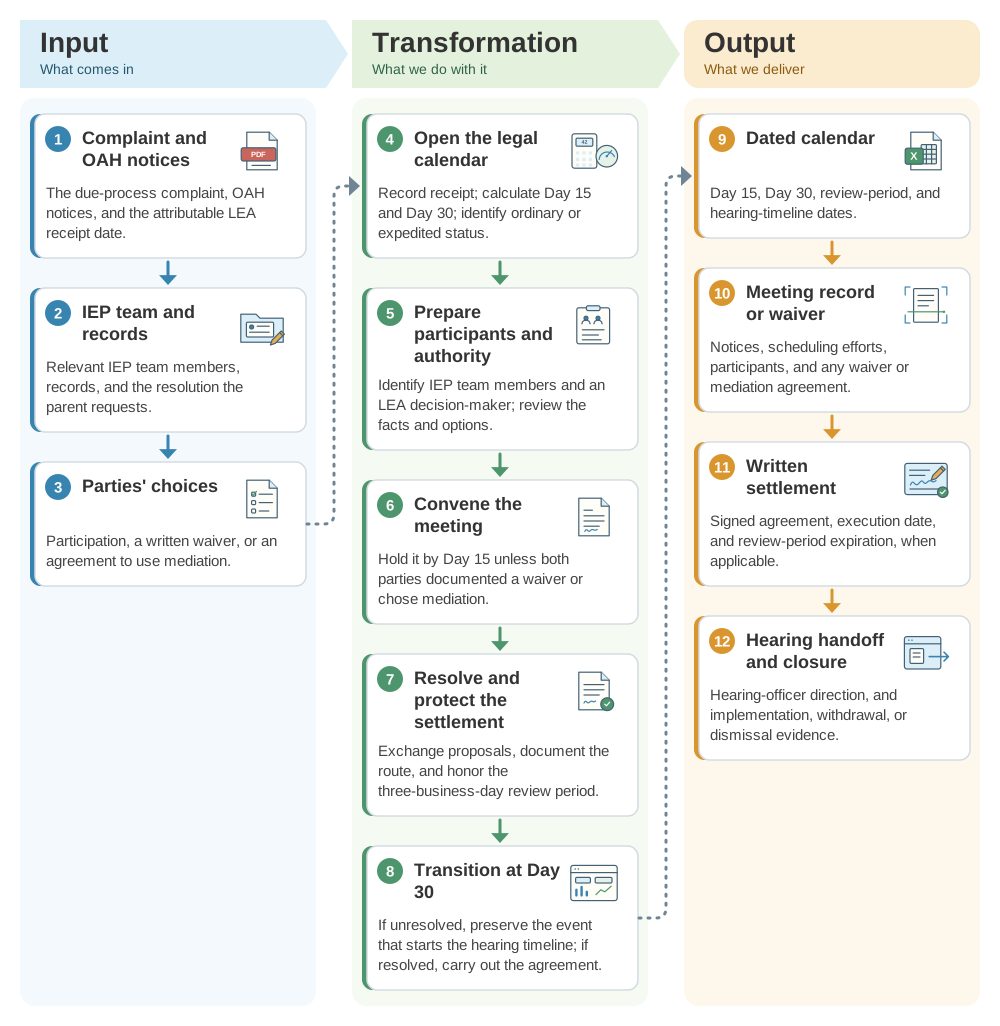
From due-process complaint to hearing handoff: the SDLA ITO workflow
After a parent or adult student files a complaint, the law gives a short opportunity to try to resolve the dispute before the hearing proceeds. This SDLA ITO (Input, Transformation, Output) graphic shows how the due-process complaint, OAH notices, and the parties' choices become the dated calendar, the meeting record or waiver, any written settlement, and the hearing handoff.
The resolution-period calendar
- Day 0 · Notice of parent complaint receivedOpen the legal calendar immediately.Record the attributable receipt date, calculate the Day 15 and Day 30 dates, route the complaint, preserve OAH materials, and identify whether the matter is ordinary or expedited.
- Immediately after intakePrepare the right participants and authority.Work with the parent to identify relevant IEP team members; select an LEA representative with decision-making authority; assess attorney participation; review the allegations, facts, records, requested resolution, and implementation options.
- No later than Day 15Convene the resolution meeting.Hold the meeting unless both parties have documented a written waiver or agreed to mediation. Calendar days continue through weekends, school breaks, and holidays.
- During the 30-day periodAttempt resolution and document the route.Exchange proposals, identify actions and authority, obtain written agreements when required, implement any immediate terms, and report the resolution-session outcome through the applicable OAH process.
- Three business days after settlement executionProtect the review period.Calendar the time during which either party may void the resolution agreement. Do not treat the settlement as irrevocable before that period expires.
- Day 30 or adjusted endpointTransition accurately.If unresolved, preserve the event that starts the hearing timeline. If resolved, carry out the binding agreement, update the pupil’s records and services as required, and retain closure evidence.
How the hearing timeline can start
| Event | Required evidence | Timeline effect |
|---|---|---|
| No resolution by the end of the ordinary 30-day period | Day 0 calculation, resolution history, outcome record, and unresolved issues. | The 45-day hearing-decision timeline generally begins after the resolution period expires. |
| Both parties waive the resolution meeting | Written agreement signed or otherwise attributable to both parties. | The 45-day timeline begins the day after the written waiver. |
| After resolution or mediation begins, both parties agree no agreement is possible | Written agreement identifying the parties and date. | The 45-day timeline begins the following day. |
| Both parties continue mediation after Day 30, then one party withdraws | Written agreement to continue and attributable withdrawal date. | The 45-day timeline begins the day after withdrawal. |
| Parent fails to participate and no waiver or mediation agreement exists | Documented reasonable efforts, communications, scheduling options, and hearing-officer direction. | Resolution and hearing timelines may be delayed until the meeting occurs; dismissal may be requested after Day 30. |
| LEA fails to convene or participate by Day 15 | Meeting record, scheduling history, or absence of the required LEA action. | The parent may seek hearing-officer intervention to begin the hearing timeline. |
Neither party may act alone on these decisions
- The LEA cannot require the parent to waive the resolution meeting.
- The parent cannot require the LEA to waive the resolution meeting.
- Neither party can force the other to participate in voluntary mediation.
- Neither party can create a binding settlement without the other party’s agreement and signature by an authorized LEA representative.
- Neither party can eliminate the three-business-day review period for a resolution-session agreement through an informal assumption.
- Neither party should change a controlling OAH or hearing timeline without the written agreement, withdrawal, or hearing-officer action required for that change.
A valid resolution agreement
Route exceptions immediately
The complaint is an expedited disciplinary matter
Route: Escalate immediately to the special education director and legal counsel. Expedited complaints generally require a resolution meeting within seven days and a 15-day resolution period.
Control: Do not apply the ordinary Day 15 and Day 30 calendar to an expedited case.
The parent cannot attend within 15 days
Route: Make and document reasonable scheduling efforts, including mutually acceptable alternative participation methods when appropriate.
Control: The LEA remains responsible for attempting to convene timely; school closure or scheduling difficulty does not automatically suspend the deadline.
The parent does not participate
Route: Continue documented reasonable efforts using calls, correspondence, and other appropriate methods. Seek hearing-officer direction rather than declaring the complaint dismissed locally.
Control: At the conclusion of the 30-day period, the LEA may request dismissal if it could not obtain participation despite documented reasonable efforts.
The parties want to continue mediation after Day 30
Route: Document their written agreement to continue mediation. Track any later withdrawal by the parent or public agency.
Control: The hearing timeline begins the day after a party withdraws from the continued mediation process.
The due-process complaint is amended
Route: Obtain legal and OAH calendar review immediately. An amended complaint can restart the resolution-meeting and resolution-period timelines under the applicable IDEA procedures.
Control: Preserve the original and amended complaints, filing and notice dates, consent or hearing-officer authorization, and revised deadlines.
Resolution-period preflight
- The complaint, OAH case number, filing party, notice-receipt date, and service evidence are confirmed.
- The ordinary or expedited route is identified correctly.
- Day 15 and Day 30 dates—or the expedited dates—are independently reviewed.
- The parent and LEA identified the relevant IEP team participants.
- The LEA representative has real decision-making authority appropriate to the dispute.
- Attorney participation complies with the resolution-session rule.
- Records, allegations, factual chronology, proposed remedies, fiscal authority, and implementation capacity are reviewed.
- A waiver or mediation route is supported by the required mutual agreement.
- Interpretation, disability access, remote participation, and scheduling needs are addressed.
- The OAH resolution-session outcome reporting responsibility and deadline are assigned.
- Every settlement term has an owner, date, implementation method, and evidence.
- The three-business-day review period and hearing-timeline trigger are recorded accurately.
Evidence to retain
- Due-process complaint, OAH notices, service, and attributable LEA receipt date.
- Day 15, Day 30, three-business-day, and hearing-timeline calculations.
- Meeting notices, scheduling efforts, parent communications, and accessibility arrangements.
- Relevant IEP team member determination and participant list.
- LEA representative’s role and decision-making authority.
- Written waiver or mutual agreement to use mediation, when applicable.
- Resolution-session participation and OAH outcome reporting.
- Written settlement, signatures, execution date, and review-period expiration.
- Written agreement that no agreement is possible, when applicable.
- Agreement to continue mediation and later withdrawal, when applicable.
- Documented reasonable efforts to obtain participation.
- Hearing-officer orders, amended complaints, and revised calendar.
- Implementation, payment, service, IEP, record, withdrawal, or dismissal evidence required by settlement.
Official guidance and help
- 34 CFR section 300.510Resolution meeting, participants, 15- and 30-day requirements, waiver, mediation, participation failures, timeline adjustments, settlement, and three-business-day review period.
- IDEA section 615(f)(1)(B)Statutory resolution-session and resolution-period requirements.
- CDE – Special Education Dispute ResolutionCalifornia explanation of the resolution period, session participants, confidentiality distinction, waivers, mediation, timeline adjustments, OAH resources, and reporting.
- 34 CFR section 300.506Voluntary IDEA mediation, qualified impartial mediators, confidentiality, and legally binding agreements.
- 34 CFR section 300.515Forty-five-day hearing-decision timeline and hearing-officer extensions.
Implementation questions: Follow current OAH notices and orders and obtain appropriate SELPA or legal guidance for case-specific calculations, sufficiency challenges, amended complaints, settlement authority, confidentiality, expedited cases, and enforcement.
Source review completed August 28, 2026. Verify the current due-process complaint, service and notice dates, OAH case record, federal requirements, state guidance, and case-specific orders before acting.