



SDLA Compliance Resource
Complete CDE-Ordered Corrective Actions
An implementation guide for translating a CDE special education complaint decision into assigned work, timely remedies, complete evidence, and confirmed closure.
In Plain Language: When CDE finds that an LEA violated special education law, its investigation report identifies what must be done to remedy the effect on the affected pupil or pupils and what must change to support future compliance. Read the order carefully, assign every action, complete exactly what CDE required, submit the requested evidence by each deadline, and obtain CDE confirmation that the action is closed.
Why this matters
A corrective action is part of CDE’s final complaint decision—not a district suggestion list. Missing a deadline, submitting incomplete evidence, or correcting only the individual case without addressing an ordered systemic problem can leave the finding open and expose the LEA to additional monitoring or enforcement.
Joint ownership
Accountable owner: special education director. Order coordinator: designated complaint or compliance administrator. Action owners: assigned student-level and department staff. Evidence owner: compliance or records specialist. Partners: fiscal services, SELPA, legal counsel when appropriate, and every administrator responsible for an ordered systemic correction.
Correct the pupil’s experience and the practice that caused the problem
Pupil-specific remedy
Corrects the effect on the affected pupil or family. CDE may order an assessment, IEP meeting, compensatory education, service, reimbursement, record correction, notice, or another pupil-specific action.
Completion question: Did the pupil or family actually receive the remedy CDE ordered?
Systemic correction
Changes the practice that caused or permitted the violation. CDE may require revised procedures, staff training, additional file review, monitoring, reporting, or evidence of subsequent compliant practice.
Completion question: Does the evidence show that the revised practice is being implemented correctly?
A report may order one or both types of action. Completing a pupil-specific remedy does not automatically satisfy an ordered systemic correction, and issuing a new procedure does not replace an ordered remedy for the affected pupil.
From CDE order to confirmed closure: the SDLA ITO workflow
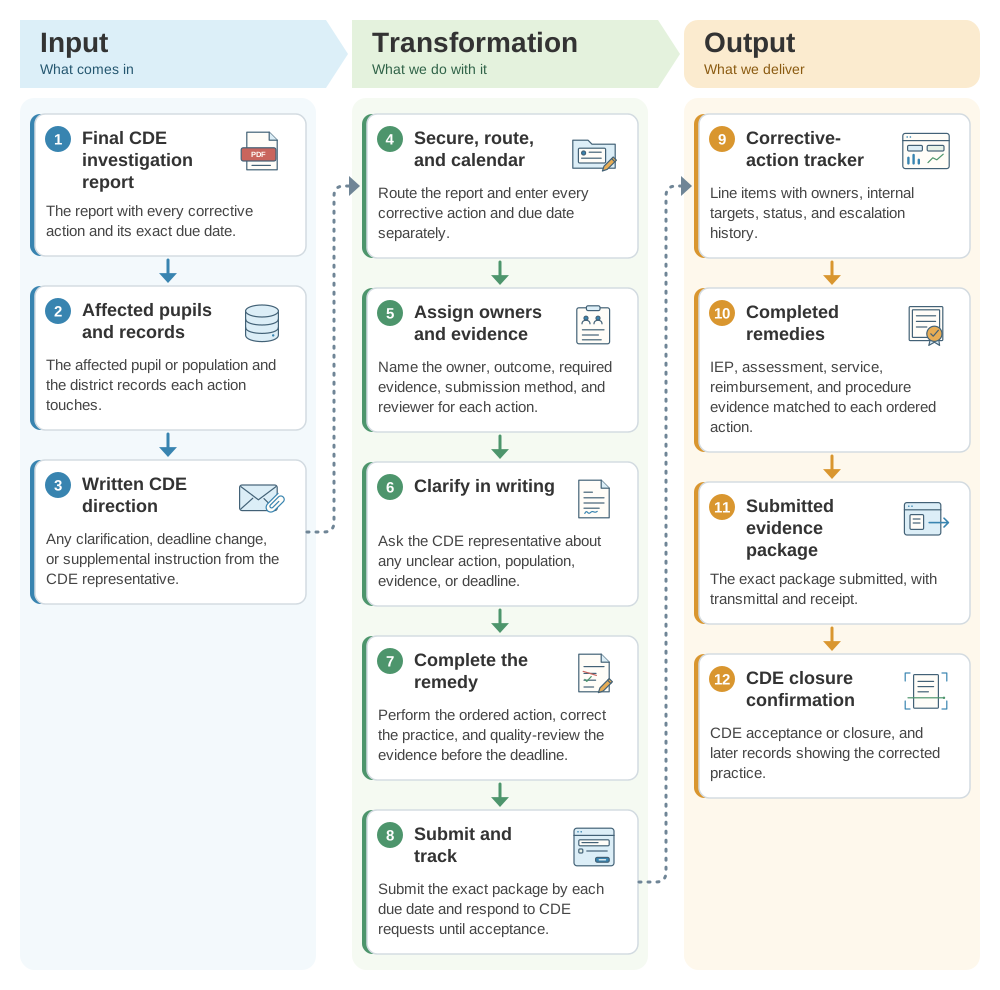
Read the order carefully, assign every action, and complete exactly what CDE required. This SDLA ITO (Input, Transformation, Output) graphic shows how the CDE investigation report, the affected pupils' records, and any written CDE direction become the corrective-action tracker, the completed remedies, the evidence package, and CDE closure.
The order-to-closure calendar
- On receipt of the final investigation reportSecure, route, and calendar the order.Send the report to the superintendent or designee, special education director, order coordinator, and appropriate advisory staff. Enter every corrective action and exact due date separately.
- Immediately after intakeAssign accountable owners and evidence.For each action, identify the affected pupil or population, required outcome, responsible owner, internal target, evidence CDE requires, submission method, and reviewer.
- Early in the response periodClarify uncertainty in writing.If the action, population, evidence, or deadline is unclear, contact the assigned CDE representative promptly. Do not silently narrow, replace, or reinterpret the ordered remedy.
- Before each ordered deadlineComplete the remedy and correct the practice.Perform the actual ordered action, preserve attributable records, quality-review the evidence, and resolve discrepancies while time remains.
- By each CDE due dateSubmit the exact evidence package.Use the specified secure method, identify the correct complaint and action, retain the submitted version, and preserve transmittal and receipt evidence.
- After submissionTrack through CDE acceptance.Respond promptly to requests for clarification, revision, or supplemental evidence. Do not close the district tracker solely because evidence was sent.
- After CDE closureCarry the correction into ordinary practice.Retain CDE confirmation, reconcile pupil and system records, monitor the corrected procedure, and use the finding to prevent recurrence.
Use one line-item corrective-action tracker
The tracker is a recommended district control. CDE’s investigation report—not the tracker—remains the authority.
| CDE-required action | Due date | Owner | Completion evidence | Submission | CDE status |
|---|---|---|---|---|---|
| Copy the action exactly or preserve an attributable reference to the controlling report. | Use the exact CDE date; add an earlier internal target separately. | Name one accountable role and the staff completing the work. | Identify the records that will prove the ordered outcome occurred. | Record method, date, submitter, receipt, and retained package. | Not started, in progress, submitted, supplemental evidence requested, or CDE accepted/closed. |
Match the evidence to the ordered outcome
| Ordered action | Evidence should ordinarily demonstrate | Do not stop at |
|---|---|---|
| Convene an IEP meeting | Notice, participation, completed IEP action, required parent documents, and resulting implementation. | Sending an invitation or placing a meeting on the calendar. |
| Conduct an assessment | Assessment process, completed report, team consideration, required notices, and ordered follow-through. | Issuing an assessment plan or assigning an evaluator. |
| Provide compensatory education or services | Ordered amount and type, qualified provider, family communication, dates delivered, duration, access supports, and remaining balance. | Offering dates, signing a contract, or encumbering funds. |
| Reimburse a family | Approved amount, completed payment, delivery, and reconciliation to the ordered remedy. | Internal payment approval or creation of a purchase order. |
| Revise a procedure | Approved final procedure, effective date, superseded version, distribution, implementation, and consistency with the order. | A draft procedure or an email announcing that revision is underway. |
| Train personnel | Content addressing the violation, qualified presenter, intended participants, date, materials, participation, and follow-up. | A meeting agenda or sign-in sheet without the training content. |
| Review pupil files | Required population or sample, review method, results, individual corrections, systemic findings, and responsible reviewer. | A statement that files were reviewed. |
| Demonstrate future compliance | Subsequent records showing that the corrected procedure was implemented accurately in actual cases. | Policy adoption or training completion alone. |
Manage compensatory services to actual completion
- Record the amount, type, scope, intended outcome, and deadline stated in the CDE order.
- Confirm provider qualifications and any required independence from ordinary district services.
- Communicate with the family using accessible and understandable methods.
- Address scheduling, transportation, technology, location, and other access barriers.
- Track services offered, scheduled, delivered, declined, missed, cancelled, and rescheduled.
- Maintain the original entitlement, delivered amount, and remaining balance separately.
- Escalate difficulty before the ordered deadline and seek written CDE direction when necessary.
- Submit the evidence CDE requires and retain its acceptance or closure response.
Three essential warnings
Reconsideration does not automatically pause corrective action
Either party may request reconsideration within 30 days from the date appearing on the investigation report using one or more permitted grounds. While CDE considers the request, the corrective actions remain effective and enforceable unless stayed by a court.
District control: Calendar both the reconsideration date and every corrective-action deadline. Do not suspend work based solely on the filing of a request.
Internal completion is not CDE closure
“Completed” means the LEA performed the ordered action and assembled support. “Submitted” means CDE received the evidence. “Closed” means CDE accepted the evidence or otherwise confirmed that the corrective action is complete.
District control: Keep the action active until the CDE status is documented.
Failure to act can lead to enforcement
If an agency fails to take required corrective action, CDE may use legally authorized means to secure compliance. These can include conditioning future support, withholding special education fiscal support, or seeking a court order. CDE must determine that compliance cannot be secured by other means before curtailing funding.
District control: Escalate a threatened deadline early rather than waiting to explain noncompletion after it passes.
Escalate a deadline at risk
Parent participation, consent, or scheduling remains unresolved
Act: Continue documented reasonable efforts using accessible communication, involve the special education director, and seek prompt SELPA, legal, or CDE guidance appropriate to the ordered action.
Preserve: Every contact, response, barrier, alternative offered, next action, and written direction received.
A qualified provider cannot be secured
Act: Expand the documented provider search, address contracting and access barriers, develop a supportable contingency, and contact CDE before the deadline when the order may not be fulfilled as written.
Do not: Substitute a different service or reduce the ordered amount unilaterally.
Records or evidence are incomplete
Act: Identify the missing source, assign recovery, verify whether the ordered action itself occurred, and escalate any inability to substantiate completion.
Do not: create, back-date, or reconstruct a record in a manner that misrepresents the actual event.
The order or required evidence is ambiguous
Act: Send a focused written question to the assigned CDE representative identifying the action, ambiguity, proposed understanding, and deadline.
Preserve: The question, response, resulting district decision, and any updated due date or evidence instruction.
A systemic review reveals additional noncompliance
Act: Notify the special education director, protect affected pupils, determine necessary individual and systemic correction, and seek SELPA, legal, or CDE guidance as appropriate.
Control: Do not limit correction mechanically to the original sample when the district has actual evidence of a broader problem.
Protect and quality-review the evidence package
- Use the required submission method. Follow the instructions in the report or subsequent CDE correspondence and protect pupil, family, and personnel information.
- Match evidence to the complaint and action. Label the complaint number, ordered action, pupil or population, and deliverable clearly.
- Submit only responsive records. Include what CDE requires while applying applicable confidentiality, disclosure, and redaction requirements.
- Perform an independent internal review. Confirm that the evidence proves the ordered outcome, dates agree, totals reconcile, documents are final, and personally identifiable information is handled appropriately.
- Retain the exact package. Preserve the submitted files, transmittal, receipt, CDE response, supplemental submission, and closure confirmation.
Evidence to retain
- Final CDE investigation report and all corrective-action language and deadlines.
- Reconsideration request and resulting CDE decision, when applicable.
- Line-item tracker, owners, internal targets, status, and escalation history.
- Written CDE clarification, deadline change, or supplemental instruction.
- IEP, assessment, notice, service, compensatory education, reimbursement, and delivery evidence.
- Revised procedures and the versions they replaced.
- Training content, presenters, participants, dates, and follow-up evidence.
- File-review population, method, results, individual corrections, and systemic findings.
- Subsequent records demonstrating implementation of corrected practice.
- Internal evidence quality review and discrepancy resolution.
- Exact evidence package submitted to CDE, transmittal, and receipt.
- CDE requests for revision or supplemental evidence and the LEA’s response.
- Final CDE acceptance or closure confirmation.
Official guidance and help
- CDE – Special Education Complaint ProcessComplaint investigation reports, corrective-action examples, timelines, reconsideration, monitoring, and Complaint Resolution Unit responsibilities.
- CDE – Guidance Regarding Special Education Complaint RegulationsCalifornia regulations governing investigation, reconsideration, continuing enforceability, and enforcement of corrective actions.
- 34 CFR section 300.151Federal requirement to remedy failure to provide appropriate services for the affected child and support appropriate future services for all children with disabilities.
- 34 CFR section 300.152Federal minimum state complaint procedures, investigation, decision, timeline, implementation, and enforcement requirements.
- California Education Code section 56500.2California special education complaint procedures and incorporation of federal requirements.
Implementation questions: Contact the CDE representative identified in the investigation report for order-specific clarification. Use current SELPA and legal support for local implementation, reconsideration, confidentiality, or procedural questions.
Source review completed August 28, 2026. Verify the controlling investigation report, subsequent CDE correspondence, current statutes and regulations, CDE procedures, and local SELPA guidance before acting.