



SDLA Compliance Resource
Respond to County Conditional Approval or Disapproval of the Budget
An implementation guide for districts whose adopted budget is conditionally approved or disapproved by the county superintendent, from the September 15 notice through the October 8 response and November 8 county action.
In Plain Language: The county superintendent must approve, conditionally approve, or disapprove each district's adopted budget by September 15. If the county does not approve it, the board must review the county's written recommendations at a regular public meeting and respond by October 8, including any budget revisions. The county then approves or disapproves the revised budget by November 8, and a budget review committee may follow.
Why this matters
Each step has a statutory deadline, and the consequences escalate: a disapproved revised budget can lead to a review committee, a county-imposed fiscal plan by December 31, and loss of local control over spending decisions.
Joint ownership
District: superintendent, chief business official, and the board. County office: issues recommendations, acts on the revised budget, and calls the review committee. State: the State Superintendent is notified of disapprovals by November 8.
From a county recommendation letter to an approved revised budget: the SDLA ITO workflow
A disapproval response turns the county's written recommendations into a revised, defensible budget. This SDLA ITO (Input, Transformation, Output) graphic shows how the inputs become the outputs in 9 steps.
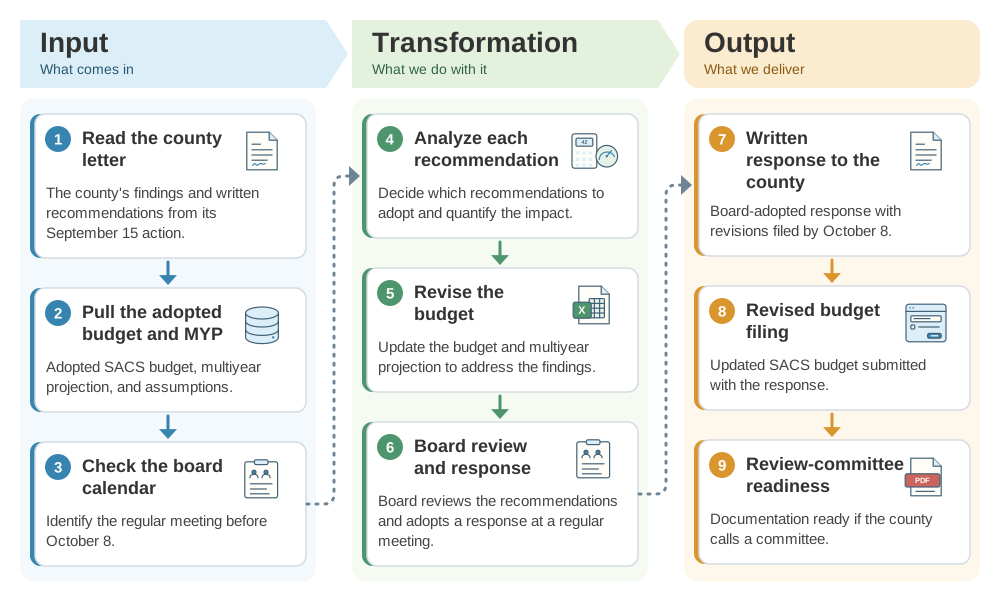
Implementation workflow
- By September 15Receive the county action.Log the county's approval status and recommendations.
- Late SeptemberAnalyze and revise.Quantify each recommendation and update the budget and MYP.
- Regular meeting before October 8Board response.Board reviews the recommendations and adopts the response and revisions.
- By October 8File.Send the response and revised budget to the county office.
- By November 8County action.County approves or disapproves the revised budget; respond to any review committee.
- By November 30 / December 31Committee and final budget.Review committee reports; a fiscal plan governs a still-disapproved district by December 31.
Disapproval response checklist
- County recommendations logged with an owner for each.
- Revised budget and MYP reconcile to the response narrative.
- Response adopted at a regular public meeting before October 8.
- Revised SACS budget filed with the response.
- Plan in place for a review committee if the revised budget is disapproved.
Official guidance and help
- Education Code 42127County review, recommendations, and the district response.
- 2026 Financial Reporting Calendar — County OversightCounty and district dates through December 31.
Source review completed October 25, 2026. Verify the dates in your county office's letter, which control if they differ.