



SDLA Compliance Resource
Present the LCAP to the Student Advisory Committee When Required
An implementation guide for distinguishing broad student consultation from the formal student advisory control, selecting the correct governance model, presenting the complete plan for review and comment, and responding before adoption.
In Plain Language: Every LCAP-producing LEA must consult students during plan development. In addition, a school district or county office serving middle- or high-school pupils must choose one formal representation model: include at least two pupils as full members of the Parent Advisory Committee (PAC), or operate a qualifying Student Advisory Committee. If the separate committee model applies, the complete LCAP must be presented to that committee for review and comment and the superintendent must respond in writing.
Why this matters
Student surveys, forums, classroom conversations, student-government meetings, and focus groups can support required student consultation. They do not automatically establish the formal representation model or complete the separate committee review. Treating all “student voice” activities as interchangeable can leave a governance gap.
Joint ownership
Governance owner: governing board establishes the selected model. Accountable presenter/respondent: superintendent. Process owner: LCAP coordinator. Participation partners: student-services staff, committee adviser, school leaders, accessibility and translation staff, and pupils representing the LEA's diversity.
Formal representation decision
| Question | If yes | If no |
|---|---|---|
| Does the district or COE serve middle-school or high-school pupils? | Choose and document one of the two formal representation models below. | The special two-pupil/committee requirement does not apply, but student consultation in LCAP development still does. |
| Has the governing board established at least two pupil positions as full PAC members? | Use the PAC-member model; pupils serve renewable terms of one full school year. | The governing board must establish or recognize a qualifying Student Advisory Committee. |
| Is a Student Advisory Committee the selected model? | Present the complete LCAP in a separate committee meeting for review and comment and provide a written response to comments. | Verify the two pupil members participate fully in the PAC's complete-plan review. |
Formal committee review versus broad student consultation
| Control | Formal student advisory review | Broader student consultation |
|---|---|---|
| Purpose | Provide advice and review and comment on the complete proposed LCAP through the selected statutory representation model. | Enable students to review and comment throughout development and surface diverse needs, experiences, and proposed solutions. |
| Governance | Board-established PAC positions or Student Advisory Committee; Greene Act requirements apply to the committees. | May include surveys, forums, student government, focus groups, classroom engagement, or meetings with student organizations. |
| Timing | Before governing-board consideration and adoption. | Ongoing and early enough to influence goals, metrics, actions, services, and expenditures. |
| Evidence | Establishment record, roster, terms, separate agenda and notice if applicable, complete draft, comments, and written response. | Methods, participants, accessibility, themes, feedback, and traceable impact on the plan. |
From the student representation model to a student review of the LCAP: the SDLA ITO workflow
Broad student consultation and the formal student advisory control are separate duties, and both must be documented. This SDLA ITO (Input, Transformation, Output) graphic shows how the board-established model, the student roster, and the consultation methods become the board action, the student participation and impact evidence, and the superintendent's response.
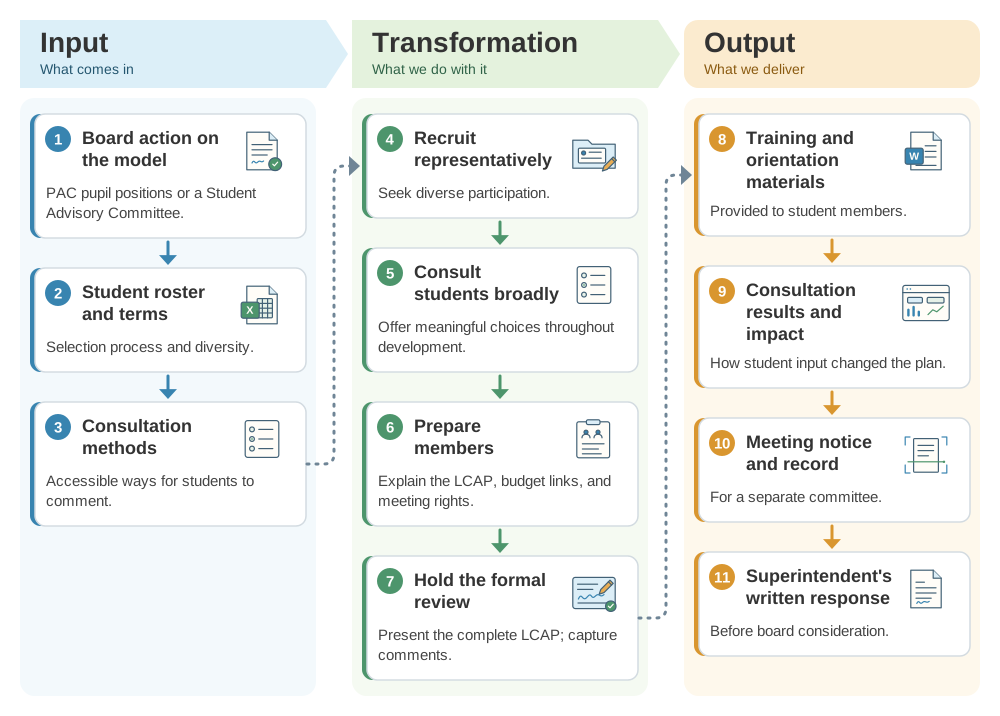
Implementation workflow
- Before the school year or term beginsConfirm the board-established model.Document the PAC pupil positions or Student Advisory Committee and recruit members through an equitable process.
- During recruitmentSeek representative participation.Consider geographical, socioeconomic, cultural, physical, and educational diversity, with particular outreach to at-risk or disadvantaged pupils.
- Throughout developmentConsult students broadly.Use accessible methods that let students review and comment on meaningful choices—not merely react to a finished plan.
- Before formal reviewPrepare members to participate.Explain the LCAP, budget connections, meeting rights, confidentiality boundaries, and how to formulate committee comments.
- At the formal reviewPresent the complete LCAP.For a separate Student Advisory Committee, hold its meeting separately from PAC and English learner PAC meetings and comply with Greene Act notice and participation requirements.
- Before adoptionRespond and show impact.The superintendent responds in writing to committee comments; the LCAP engagement narrative should explain how student input influenced decisions.
District, COE, and charter distinctions
| LEA type | Formal control | Boundary |
|---|---|---|
| School district | Education Code section 52063 applies when middle- or high-school pupils are served. | Governing board chooses two full PAC pupil members or a Student Advisory Committee. |
| County office of education | Parallel requirements appear in section 52069 for the COE's own LCAP. | The COE does not satisfy its own requirement through district committees under its jurisdiction. |
| Charter school | Section 47606.5 requires student consultation. | The formal committee provisions become relevant when a charter uses its LCAP as the SPSA under section 64001(j); verify the charter's planning model. |
Evidence to retain
- Governing-board action establishing the selected representation model.
- Roster, member-selection process, pupil terms, and representation review.
- Training and accessible orientation materials provided to pupil members.
- Student consultation methods, participation, results, and demonstrated impact on the LCAP.
- For a separate committee: Greene Act notice, agenda, public-comment opportunity, meeting record, complete LCAP presented, and committee comments.
- Superintendent’s written response and evidence that it preceded governing-board consideration.
Official guidance and help
- CDE LCFF Frequently Asked Questions: Parent and Community EngagementCurrent student advisory, committee, meeting, and consultation guidance.
- Education Code section 52063District PAC pupil-member and Student Advisory Committee options.
- Education Code section 52069Parallel county-office advisory requirements.
- CDE LCAP Template InstructionsRequired student consultation and engagement-impact documentation.
Source review completed August 30, 2026. Verify current statutes, committee establishment records, the LEA's grade span, charter/SPSA status, and the State Board-adopted LCAP template before acting.