



SDLA Compliance Resource
Verify Instructional Days and Annual Instructional Minutes
An implementation guide for building calendars and bell schedules that meet the 180-day (175 for charters) and annual-minute requirements, and documenting compliance for the audit.
In Plain Language: Districts must offer at least 180 instructional days and the annual instructional minutes set for each grade span; charter schools must offer 175 days and the same annual minutes. Calendars and bell schedules are the evidence. Changes during the year (minimum days, emergencies, schedule changes) must be tracked so the totals still meet the requirement.
Why this matters
A shortfall in days or minutes is a fiscal penalty in the annual audit, often large. Approved Form J-13A requests and SBE waivers are the only relief.
Joint ownership
District: educational services and site principals build schedules; HR aligns calendars with bargaining; attendance accounting verifies; the board adopts the calendar. Auditor: tests calendars and bell schedules.
Annual minimums
| Grade span | Annual minutes | Days |
|---|---|---|
| TK and kindergarten | 36,000 | 180 (districts) / 175 (charters) |
| Grades 1–3 | 50,400 | 180 / 175 |
| Grades 4–8 | 54,000 | 180 / 175 |
| Grades 9–12 | 64,800 | 180 / 175 |
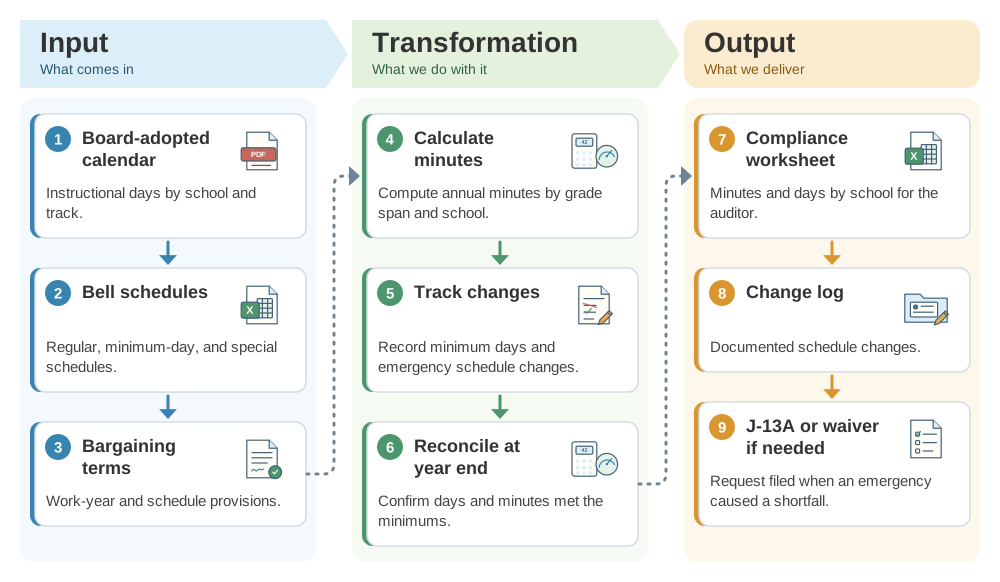
From calendars and bell schedules to verified instructional time: the SDLA ITO workflow
This workflow proves each school offered the required days and minutes. This SDLA ITO (Input, Transformation, Output) graphic shows how the inputs become the outputs in 9 steps.
Implementation workflow
- SpringBuild calendars.Draft the calendar and schedules with bargaining partners.
- Before school startsCalculate and adopt.Verify minutes and adopt the calendar.
- During the yearTrack changes.Log every schedule change and recalculate.
- Year endReconcile.Confirm compliance and prepare audit documentation.
Instructional time checklist
- Calendar meets 180 (or 175 charter) days.
- Minutes calculated by grade span for every school.
- Schedule changes logged and recalculated.
- Audit worksheet and bell schedules retained.
Official guidance and help
- CDE Instructional TimeAttendance accounting and instructional time guidance.
- Education Code 46201Annual instructional minutes.
Source review completed October 25, 2026. Verify the current instructional time requirements and any program-specific rules (such as TK and continuation schools).