



SDLA Compliance Resource
Collect and Retain Annual Pupil/Parent Sudden Cardiac Arrest Acknowledgment Before Participation
An implementation guide for identifying covered athletic activities, assigning the correct information sheet, collecting a complete annual acknowledgment, enforcing the participation gate, and responding safely when symptoms appear.
In Plain Language: Before a pupil participates in a covered school-sponsored athletic activity, the school must complete the applicable annual sudden cardiac arrest information-sheet process and retain the required record. This is a pupil-level participation gate: distributing the form is not enough, an incomplete acknowledgment is not clearance, and a form from a prior school year does not satisfy the current-year requirement.
Why this matters
The requirement is designed to ensure that pupils and families recognize symptoms and understand the danger of continuing to participate. Operationally, it also prevents the gap between “the packet was sent” and “the completed record was received, retained, and verified before participation.” That distinction is especially important for late additions, club sports, cheerleading, and pupils joining after a season begins.
Joint ownership
Primary owner: athletic director or administrator responsible for athletics. Site operator: athletics office, activities coordinator, or designated clearance staff. Health/safety partner: school nurse, athletic trainer, or health-services administrator. Records partner: staff maintaining the athletic-clearance system. Coaches verify status but should not be the sole custodians of signed records.
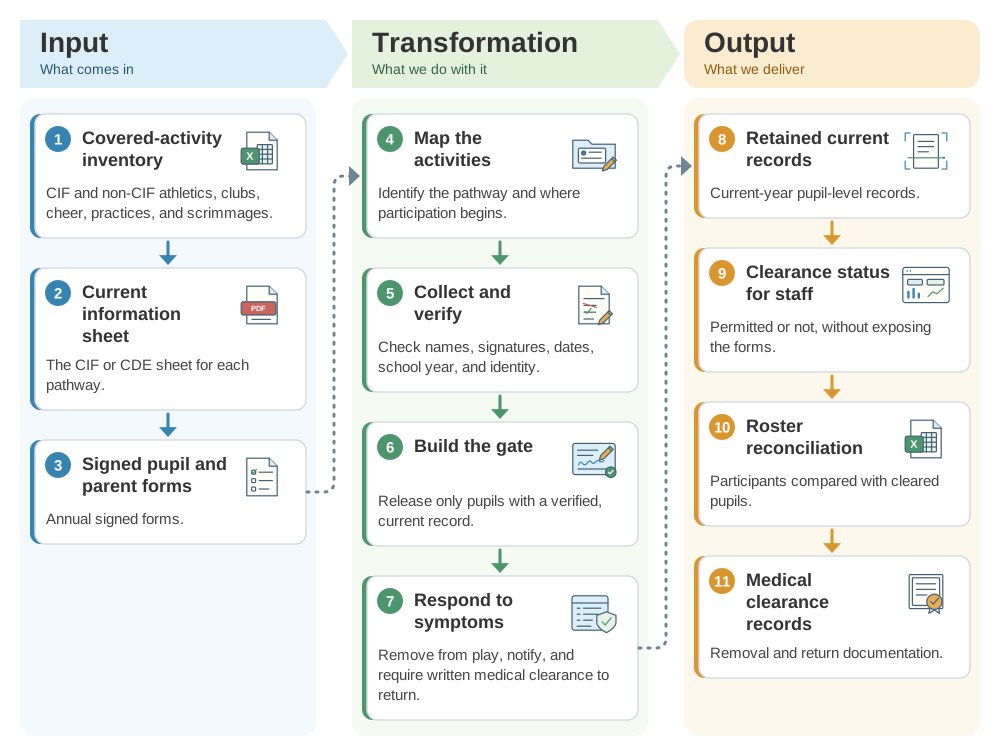
From covered activities to a verified participation gate: the SDLA ITO workflow
Distributing the form is not clearance; only a complete current-year record releases a pupil to participate. This SDLA ITO (Input, Transformation, Output) graphic shows how the list of covered activities, the information sheets, and the pupil and parent acknowledgments become the pupil-level acknowledgment records, the clearance status for coaches, and the symptom-response clearances.
The annual implementation calendar
- Before registration opensDefine the covered activity inventory and documentation pathway.List CIF and non-CIF athletics, school-sponsored contests, cheerleading, club-sponsored sports, practices, and scrimmages. Assign the correct current information sheet and the staff owner for each pathway.
- Before forms are issuedConfigure the annual clearance control.Set the correct school year, require pupil and parent/guardian completion where applicable, preserve the information presented, and prevent “sent,” “started,” or “submitted for review” from being treated as cleared.
- Before first participationCollect and retain the completed record.Verify the correct information sheet, required names and signatures, dates, school year, and pupil identity before any covered practice, scrimmage, contest, competition, or activity.
- At the participation gateRelease only pupils with verified current status.Provide coaches and activity staff with a dependable clearance status—not copies of sensitive forms—and block participation when the record is missing, incomplete, expired, or awaiting review.
- When a pupil joins or changes activitiesRecheck scope without creating false duplication.Confirm that the current-year record covers the newly selected activity and that any activity-specific requirements are complete.
- When symptoms are observed or reportedMove immediately to the symptom-response pathway.Apply removal and notification rules, restrict return, and retain written medical clearance when required. Do not treat the annual acknowledgment as a substitute.
- During and after the seasonReconcile and retain the evidence.Compare participants with clearance records, resolve exceptions, protect education and health information, and retain records under the LEA’s adopted schedule and applicable legal holds.
Determine whether the activity enters the clearance gate
| Activity | Treatment | Operational control |
|---|---|---|
| CIF-governed interscholastic athletics | Covered. The school collects and retains the SCA information sheet required by CIF for the pupil each school year. | Route through the CIF-aligned annual athletic-clearance process and verify completion before first participation. |
| Other school-sponsored athletic contest or competition | Covered. This includes a school-sponsored contest or competition outside interscholastic athletics. | Use the non-CIF acknowledgment pathway unless the activity is governed by CIF. |
| School-sponsored cheerleading | Covered. Competitive and noncompetitive school-sponsored cheerleading are included. | Do not omit noncompetitive cheer from the annual clearance roster. |
| Club-sponsored sports activity | Covered when sponsored by the school. | Confirm sponsorship and route the pupil through the non-CIF pathway when CIF does not govern the activity. |
| Practice, interscholastic practice, or scrimmage | Covered when associated with one of the listed athletic activities. | The gate applies before practice or scrimmage—not merely before the first contest. |
| Ordinary required physical education or unrelated regular-schoolday movement | Not automatically routed through this athletic acknowledgment process. | Do not classify ordinary PE as covered athletics merely because physical activity occurs. Escalate unusual dual-purpose activities for local review. |
CIF and non-CIF: one safety objective, two documentation pathways
CIF-governed activity
What CIF means here: The California Interscholastic Federation governs interscholastic high-school athletics through its sections and member schools. For a CIF-governed activity, Education Code section 33479.3 directs the school to collect and retain the SCA information sheet required by CIF for that pupil each school year.
Local control: Identify which teams are CIF-governed, use the current CIF-required material, and preserve a reproducible pupil-level record before participation.
Covered activity not governed by CIF
What changes: The pupil and the pupil’s parent or guardian must sign and return an acknowledgment that they received and reviewed the information sheet posted by CDE.
Local control: Ensure both people are associated with the acknowledgment, retain the completed current-year record, and do not treat a parent-only or pupil-only completion as sufficient.
The CDE makes an acknowledgment form available when a school has not designated another form. CDE explains that a district may use the CDE Parent/Guardian and Pupil SCA Information and Acknowledgment Form, a CIF form, or an appropriate locally designed form.
Pupil athletic-participation clearance gate
When symptoms appear, leave the ordinary clearance pathway
Exception and routing table
| Situation | Route | Do not |
|---|---|---|
| New pupil joins after the season begins | Apply the same current-year preparticipation gate before the pupil’s first practice or other covered participation. | Assume the team’s preseason collection automatically covered a late addition. |
| Pupil participates in multiple sports | Determine whether one verified current-year acknowledgment covers the LEA’s defined scope and link it to each activity; complete any activity-specific controls. | Collect needless duplicates or assume a record covers activities outside its documented scope. |
| Form is from a previous school year | Issue and collect the current-year acknowledgment before participation. | Carry the prior-year completion status forward as current. |
| Parent signature is present but pupil signature is missing | Hold the record as incomplete and obtain the pupil’s required acknowledgment. | Release participation based on a partially completed non-CIF form. |
| Electronic record cannot be reproduced | Resolve the platform, identity, audit, or export problem and retain a reproducible completion record. | Treat a dashboard checkmark with no supporting record as sufficient evidence. |
| Uncertainty about CIF status | Ask the athletic director to confirm whether the activity is governed by CIF and assign the matching form pathway. | Let a coach or family select the legal pathway informally. |
| Club sport or noncompetitive cheer | Confirm school sponsorship; if covered and not CIF-governed, use the pupil-and-parent acknowledgment pathway. | Exclude the activity merely because it is called a club or is noncompetitive. |
| Ordinary physical education | Keep ordinary PE outside the athletics acknowledgment workflow unless the activity also constitutes a covered practice, scrimmage, or athletic activity. | Expand the form requirement to all physical movement without a legal or locally approved basis. |
| Pupil reports or exhibits possible SCA symptoms | Move to the symptom-response protocol immediately; document removal, notification, evaluation, and written return clearance as applicable. | Rely on the signed acknowledgment or ordinary participation status to keep the pupil in activity. |
Electronic signature and athletic-clearance controls
- The system associates the correct pupil and parent/guardian with the acknowledgment.
- The applicable current information sheet is available for review before acknowledgment.
- The required pupil and parent/guardian actions are separately attributable and dated.
- The school can reproduce the content presented and the completed acknowledgment.
- Status values distinguish sent, opened, started, submitted, incomplete, denied, and cleared.
- The participation gate blocks a pupil whose record is missing, incomplete, expired, or awaiting staff review.
- Authorized staff can correct an error without erasing the original audit trail.
- Coaches receive only the clearance status and operational information they need.
- Access, export, retention, and deletion follow the LEA’s approved student-record and vendor controls.
Products in the SDLA inventory that may support the workflow
These examples can facilitate collection and review, but product configuration determines whether the LEA’s legal and evidentiary controls are actually met. Inclusion is not an endorsement, and a platform checkmark is not automatically a sufficient acknowledgment record.
Home Campus – Athletic Clearances
Provides an athletics-specific workflow in which parents and pupils complete information and signature forms and athletic staff review the submission before clearing participation.
Verify locally: current SCA content, pupil and parent attribution, annual reset behavior, multi-sport scope, exportable evidence, staff approval, and retention.
SportsEngine HQ – Registration
Supports online registration, electronic documents, required acknowledgment fields, waivers, and printable registration-entry evidence.
Verify locally: separate pupil and parent completion, identity assurance, exact information presented, annual participation gate, reproducible record, and school approval status.
Recommended school workflow
- Name the owners. Assign district and site athletic leadership, clearance operators, health/safety partners, records custodians, and staff authorized to resolve exceptions.
- Map every covered activity. Identify CIF status, school sponsorship, practices, scrimmages, cheer, clubs, and the exact point at which participation begins.
- Approve the form set. Use current CDE, CIF, or locally approved information and acknowledgment materials and preserve version control.
- Build a real participation gate. Configure paper or electronic processes so incomplete or unreviewed records cannot produce a cleared status.
- Communicate accessibly. Provide understandable instructions, language assistance, accessible formats, and a paper path when needed.
- Review every completion. Verify pupil identity, parent/guardian identity, required signatures, dates, school year, activity scope, and reproducibility before release.
- Publish status safely. Give coaches a current permitted/not-permitted status and a rapid correction path without broadly exposing signed forms or health information.
- Reconcile actual participants. Compare practice and competition rosters with the clearance system, including late additions and pupils changing sports.
- Activate the symptom-response pathway. Ensure observed or reported warning signs trigger immediate safety action independently of the annual acknowledgment.
Evidence to retain
- Current information-sheet version and approval source.
- Pupil and parent/guardian acknowledgment required by the applicable pathway.
- Attributable signature or acknowledgment evidence and completion date.
- School year and covered activity or documented clearance scope.
- CIF or non-CIF documentation pathway.
- Receipt date, retention location, and reproducible copy or export.
- Participation-release status and responsible reviewer.
- Exception, correction, and late-participant resolution log.
- Roster-to-clearance reconciliation and unresolved-item follow-up.
- Symptom removal, notification, evaluation, and written return-clearance records when applicable.
The SCA statute requires annual collection and retention but does not establish the LEA’s entire records-retention schedule. Apply the district’s adopted schedule, privacy rules, pending claims or legal holds, and counsel-approved destruction practices rather than inventing a local destruction date from this requirement.
Official guidance and help
- CDE Eric Paredes Sudden Cardiac Arrest Prevention Act guidanceState overview, acknowledgment materials, statutory links, symptoms and warning signs, removal requirements, and additional resources.
- CDE Parent/Guardian and Pupil SCA Information and Acknowledgment FormOne-page information and acknowledgment form available when the school has not designated another form.
- Education Code sections 33479–33479.9Definitions, annual collection and retention, symptoms, removal, written return clearance, and related statutory requirements.
- CIF Sudden Cardiac Arrest resourcesCIF information and materials for interscholastic athletics; verify the current required information sheet with the applicable CIF section.
CDE Office of School-Based Health Programs:
Source review completed August 28, 2026. Verify current CDE and CIF materials, locally covered activities, electronic-signature controls, forms, health-response procedures, and record-retention requirements before acting.