


SDLA Compliance Resource
Collect Kindergarten Oral Health Assessment Documentation by May 31
A family-notice, documentation, waiver, access-support, and pupil-record process for the child’s first public-school year in transitional kindergarten, kindergarten, or—when applicable—first grade.
In Plain Language: Notify the parent using the standardized content, track proof of a qualifying oral health assessment or a completed waiver reason, support families facing cost or access barriers, and preserve the pupil-level result for the annual aggregate report.
Why this matters
Oral pain and untreated decay affect attendance, eating, sleep, concentration, and learning. The school’s role is to notify, support access, collect lawful documentation, and report—not to diagnose or treat.
Primary ownership
Primary owner: school nurse or designated health-services coordinator. Handoff partners: enrollment, TK/K/grade 1 staff, family liaison, attendance, records, community dental partners, district KOHA reporter, and families.
From enrollment to a closed KOHA record by May 31: the SDLA ITO workflow
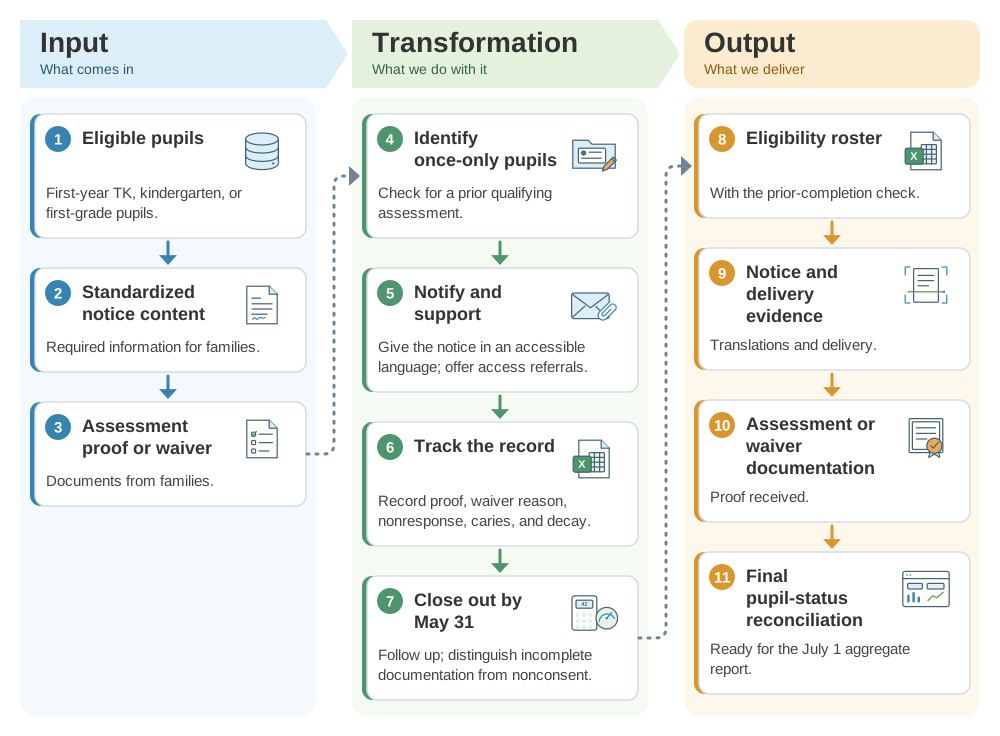
A family's proof of assessment or a waiver is recorded per pupil, which feeds the district's July 1 aggregate. This SDLA ITO (Input, Transformation, Output) graphic shows how the first-year pupil list, the standardized notice, and assessment or waiver documents become the eligibility roster, the notice and documentation, and the reconciled pupil status.
Operational workflow
- At enrollment, identify pupils subject to the one-time requirement and check whether a prior qualifying assessment is already documented.
- Give the standardized notice with required oral-health, insurance, county-health, privacy, assessment, waiver, and schoolsite opt-out information in an accessible language/mode.
- Track assessment proof, waiver reason, nonresponse, caries experience, and untreated decay using the current form and protected record process.
- Follow up before May 31, offer access referrals without coercion, and distinguish incomplete documentation from nonconsent.
- Freeze and reconcile the pupil-level status for the district’s July 1 aggregate report.
Implementation pathway
Evidence to retain
- Eligibility roster and prior-completion check
- Notice, translation, and delivery evidence
- Assessment or waiver documentation
- Access referrals and follow-up
- Final pupil-status reconciliation
Official guidance and help
- Education Code section 49452.8Current controlling requirement
- CDE Required KOHACurrent scope, dates, and forms
- System for California Oral Health ReportingCurrent forms and reporting system
Source review completed August 30, 2026. Verify current California law, CDE/CDPH instructions, local health and county procedures, pupil records, privacy requirements, and live reporting-system status before acting.