

SDLA Compliance Resource
Publicly Consider County LCAP Recommendations
An operational guide to the public consideration step in the 2026–27 LCAP accountability cycle.
State county-review duties and local intake procedures
A county superintendent performs these statewide statutory duties for school-district LCAPs. A county-specific portal or earlier intake target is a separate local procedure.
- EC 52070(a): the district files its adopted LCAP/annual update with the county superintendent no later than five days after adoption. The county may request written clarification by August 15; the district board responds in writing within fifteen days of the request.
- The county may send written amendment recommendations within fifteen days after receiving the district response. The district board considers those recommendations in a public meeting within fifteen days of receipt. Retain actual delivery/receipt dates; these are triggered clocks, not identical fixed dates for every district.
- The county superintendent approves by October 8 if the statutory template, budget, expenditure and applicable carryover/service conditions are met. Keep local board adoption distinct from reviewer approval and retain the approval/revision record.
- Where the county superintendent has jurisdiction over a single district, the State Superintendent performs the EC 52070 duties. COE-own LCAP review and charter submission follow their own authorities; this district approval chain must not be generalized to them.
- If a county requests an earlier upload, checklist or local format, record the county, notice, receiving system and local target separately from EC 52070. No statewide earlier intake date is established by a county worksheet.
Authority: EC 52070: district/county clocks and single-district exception. Reviewed October 21, 2026.
In Plain Language: Place the county superintendent’s recommendations before the district governing board at a public meeting within 15 calendar days of receipt.
Why this matters
This step restores public governance to the review exchange. Quiet staff-level handling does not satisfy a requirement for the board to consider the recommendations publicly.
Primary ownership
Primary owner: superintendent and governing-board office. Partners: LCAP lead, business services, program owners, communications, legal counsel, and county liaison.
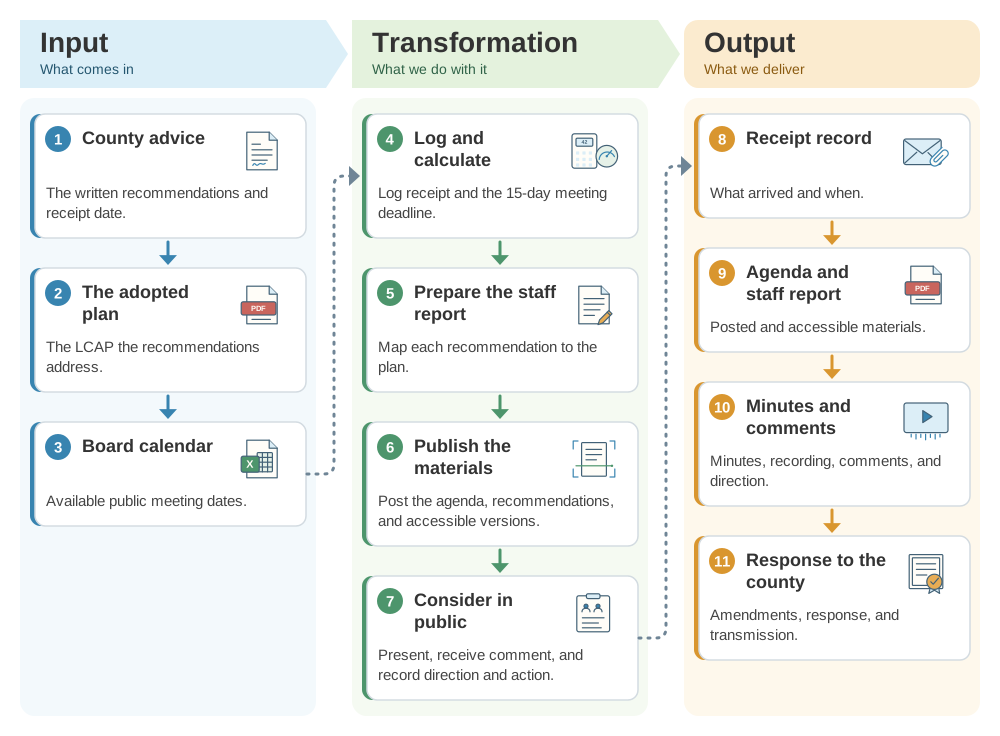
From county recommendations to public board consideration: the SDLA ITO workflow
The board considers the county's recommendations at a public meeting, and the district then sends its action back. This SDLA ITO (Input, Transformation, Output) graphic shows how the county recommendations, their receipt date, and the LCAP become the agenda and staff report, the minutes and comments, and the transmission to the county.
Operational workflow
- Log receipt and calculate the 15-calendar-day meeting deadline.
- Prepare a public staff report mapping each recommendation to the plan.
- Publish the agenda, recommendations, accessible materials, and translations as needed.
- Present the item for public board consideration and receive comment.
- Record direction, amendments, vote/action, and transmission to the county.
Implementation pathway
Evidence to retain
- County recommendations and receipt date
- Agenda and public staff report
- Accessible posted materials
- Minutes, recording, public comment, and direction
- Amendment/response and county transmission
Official guidance and help
- CDE Local Control and Accountability PlanCurrent templates, instructions, and resources
- CDE LCFF Frequently Asked QuestionsState review and approval context
- Education Code section 52062District consultation, hearing, adoption, submission, and posting
- Education Code section 52070County review, clarification, recommendations, and approval
Source review completed August 30, 2026. Verify the current CDE template, instructions, statutory dates, reviewing-authority procedures, and local meeting calendar before acting.