



SDLA Compliance Resource
Publish the Annual and Five-Year Developer Fee Reports
An implementation guide for accounting for school facility (developer) fees, making the annual report public within 180 days after year end, and making the five-year findings for unexpended fees.
In Plain Language: Developer fees collected for school facilities must be kept in a separate fund and accounted for publicly. Within 180 days after the end of each fiscal year, the district must publish a report showing the fee amounts, beginning and ending balances, fees and interest collected, and projects funded. Every fifth year it must also make findings explaining why any unspent fees are still needed.
Why this matters
If the district does not make the five-year findings, it can be required to refund unexpended fees to current property owners. The annual report is also a common target for developer challenges and audits.
Joint ownership
District: facilities director and fiscal services prepare; the board reviews and adopts findings. Auditor: reviews the capital facilities fund.
Two reports
| Report | Frequency | Required content |
|---|---|---|
| Annual report (GC 66006(b)) | Every fiscal year | Fee description and amount, beginning and ending balances, fees and interest collected, projects funded and percentage funded by fees, interfund loans, refunds. |
| Five-year findings (GC 66001(d)) | Fifth year after first deposit and every five years after | Purpose of the fee, reasonable relationship to that purpose, sources and amounts of funding to complete projects, and expected deposit dates. |
From capital facilities fund data to a published developer fee report: the SDLA ITO workflow
This workflow turns capital facilities fund activity into the public reports that protect fee revenue. This SDLA ITO (Input, Transformation, Output) graphic shows how the inputs become the outputs in 9 steps.
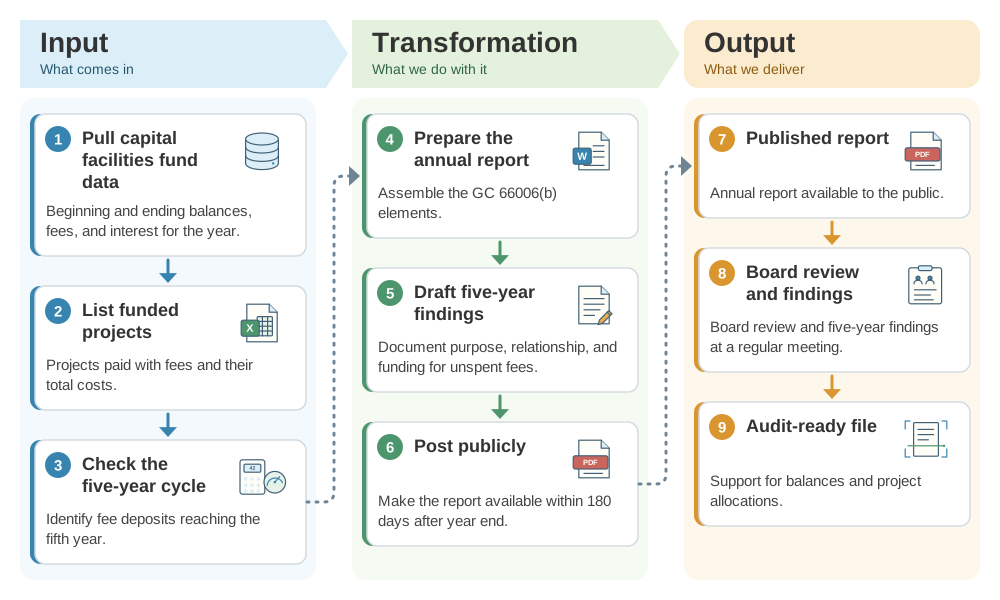
Implementation workflow
- After year-end closePull fund data.Extract capital facilities fund activity and project costs.
- FallPrepare reports.Draft the annual report and any five-year findings.
- By December 27Make public.Post the report within 180 days after June 30.
- 15+ days after postingBoard review.Review the report and adopt findings at a regular meeting.
Developer fee report checklist
- Fees held in a separate capital facilities fund.
- All GC 66006(b) elements included.
- Five-year findings prepared when due.
- Public posting date documented.
- Board review at a regular meeting at least 15 days after posting.
Official guidance and help
- Government Code 66006Annual accounting and public report.
- Government Code 66001Five-year findings for unexpended fees.
Source review completed October 25, 2026. Verify the current statutory text and your counsel's guidance on the five-year cycle before publishing.