

SDLA Compliance Resource
Submit the CCSPP Annual Expenditure Report
Reconcile the covered grant-year expenditures and submit the CDE-required Annual Expenditure Report through the route identified in the grantee instructions.
In Plain Language: Reconcile the covered grant-year expenditures and submit the CDE-required Annual Expenditure Report through the route identified in the grantee instructions.
Why this matters
Legacy implementation grants and the newer ongoing annual apportionment are different funding arrangements. The report must follow the award and reporting instructions that actually apply.
Primary ownership
Community-schools lead and grant accountant, with site leads and the authorized submitter
Required distinctions and controls
- Identify the implementation cohort, award number, reporting year and approved budget before preparing the report.
- The North Star R-TAC reporting page identifies September 11, 2026 and submission to CDE for the 2025–26 implementation-grantee AER. This is regional implementation guidance for a state grant, not a separate county filing requirement. Confirm the date against the LEA’s CDE notice.
- Do not apply that historical AER date automatically to a new 2026–27 annual-apportionment recipient. CDE states that the ongoing apportionment has no statutory expenditure or encumbrance deadline.
From the CDE notice to a submitted CCSPP annual expenditure report: the SDLA ITO workflow
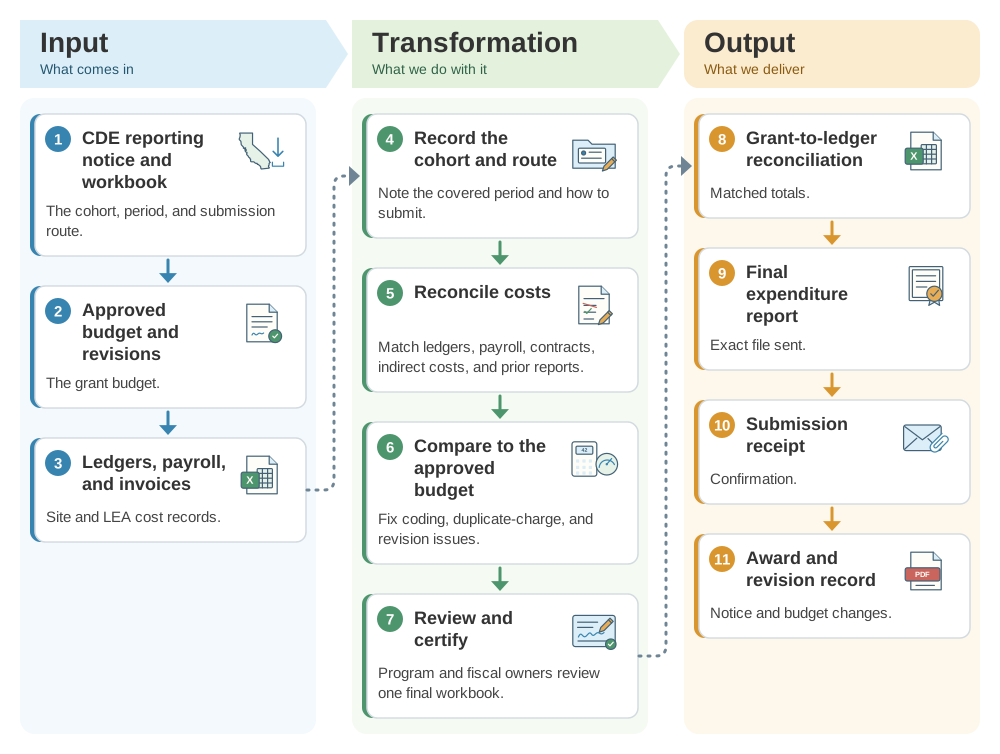
The reporting obligation is set, but the deadline comes from the applicable CDE grantee notice. This SDLA ITO (Input, Transformation, Output) graphic shows how the CDE reporting notice and workbook, the approved budget, and the site and LEA ledgers become the grant-to-ledger reconciliation, the final report, and the submission receipt.
Recommended LEA workflow
- Obtain the CDE reporting notice and correct workbook; record the covered cohort, period and submission route.
- Reconcile site and LEA ledgers, payroll, contracts, invoices, indirect costs and previously reported amounts.
- Compare actual costs with the approved grant budget and resolve coding, duplicate-charge and budget-revision issues.
- Have program and fiscal owners review the same final workbook and certify the applicable submission.
- Retain the exact sent file and receipt. If a deadline has passed, obtain CDE correction or late-report instructions rather than assuming the system reopened.
Evidence to retain
- CDE award/reporting notice
- Approved budget and revisions
- Grant-to-ledger reconciliation
- Final AER and submission receipt
Official guidance and help
- CDE CCSPP program and recipient guidance
- CDE ongoing-funding FAQ
- North Star R-TAC AER notice (regional guidance)
Return to the Annual Compliance Calendar
Reviewed October 21, 2026. Confirm the current agency instructions, applicable funding year, recipient scope, local policy and final submitted or approved state before acting. Recommended preparation steps support the named requirement and do not create an additional statewide filing deadline.