



SDLA Compliance Resource
Maintain Timely Enrollment, Exit, Demographic, and Program Records and Resolve SSID Anomalies
A continuous-control guide for finding an existing Statewide Student Identifier before requesting another, keeping student records current, coordinating cross-LEA anomalies, and verifying the posted CALPADS history rather than waiting for a certification crisis.
In Plain Language: Each pupil should have one Statewide Student Identifier (SSID) and one coherent longitudinal history. Before requesting an SSID, search carefully for an existing match. After enrollment, keep enrollment, exit, demographic, English-language, and program records aligned with authoritative local evidence. Resolve anomalies with the other LEA and confirm corrections in CALPADS—not only in the SIS.
Why this matters
Duplicate SSIDs and stale or overlapping enrollments split a pupil's history, interfere with assessment and language-status records, create cross-LEA conflicts, distort counts, and affect accountability and services. A locally corrected record remains wrong statewide until the transaction posts and the CALPADS history and reports reflect it.
Joint ownership
Identity and enrollment: registrar/enrollment staff. Local record: SIS administrator. Program authority: multilingual, special education, foster/homeless, Title I, and other program staff. State record: CALPADS administrator and anomaly contact. Cross-LEA partner: prior or concurrent LEA's anomaly/data contact.
The longitudinal record lifecycle
From enrollment to one clean longitudinal record per pupil: the SDLA ITO workflow
Search for an existing SSID before requesting another, and verify the posted CALPADS record after each change. This SDLA ITO (Input, Transformation, Output) graphic shows how identity information, prior-school data, and SIS and CALPADS transactions become the match evidence, the posted enrollment and exit records, and the cleared anomalies.
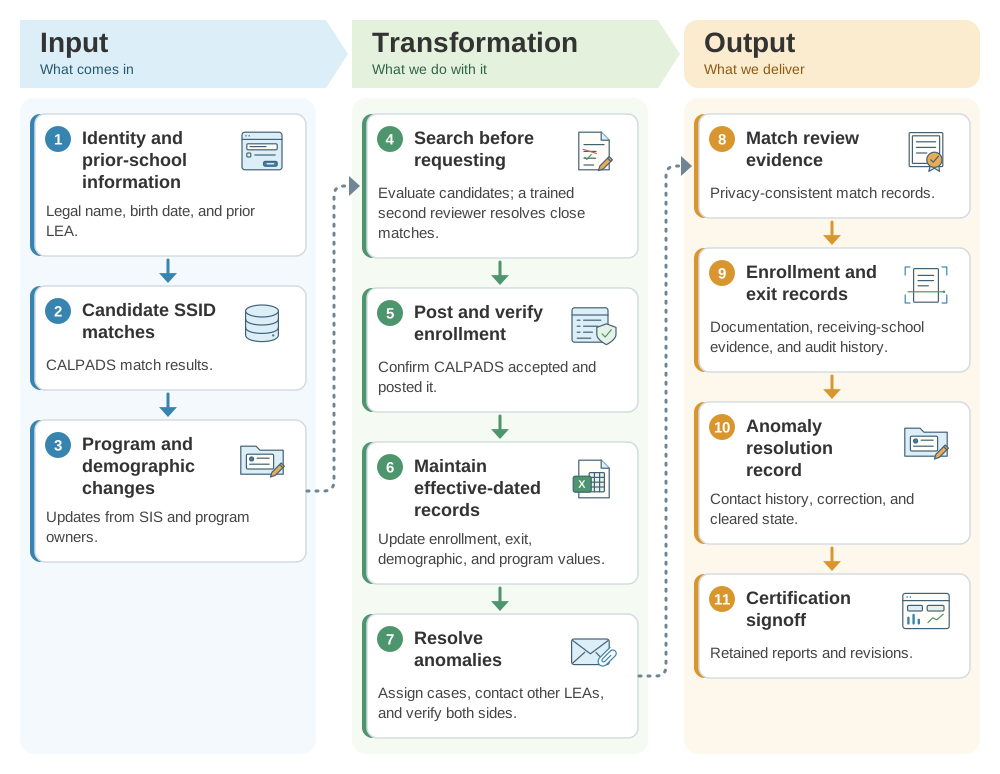
Continuous maintenance workflow
- At intakeCollect and verify identity and prior-school information.Use legal-name, birth-date, gender, prior LEA/school, and other permitted match information; research differences rather than overwriting history.
- Before requesting an SSIDSearch and evaluate candidates.Use the CALPADS match process and available prior records. Have a trained second reviewer resolve close or conflicting matches.
- At enrollmentPost the enrollment promptly.Confirm school of attendance, enrollment status, start date, grade, local student ID, and demographic record; verify CALPADS accepted and posted the transaction.
- Whenever facts changeMaintain effective-dated records.Route program decisions and demographic corrections to the SIS and CALPADS owners; protect longitudinal values such as initial language evidence from unsupported replacement.
- At exitUse the actual documented outcome.Confirm last expected attendance, exit date/category, completion status when applicable, receiving-school evidence, and program closure rules.
- Weekly or on a defined cadenceReview anomalies and overlapping enrollments.Assign each case, contact the other LEA, exchange only necessary information securely, document the agreed correction, and verify both sides.
- Before certificationReconcile pupil lists and counts.Compare supporting reports to current SIS enrollment, exits, demographics, and program rosters; regenerate revisions after corrections.
Mismatch and anomaly resolution
| Condition | Investigate | Resolve and verify |
|---|---|---|
| Possible duplicate SSIDs | Legal identity, birth date, prior enrollment, name changes, match history, and records under each SSID. | Do not merge locally by assumption; follow CALPADS procedures or Service Desk direction and confirm the surviving history. |
| Multiple primary enrollment anomaly | Actual attendance dates, transfer documents, no-show status, last day, start date, and which LEA owns the conflicting record. | Agree which record/date is wrong, correct the responsible source, post both sides as needed, and clear the anomaly. |
| SIS corrected; CALPADS unchanged | Extract selection, transaction type, effective date, validation result, rejected record, and later overwrites. | Regenerate or correct the transaction and verify the current posted record. |
| Prior LEA contact unknown | CALPADS anomaly screen and listed school/LEA contact. | If no anomaly contact appears, submit a CALPADS Service Desk ticket or call the published number. |
| Program roster disagrees | Program authority, effective date, enrollment context, local code mapping, and record end date. | Correct the authoritative source and related SPRG or other record; rerun the supporting report. |
Partner and access controls
- Assign a current CALPADS anomaly contact and backup; CALPADS does not send anomaly notifications, so staff must review the system.
- Only the CALPADS LEA Administrator changes the anomaly-contact role; review roles during staff transitions.
- Maintain a secure escalation path for cross-LEA disputes and a Service Desk authority for cases that cannot be resolved locally.
- Define which program owner authorizes each value and which data owner enters, submits, verifies, and certifies it.
- Protect pupil data in communications and share only what is needed to resolve identity or enrollment.
Pre-certification controls
- All expected pupils have one verified SSID and current enrollment context.
- No unexplained multiple-primary, concurrent, or exit-related anomalies remain.
- Enrollment, exit, demographic, English-language, and program histories align with authoritative evidence.
- Fatal errors, certification data discrepancies, and supporting-report variances have documented dispositions.
- Program owners review pupil-level lists; executive certification relies on the regenerated final revision.
- Post-certification changes are processed within the applicable amendment window and verified.
Evidence to retain
- Identity and match-review evidence consistent with privacy requirements.
- Enrollment and exit documentation, receiving-school evidence, and SIS audit history.
- Program-authority handoffs and effective-dated local and CALPADS records.
- Anomaly reports, contact history, agreed correction, transaction results, and cleared state.
- Extracts, upload results, rejected-record resolution, posted-record evidence, and regenerated reports.
- Certification signoff and retained revision reports.
Official guidance and help
- CALPADS System DocumentationSSID and Enrollment Procedures, Data Guide, errors, specifications, and code sets.
- CALPADS Update Flash 3272026 best practices for finding SSIDs for new TK/K pupils and related pre-enrollment.
- CALPADS Frequently Asked QuestionsAnomaly contacts, enrollment, exits, and operational guidance.
- CALPADS CalendarCurrent submission and certification milestones.
Source review completed August 30, 2026. Verify current SSID and Enrollment Procedures, code sets, local source evidence, privacy rules, and the posted CALPADS state before acting.