



SDLA Compliance Resource
Resolve 2026–27 CALPADS Data-Quality Differences and Strengthen the Data Process
A reconciliation guide for finding where local source records, CALPADS submissions, certification reports, and program expectations diverge; correcting the responsible source; and using root-cause evidence to prevent recurrence.
In Plain Language: When CALPADS data do not reconcile, do not chase a clean-looking report by changing whichever value is easiest. Identify the authoritative business fact, trace how it moved through the local system and submission, correct the responsible source, post the correction, and verify the resulting state. For 2026–27, CDE states that districts and county offices identified with a data-quality issue will be eligible for CALPADS differentiated assistance (DA).
Why this matters
A certified submission can still contain inaccurate data, and a local SIS can disagree with what CALPADS actually posted. Unresolved differences affect funding, accountability, services, civil-rights reporting, certification, longitudinal records, and downstream systems. The objective is trustworthy data and a stronger management process—not merely removal of an error.
Joint ownership
Executive sponsor: superintendent or designee. Data-process owner: CALPADS administrator. Source owners: enrollment, program, attendance, discipline, human resources, course, special-education, and SIS staff. Assistance partners: COE for districts; CDE/SPI support for COEs; CSIS and the Service Desk for system guidance.
The reconciliation path
If the numbers do not agree
| Comparison | Questions | Proof of resolution |
|---|---|---|
| Program roster ↔ SIS | Was the program decision received, dated, entered, ended, and updated for the right pupils? | Authorized roster and matching local records with correction history. |
| SIS ↔ extract | Did selection rules, mappings, dates, blank handling, code tables, or interface timing omit or transform data? | Controlled source-to-extract comparison and corrected configuration or record. |
| Extract ↔ posted CALPADS | Was the file uploaded, did each record pass, and did a later transaction overwrite or fail to update it? | Upload results and current posted record—not merely a successful file transmission. |
| Posted record ↔ certification report | Does the record fall within the report population, census date, academic year, enrollment context, and revision snapshot? | Regenerated revision and reconciled supporting/certification report. |
| CALPADS ↔ downstream result | Which snapshot, deadline, business rules, filters, and other data sources produced the downstream measure? | Documented lineage and confirmation from the responsible CDE program when needed. |
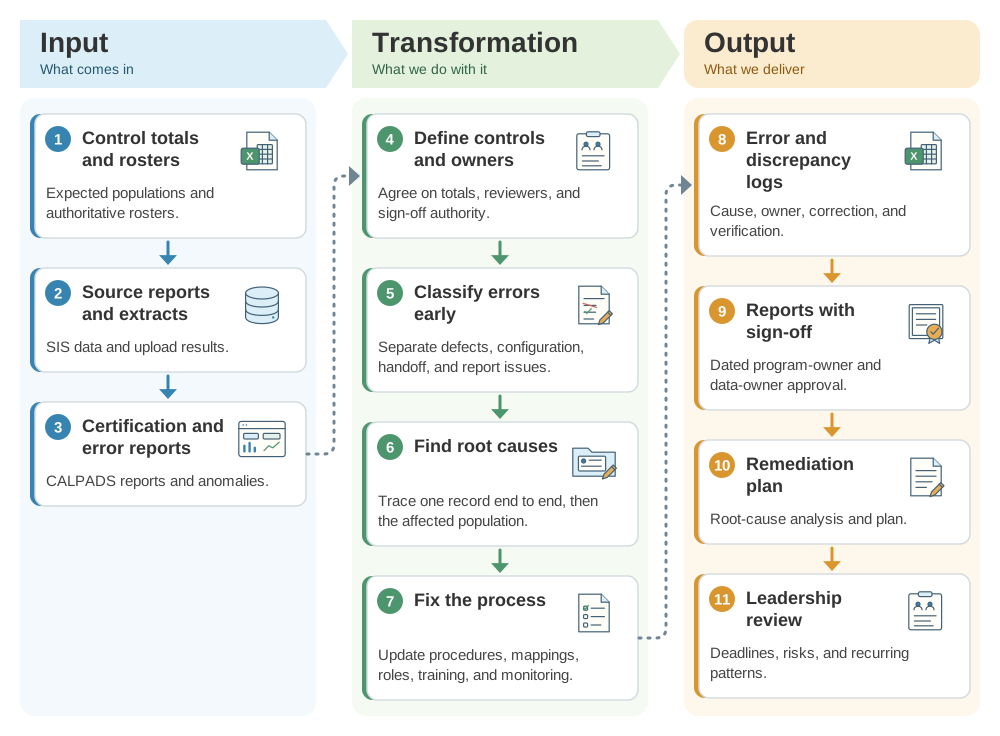
From a CALPADS difference to a corrected source and a fixed process: the SDLA ITO workflow
Do not chase a clean-looking report by changing whichever value is easiest. This SDLA ITO (Input, Transformation, Output) graphic shows how control totals, source reports, extracts, and certification reports become the control totals and error logs, the signed-off reports, and the remediation plan and procedures.
Operational workflow
- At the start of each submissionDefine control totals and owners.Agree on the expected populations, authoritative rosters, source reports, report reviewers, and signoff authority.
- Before the zero-fatal-error targetPost early and classify errors.Separate record defects, mapping/configuration problems, missing handoffs, system issues, and report misunderstandings.
- After fatal errors clearReconcile supporting reports.Compare counts and pupil lists to source evidence; review anomalies and certification data discrepancies rather than treating zero fatals as completion.
- When a difference persistsComplete root-cause analysis.Trace one representative record end to end, expand to the affected population, and assign the correction at the earliest reliable source.
- Before certificationObtain knowledgeable review.Program and data owners validate the same regenerated revision and document unexplained exceptions.
- After certificationFix the process.Update procedures, code mappings, roles, training, calendars, quality checks, and leadership monitoring.
District, COE, and charter distinctions
| LEA type | Responsibility | Assistance boundary |
|---|---|---|
| School district | Submit accurate, complete data on time; investigate mismatches; build sustainable local data-management practices. | If eligible for CALPADS DA, the county superintendent provides assistance focused on the district's data-management processes. |
| County office of education | Maintain the same controls for the COE's own CALPADS data and fulfill separately assigned county review/support roles. | For COE CALPADS DA, the Superintendent provides assistance focused on COE processes and capacity. |
| Charter school | Maintain accurate data and reconciliation whether reporting independently or through an authorizer. | Charters are excluded from the specific CALPADS DA eligibility statement on the CDE page; that does not reduce their reporting or data-quality obligations. |
Evidence to retain
- Control totals, authoritative rosters, source reports, extracts, upload results, and posted-record evidence.
- Error and discrepancy logs with population, root cause, owner, correction, resubmission, and verification.
- Certification and supporting reports with dated program-owner and data-owner signoff.
- Anomaly communications and cross-LEA resolution evidence.
- Data-management needs assessment, root-cause analysis, remediation plan, procedures, and training evidence.
- Leadership review of deadlines, unresolved risks, and recurring failure patterns.
Official guidance and help
- CDE CALPADS Differentiated AssistanceCurrent eligibility phase, best practices, and Universal Supports Toolkit.
- CALPADS CalendarSubmission, zero-fatal-error, certification, and amendment milestones.
- CALPADS System DocumentationCurrent specifications, code sets, errors, and procedures.
- CALPADS Frequently Asked QuestionsOperational reporting and anomaly guidance.
Source review completed August 30, 2026. CDE's final 2026–27 data-quality identification parameters were not yet published on the cited CALPADS DA page; verify current criteria and all submission guidance before acting.