



Educational technology history
The Writing Machine
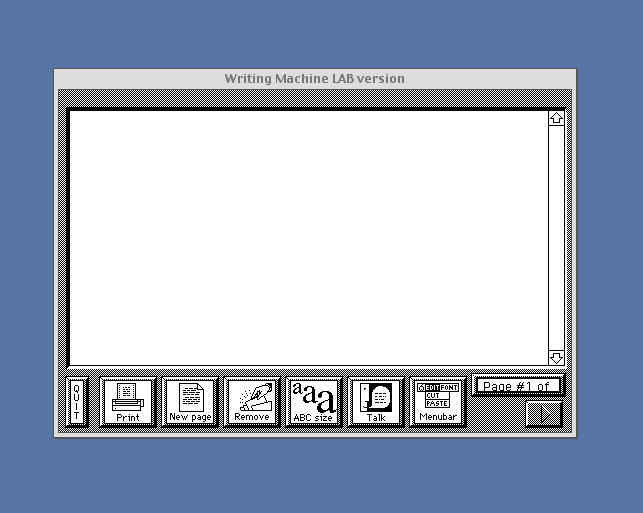
A text-to-speech word processor designed in 1992 to give elementary students a simpler, more developmentally appropriate way to draft, revise, and publish their writing.
Origins and purpose
Chris Moggia created The Writing Machine in HyperCard for Macintosh computers. The software was distributed through the Language Development Program for African American Students (L.D.P.A.A.S.), a Los Angeles Unified School District writing initiative.
Its focused interface was easier for young students to navigate than the general-purpose word processors available at the time. Text-to-speech support helped students review their work as they moved from handwritten drafts to editing and printing.
Teacher training and classroom use
From 1993 through 1998, more than 3,000 copies were distributed to teachers across LAUSD through the L.D.P.A.A.S. teacher-training program. Anthony Jackson and Chris Moggia led a series of Saturday workshops at 99th Street Accelerated School in Watts, where participating educators learned to incorporate the software into writing instruction.
The program was distributed free of charge on 3.5-inch floppy disks. Its streamlined workflow kept students focused on entering handwritten work, revising it with auditory feedback, and producing a printed copy. The project demonstrated how software designed around learners—rather than around a broad set of office functions—could improve access to the writing process.
The Writing Machine in use
In this 1994 recording, Dr. Anthony Jackson demonstrates The Writing Machine in the computer lab at 99th Street Accelerated School. The footage provides a rare firsthand view of the program, the lab environment, and the instructional work surrounding its use.
Open the video on YouTubeIntellectual virtues in practice
Intellectual Virtue 3
Intellectual Autonomy
Rather than accepting a tool that did not meet his students’ developmental needs, Moggia independently explored HyperCard and created an alternative. The result was a purpose-built program that educators could copy, share, and use without charge.

Intellectual Virtue 8
Intellectual Courage
Creating a new classroom tool required challenging the assumption that existing commercial software was sufficient. Moggia acted on evidence from his classroom, built a simpler interface, and placed the untested solution directly into the hands of teachers and students.
Archive note: Dates, distribution figures, program names, and workshop details are based on the historical account provided for this article.