

Commentary
A Menu Without the Food
Imagine walking into a restaurant, sitting down, and being handed a menu that doesn’t list any food. The first page contains the county health inspection notes; the second covers the fire code and occupancy limits. Then come the allergen notice, the accessibility statement, the nondiscrimination policy, and the complaint procedure.
All important information. But you keep flipping, and nowhere is there a single dish. What madness is this?
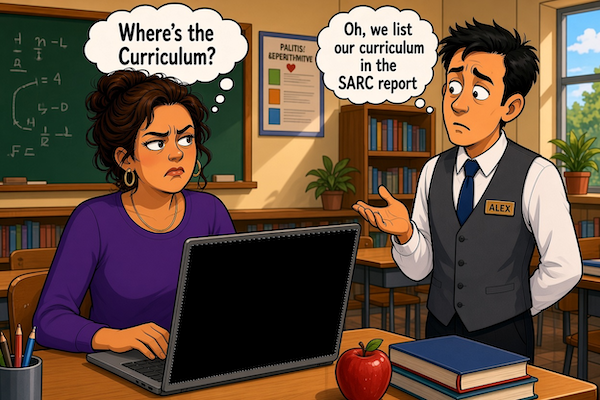
That’s close to what I found after reviewing hundreds of California school district websites. Many are thorough about compliance: board policies, annual notices, legal postings, and federal, state, and county requirements. But on many of those same sites, I found surprisingly little clear, easy-to-find information about what students are learning and teachers are teaching.
That leaves parents with basic questions. Which math series did the board adopt? Which English language arts (ELA) program sits on the classroom shelf? What novels are on the ninth-grade reading list? Which software programs are students using, and why? What does a typical Tuesday look like for a fourth grader, or a tenth grader in Algebra I?
I found some useful pacing guides, particularly for K–6, but had a harder time finding comparable information for grades 7–12. Some districts list their adopted textbook series – that’s a good start. Others point to the state standards, which describe what students should learn. But a link to a long list of standards doesn’t tell families which materials their children will actually use. That’s like a menu listing the ingredients instead of the lunch specials.
There are exceptions. Fremont Unified does an excellent job making this information available. Its core textbook lists are organized by grade and include publishers and ISBNs (!!!), alongside core and supplemental literature lists. Now a parent can identify the actual book instead of playing detective. Thank you, Fremont. A few other districts do this well, and their examples are encouraging.
Library collections deserve some visibility, too. Some districts, including West Contra Costa Unified, provide links and instructions for searching their school library catalogs. That’s useful, and a searchable catalog is the closest thing I’ve found to a list of library books. Families should be able to find those links easily. When a catalog isn’t available, I’ll take the basics: How many titles are in the collection? Are there lists by grade level or genre?
I don’t think these gaps reflect anyone’s bad intent. Keeping a district website current requires coordination across departments, and compliance has deadlines and consequences. Curriculum information can be scattered across board agendas, adoption binders, and teachers’ heads. Putting it online raises questions about licensing, upkeep, and who is responsible for keeping it current. Someone has to be in charge of updating the menu.
Still, families make decisions about homes and schools based in part on what they believe happens inside classrooms, and too often they’re choosing from a menu with no food on it.
Transparency about instruction doesn’t have to be elaborate. Start with the basics: the adopted core programs by grade and subject, the pacing guides, the supplemental tools, and a sample daily schedule. Add links to library catalogs and literature lists. Put it somewhere families can find without a scavenger hunt. Update it each time the board adopts something new, and check periodically that it still reflects what students are using.
Keep the health grade. Just add the meals back to the menu.
P.S. If your district does this well, I’d love to see it. Send me a link and I may feature it here.